Dalton Kevin M, Frydman Judith, Pande Vijay S
Biophysics Program, Stanford University, Stanford, California, United States of America.
Department of Biology, Stanford University, Stanford, California, United States of America.
PLoS One. 2015 Mar 30;10(3):e0117724. doi: 10.1371/journal.pone.0117724. eCollection 2015.
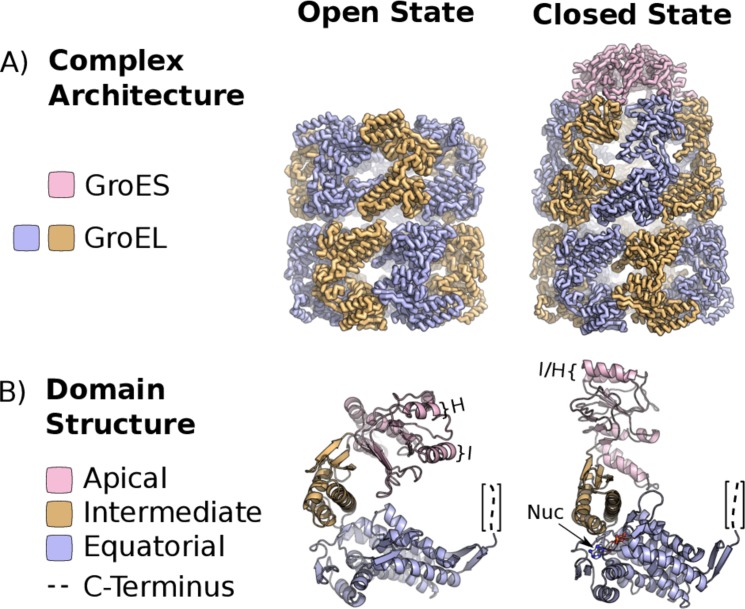
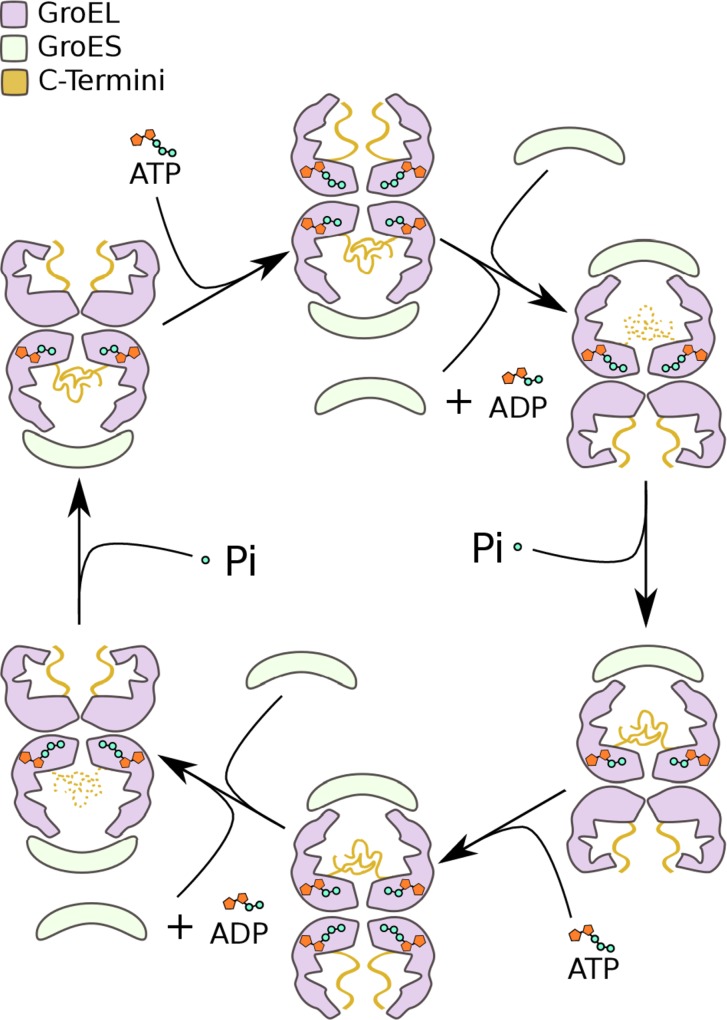
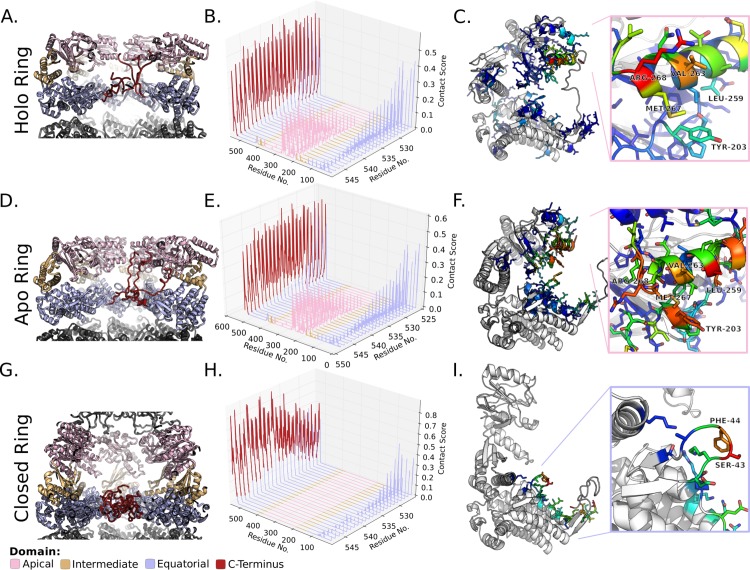
Chaperonins are large ring shaped oligomers that facilitate protein folding by encapsulation within a central cavity. All chaperonins possess flexible C-termini which protrude from the equatorial domain of each subunit into the central cavity. Biochemical evidence suggests that the termini play an important role in the allosteric regulation of the ATPase cycle, in substrate folding and in complex assembly and stability. Despite the tremendous wealth of structural data available for numerous orthologous chaperonins, little structural information is available regarding the residues within the C-terminus. Herein, molecular dynamics simulations are presented which localize the termini throughout the nucleotide cycle of the group I chaperonin, GroE, from Escherichia coli. The simulation results predict that the termini undergo a heretofore unappreciated conformational cycle which is coupled to the nucleotide state of the enzyme. As such, these results have profound implications for the mechanism by which GroE utilizes nucleotide and folds client proteins.
伴侣蛋白是大型环状寡聚体,通过包裹在中央腔中来促进蛋白质折叠。所有伴侣蛋白都具有灵活的C末端,这些末端从每个亚基的赤道结构域伸入中央腔。生化证据表明,这些末端在ATP酶循环的变构调节、底物折叠以及复合物组装和稳定性中起着重要作用。尽管有大量关于众多直系同源伴侣蛋白的结构数据,但关于C末端内的残基的结构信息却很少。在此,我们展示了分子动力学模拟,该模拟确定了来自大肠杆菌的I型伴侣蛋白GroE在整个核苷酸循环过程中C末端的位置。模拟结果预测,这些末端经历了一个迄今为止未被认识到的构象循环,该循环与酶的核苷酸状态相关联。因此,这些结果对GroE利用核苷酸和折叠客户蛋白的机制具有深远影响。