Kralovicova Jana, Patel Alpa, Searle Mark, Vorechovsky Igor
a University of Southampton; Faculty of Medicine ; Southampton , UK.
RNA Biol. 2015;12(1):54-69. doi: 10.1080/15476286.2015.1017207.
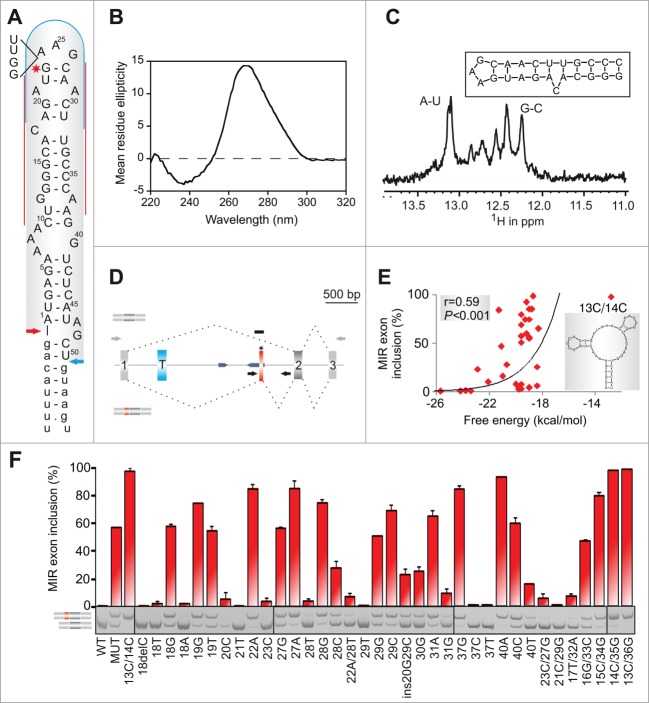
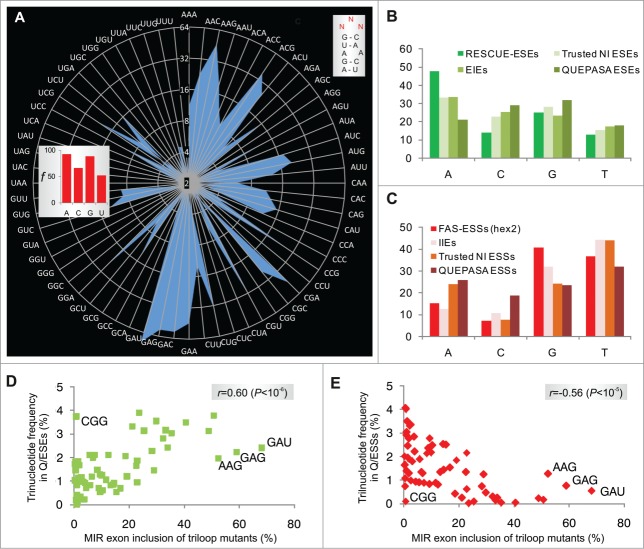
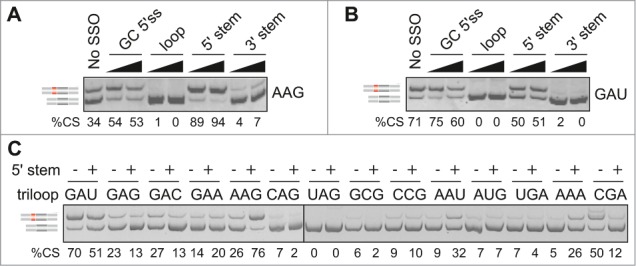
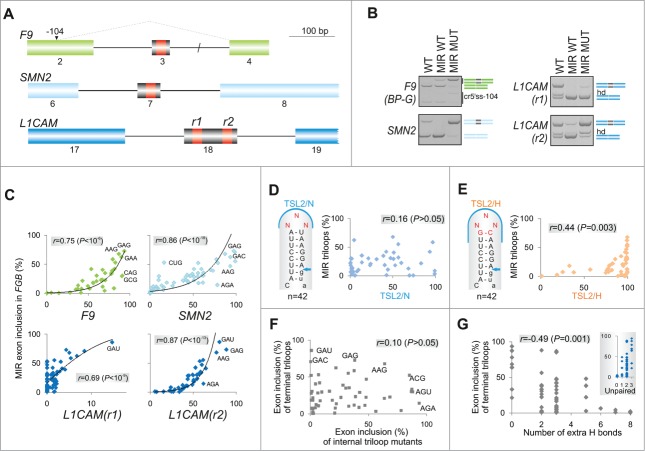
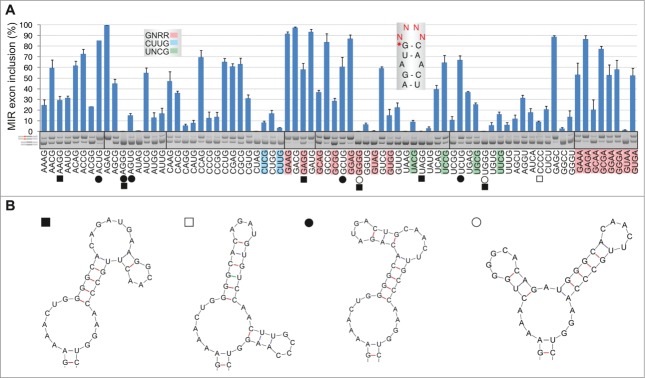
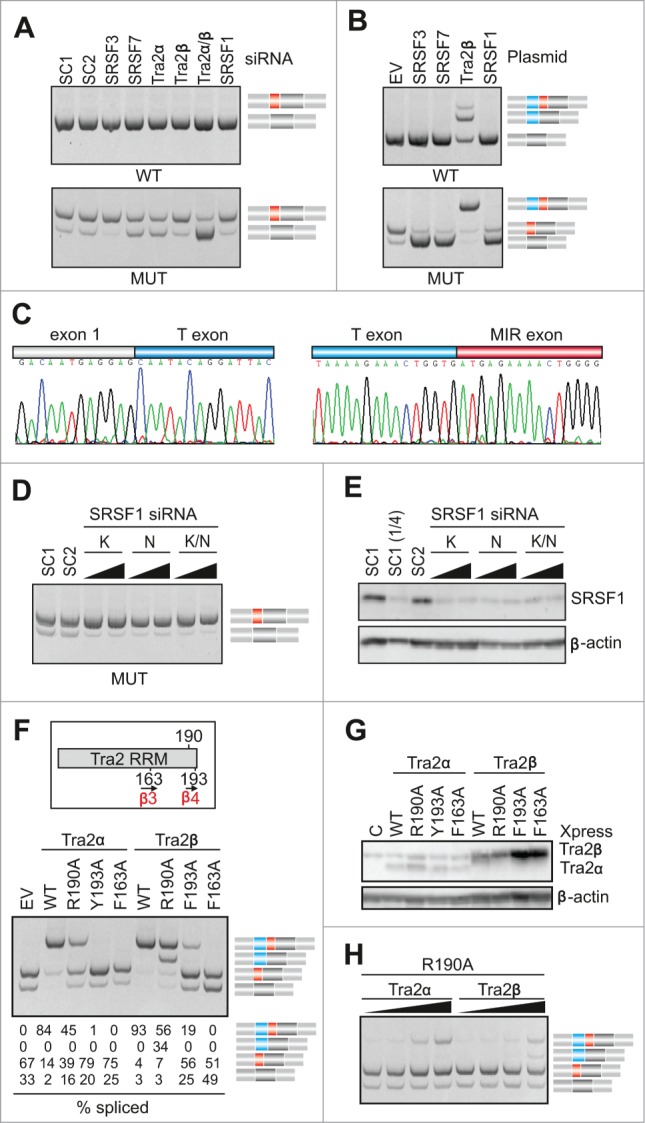
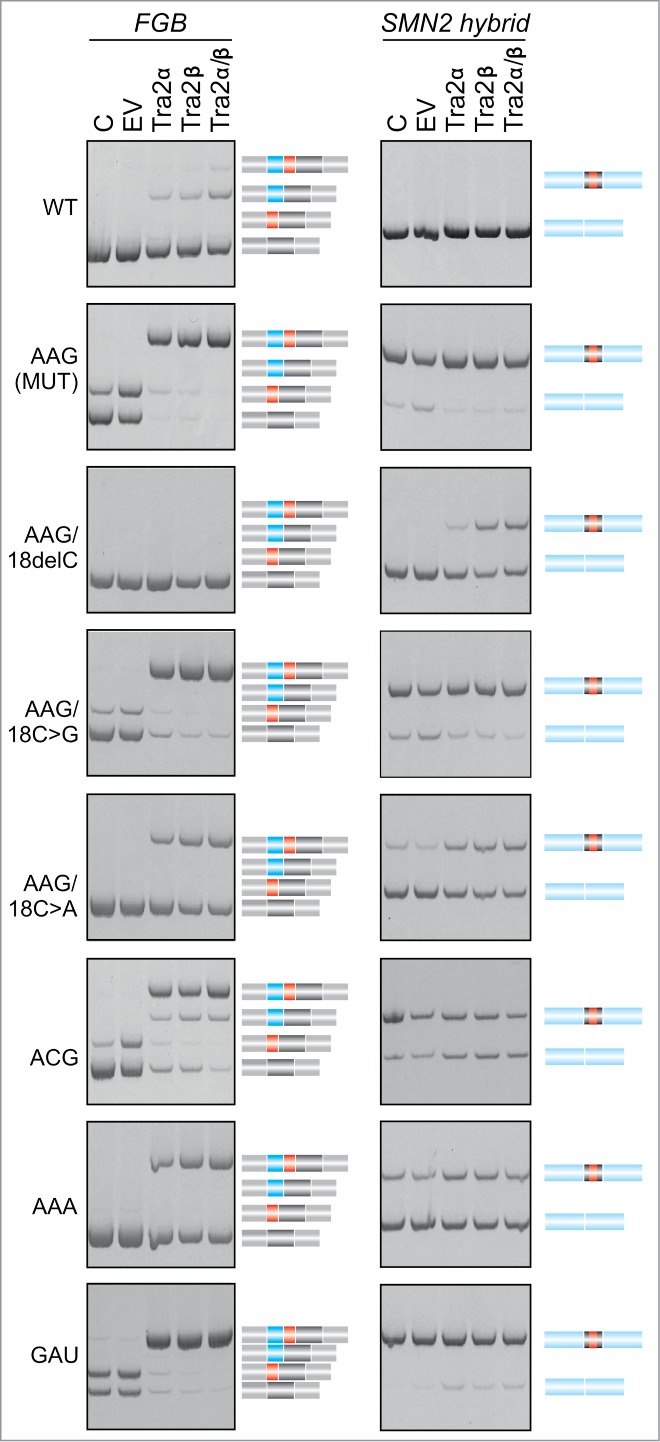
Splice-site selection is controlled by secondary structure through sequestration or approximation of splicing signals in primary transcripts but the exact role of even the simplest and most prevalent structural motifs in exon recognition remains poorly understood. Here we took advantage of a single-hairpin exon that was activated in a mammalian-wide interspersed repeat (MIR) by a mutation stabilizing a terminal triloop, with splice sites positioned close to each other in a lower stem of the hairpin. We first show that the MIR exon inclusion in mRNA correlated inversely with hairpin stabilities. Employing a systematic manipulation of unpaired regions without altering splice-site configuration, we demonstrate a high correlation between exon inclusion of terminal tri- and tetraloop mutants and matching tri-/tetramers in splicing silencers/enhancers. Loop-specific exon inclusion levels and enhancer/silencer associations were preserved across primate cell lines, in 4 hybrid transcripts and also in the context of a distinct stem, but only if its loop-closing base pairs were shared with the MIR hairpin. Unlike terminal loops, splicing activities of internal loop mutants were predicted by their intramolecular Watson-Crick interactions with the antiparallel strand of the MIR hairpin rather than by frequencies of corresponding trinucleotides in splicing silencers/enhancers. We also show that splicing outcome of oligonucleotides targeting the MIR exon depend on the identity of the triloop adjacent to their antisense target. Finally, we identify proteins regulating MIR exon recognition and reveal a distinct requirement of adjacent exons for C-terminal extensions of Tra2α and Tra2β RNA recognition motifs.
剪接位点的选择是由二级结构通过隔离或使初级转录本中的剪接信号靠近来控制的,但即使是最简单、最普遍的结构基序在外显子识别中的具体作用仍知之甚少。在这里,我们利用了一个单发卡外显子,它在哺乳动物广泛散布重复序列(MIR)中通过一个稳定末端三链环的突变而被激活,剪接位点位于发卡较低茎部彼此靠近的位置。我们首先表明,MIR外显子包含在mRNA中的情况与发卡稳定性呈负相关。通过在不改变剪接位点构型的情况下对未配对区域进行系统操作,我们证明了末端三链环和四链环突变体的外显子包含情况与剪接沉默子/增强子中匹配的三聚体/四聚体之间存在高度相关性。环特异性外显子包含水平和增强子/沉默子关联在灵长类细胞系、4种杂合转录本以及不同茎的背景下都得以保留,但前提是其环封闭碱基对与MIR发卡共享。与末端环不同,内部环突变体的剪接活性是由它们与MIR发卡反平行链的分子内沃森-克里克相互作用预测的,而不是由剪接沉默子/增强子中相应三核苷酸的频率预测的。我们还表明,靶向MIR外显子的寡核苷酸的剪接结果取决于与其反义靶标相邻的三链环的身份。最后,我们鉴定了调节MIR外显子识别的蛋白质,并揭示了相邻外显子对Tra2α和Tra2β RNA识别基序C末端延伸的独特需求。