Brorsson Caroline A, Onengut Suna, Chen Wei-Min, Wenzlau Janet, Yu Liping, Baker Peter, Williams Alistair J K, Bingley Polly J, Hutton John C, Eisenbarth George S, Concannon Patrick, Rich Stephen S, Pociot Flemming
Department of Pediatrics, Herlev University Hospital, Herlev, Denmark.
Division of Endocrinology, Department of Medicine, University of Virginia, Charlottesville, VA Center for Public Health Genomics, University of Virginia, Charlottesville, VA.
Diabetes. 2015 Aug;64(8):3017-27. doi: 10.2337/db14-1730. Epub 2015 Mar 31.
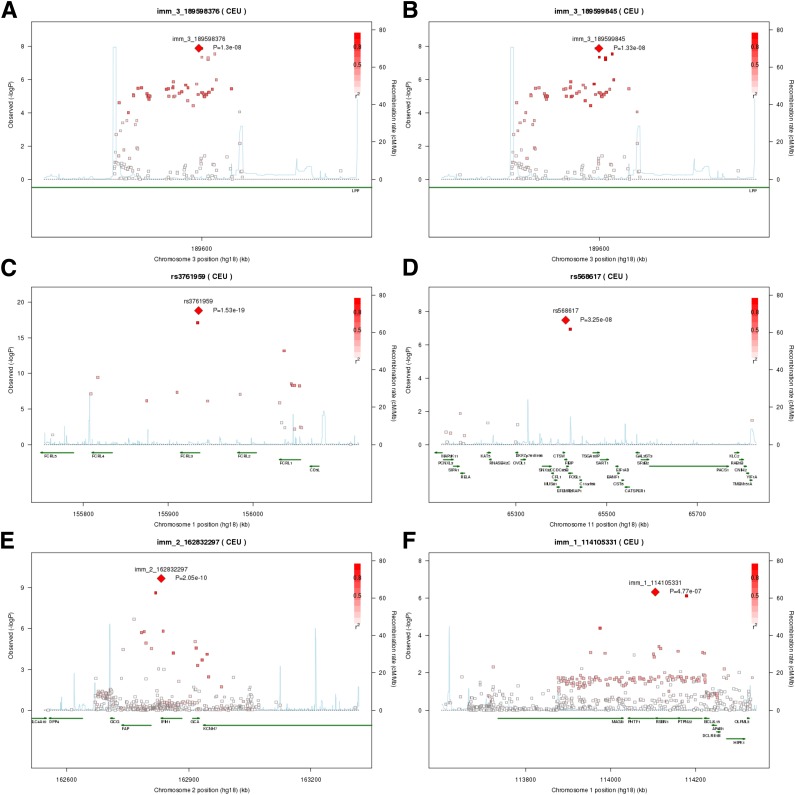
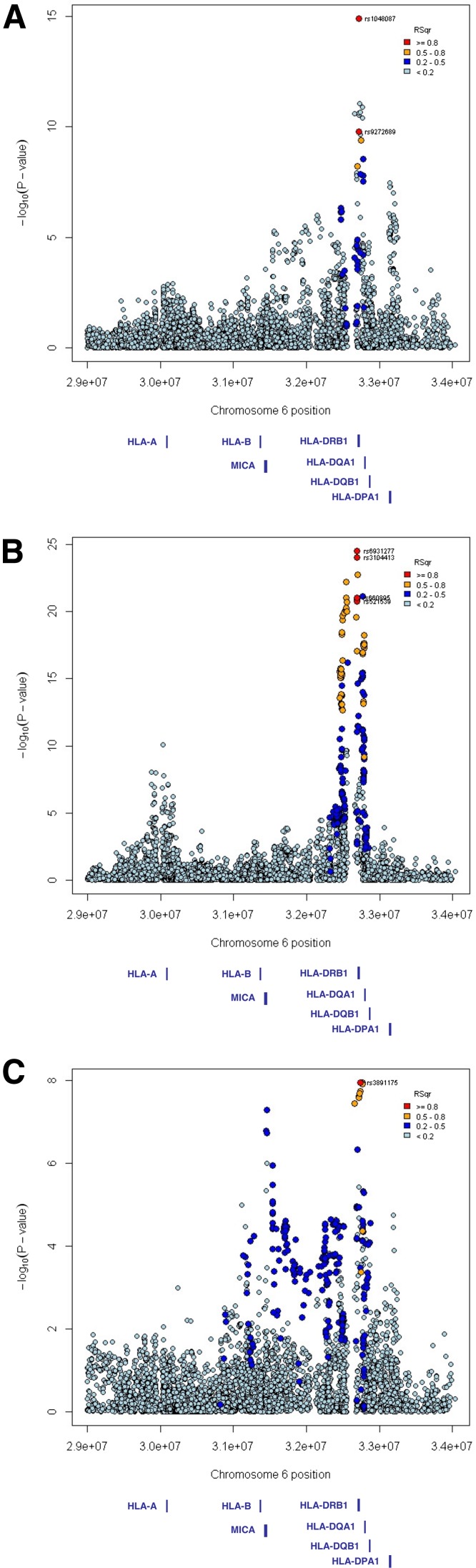
Islet autoantibodies detected at disease onset in patients with type 1 diabetes are signs of an autoimmune destruction of the insulin-producing β-cells. To further investigate the genetic determinants of autoantibody positivity, we performed dense immune-focused genotyping on the Immunochip array and tested for association with seven disease-specific autoantibodies in a large cross-sectional cohort of 6,160 type 1 diabetes-affected siblings. The genetic association with positivity for GAD autoantibodies (GADAs), IA2 antigen (IA-2A), zinc transporter 8, thyroid peroxidase, gastric parietal cells (PCAs), tissue transglutaminase, and 21-hydroxylase was tested using a linear mixed-model regression approach to simultaneously control for population structure and family relatedness. Four loci were associated with autoantibody positivity at genome-wide significance. Positivity for GADA was associated with 3q28/LPP, for IA-2A with 1q23/FCRL3 and 11q13/RELA, and for PCAs with 2q24/IFIH1. The 3q28 locus showed association after only 3 years duration and might therefore be a marker of persistent GADA positivity. The 1q23, 11q13, and 2q24 loci were associated with autoantibodies close to diabetes onset and constitute candidates for early screening. Major susceptibility loci for islet autoantibodies are separate from type 1 diabetes risk, which may have consequences for intervention strategies to reduce autoimmunity.
在1型糖尿病患者疾病发作时检测到的胰岛自身抗体是胰岛素分泌β细胞发生自身免疫性破坏的迹象。为了进一步研究自身抗体阳性的遗传决定因素,我们在免疫芯片阵列上进行了密集的免疫聚焦基因分型,并在一个由6160名受1型糖尿病影响的兄弟姐妹组成的大型横断面队列中测试了与七种疾病特异性自身抗体的关联。使用线性混合模型回归方法测试了与谷氨酸脱羧酶自身抗体(GADA)、IA2抗原(IA-2A)、锌转运体8、甲状腺过氧化物酶、胃壁细胞(PCA)、组织转谷氨酰胺酶和21-羟化酶阳性的遗传关联,以同时控制群体结构和家族相关性。在全基因组显著性水平上,有四个基因座与自身抗体阳性相关。GADA阳性与3q28/LPP相关,IA-2A阳性与1q23/FCRL3和11q13/RELA相关,PCA阳性与2q24/IFIH1相关。3q28基因座仅在病程3年后显示出关联,因此可能是持续性GADA阳性的一个标志物。1q23、11q13和2q24基因座与接近糖尿病发病时的自身抗体相关,是早期筛查的候选基因座。胰岛自身抗体的主要易感基因座与1型糖尿病风险无关,这可能会对减少自身免疫的干预策略产生影响。