Hsieh Chia-Wen C, Cannella David, Jørgensen Henning, Felby Claus, Thygesen Lisbeth G
Department of Geosciences and Natural Resource Management, Faculty of Science, University of Copenhagen, Rolighedsvej 23, DK-1958 Frederiksberg C, Denmark.
Present address: Center for Bioprocess Engineering, Department of Chemical and Biochemical Engineering, Technical University of Denmark, Søltofts Plads, Building 229, DK-2800 Kgs. Lyngby, Denmark.
Biotechnol Biofuels. 2015 Mar 28;8:52. doi: 10.1186/s13068-015-0242-y. eCollection 2015.
Non-ionic surfactants such as polyethylene glycol (PEG) can increase the glucose yield obtained from enzymatic saccharification of lignocellulosic substrates. Various explanations behind this effect include the ability of PEG to increase the stability of the cellulases, decrease non-productive cellulase adsorption to the substrate, and increase the desorption of enzymes from the substrate. Here, using lignin-free model substrates, we propose that PEG also alters the solvent properties, for example, water, leading the cellulases to increase hydrolysis yields.
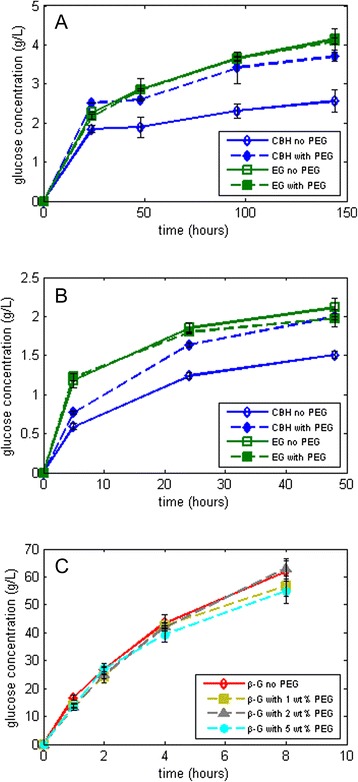
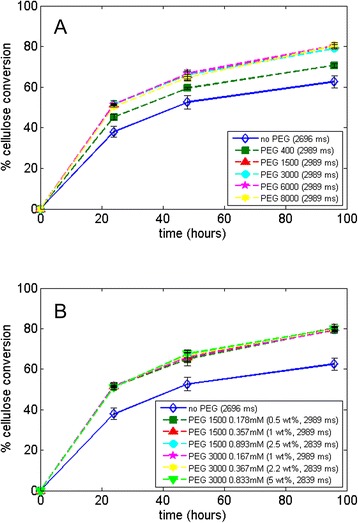
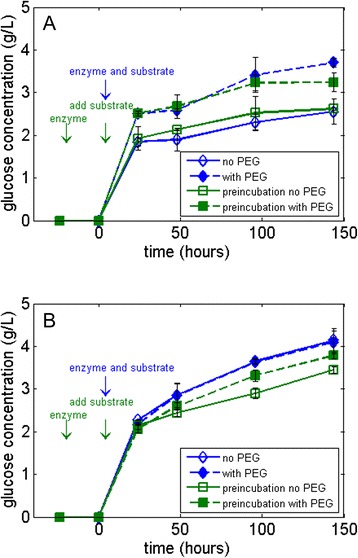
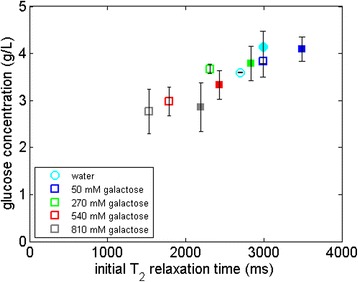
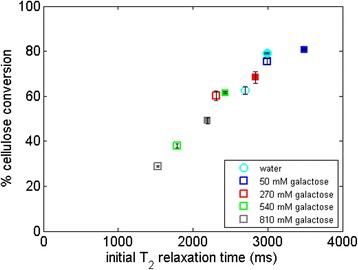
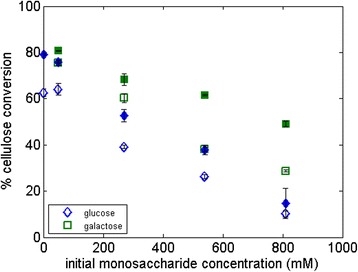
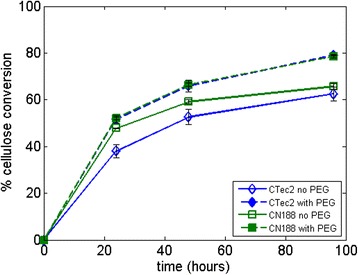
The effect of PEG differs for the individual cellulases. During hydrolysis of Avicel and PASC with a processive monocomponent exo-cellulase cellobiohydrolase (CBH) I, the presence of PEG leads to an increase in the final glucose concentration, while PEG caused no change in glucose production with a non-processive endoglucanase (EG). Also, no effect of PEG was seen on the activity of β-glucosidases. While PEG has a small effect on the thermostability of both cellulases, only the activity of CBH I increases with PEG. Using commercial enzyme mixtures, the hydrolysis yields increased with the addition of PEG. In parallel, we observed that the relaxation time of the hydrolysis liquid phase, as measured by LF-NMR, directly correlated with the final glucose yield. PEG was able to boost the glucose production even in highly concentrated solutions of up to 150 g/L of glucose.
The hydrolysis boosting effect of PEG appears to be specific for CBH I. The mechanism could be due to an increase in the apparent activity of the enzyme on the substrate surface. The addition of PEG increases the relaxation time of the liquid-phase water, which from the data presented points towards a mechanism related to PEG-water interactions rather than PEG-protein or PEG-substrate interactions.
非离子表面活性剂如聚乙二醇(PEG)可提高木质纤维素底物酶促糖化所得的葡萄糖产率。对此效应背后的各种解释包括PEG提高纤维素酶稳定性的能力、减少非生产性纤维素酶对底物的吸附以及增加酶从底物上的解吸。在此,我们使用无木质素的模型底物提出,PEG还会改变溶剂性质,例如水,从而使纤维素酶提高水解产率。
PEG对各个纤维素酶的影响有所不同。在用一种持续性单组分外切纤维素酶纤维二糖水解酶(CBH)I水解微晶纤维素(Avicel)和磷酸膨胀纤维素(PASC)的过程中,PEG的存在会导致最终葡萄糖浓度增加,而对于非持续性内切葡聚糖酶(EG),PEG对葡萄糖生成没有影响。此外,未观察到PEG对β-葡萄糖苷酶活性有影响。虽然PEG对两种纤维素酶的热稳定性影响较小,但只有CBH I的活性随PEG增加。使用商业酶混合物时,添加PEG可提高水解产率。同时,我们观察到通过低场核磁共振(LF-NMR)测量的水解液相弛豫时间与最终葡萄糖产率直接相关。即使在高达150 g/L葡萄糖的高浓度溶液中,PEG也能够提高葡萄糖生成量。
PEG的水解促进作用似乎对CBH I具有特异性。其机制可能是由于酶在底物表面的表观活性增加。PEG的添加增加了液相水的弛豫时间,从所呈现的数据来看,这指向一种与PEG-水相互作用而非PEG-蛋白质或PEG-底物相互作用相关的机制。