Nicholson James, Azim Syed, Rebecchi Mario J, Galbavy William, Feng Tian, Reinsel Ruth, Rizwan Sabeen, Fowler Christopher J, Benveniste Helene, Kaczocha Martin
Department of Orthopedic Surgery, Stony Brook University, Stony Brook, New York, United States of America.
Department of Anesthesiology, Stony Brook University, Stony Brook, New York, United States of America.
PLoS One. 2015 Apr 2;10(4):e0123132. doi: 10.1371/journal.pone.0123132. eCollection 2015.
There is compelling evidence in humans that peripheral endocannabinoid signaling is disrupted in obesity. However, little is known about the corresponding central signaling. Here, we have investigated the relationship between gender, leptin, body mass index (BMI) and levels of the endocannabinoids anandamide (AEA) and 2-arachidonoylglycerol (2-AG) in the serum and cerebrospinal fluid (CSF) of primarily overweight to obese patients with osteoarthritis.
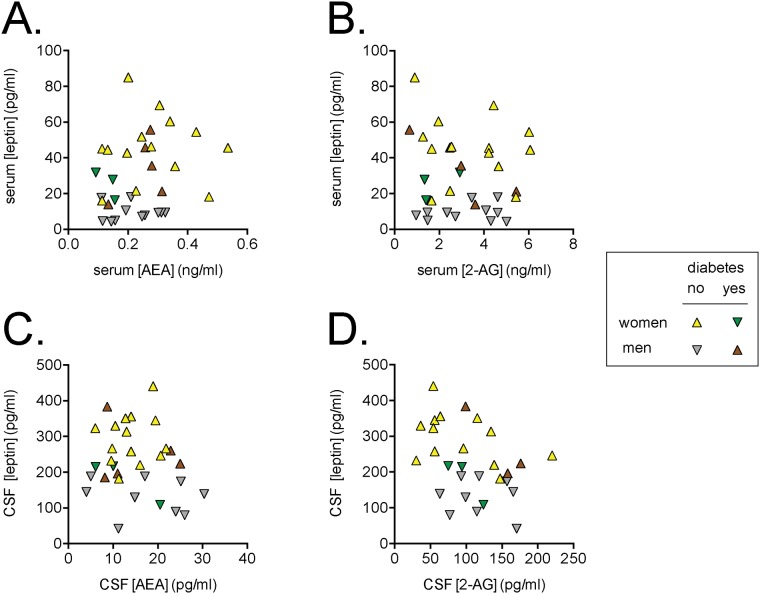
METHODOLOGY/PRINCIPAL FINDINGS: Patients (20 females, 15 males, age range 44-78 years, BMI range 24-42) undergoing total knee arthroplasty for end-stage osteoarthritis were recruited for the study. Endocannabinoids were quantified by liquid chromatography - mass spectrometry. AEA and 2-AG levels in the serum and CSF did not correlate with either age or BMI. However, 2-AG levels in the CSF, but not serum, correlated negatively with CSF leptin levels (Spearman's ρ -0.48, P=0.0076, n=30). No such correlations were observed for AEA and leptin.
CONCLUSIONS/SIGNIFICANCE: In the patient sample investigated, there is a negative association between 2-AG and leptin levels in the CSF. This is consistent with pre-clinical studies in animals, demonstrating that leptin controls the levels of hypothalamic endocannabinoids that regulate feeding behavior.
有确凿证据表明,在人类中,外周内源性大麻素信号在肥胖症中会受到干扰。然而,对于相应的中枢信号却知之甚少。在此,我们研究了主要为超重至肥胖的骨关节炎患者的性别、瘦素、体重指数(BMI)与血清和脑脊液(CSF)中内源性大麻素花生四烯乙醇胺(AEA)和2-花生四烯酸甘油酯(2-AG)水平之间的关系。
方法/主要发现:招募因终末期骨关节炎接受全膝关节置换术的患者(20名女性,15名男性,年龄范围44 - 78岁,BMI范围24 - 42)进行该研究。通过液相色谱 - 质谱法定量内源性大麻素。血清和脑脊液中的AEA和2-AG水平与年龄或BMI均无相关性。然而,脑脊液中的2-AG水平(而非血清中的)与脑脊液瘦素水平呈负相关(斯皮尔曼相关系数ρ = -0.48,P = 0.0076,n = 30)。未观察到AEA与瘦素之间存在此类相关性。
结论/意义:在所研究的患者样本中,脑脊液中2-AG与瘦素水平之间存在负相关。这与动物的临床前研究一致,表明瘦素控制调节进食行为的下丘脑内源性大麻素水平。