Kim Joon Bum, Yang Dong Hyun, Kang Joon-Won, Jung Sung-Ho, Choo Suk Jung, Chung Cheol Hyun, Song Jae-Kwan, Lee Jae Won
Department of Thoracic and Cardiovascular Surgery, Asan Medical Center, University of Ulsan College of Medicine, Seoul, Korea.
Department of Radiology, Asan Medical Center, University of Ulsan College of Medicine, Seoul, Korea.
Yonsei Med J. 2015 May;56(3):608-16. doi: 10.3349/ymj.2015.56.3.608.
The Maze procedure has shown excellent efficacy in the elimination of atrial fibrillation (AF); however, little is known about the quality of functional recovery in the left atrium (LA) following successful sinus rhythm conversion by the Maze procedure.
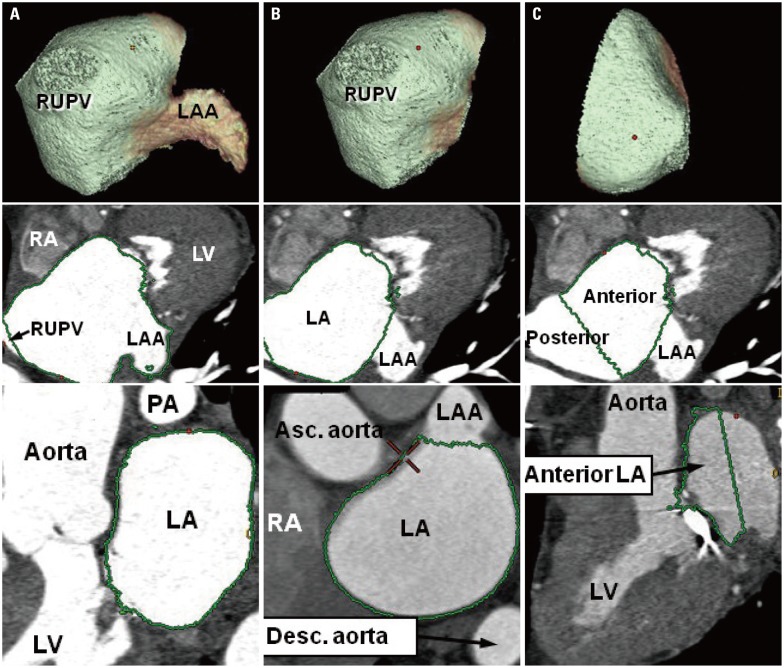
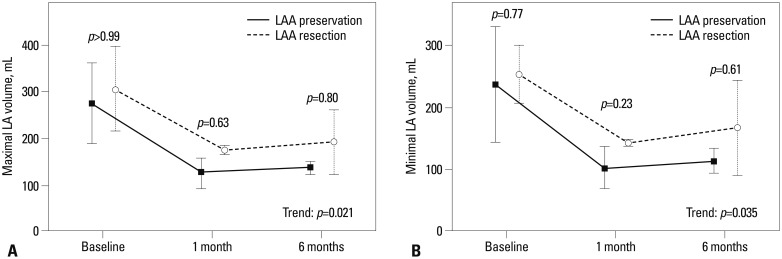
We prospectively enrolled 12 patients (aged 52.5±10.1 years, 1 female) with valvular AF undergoing mitral valve surgery combined with the Maze procedure. Parameters of LA function in three anatomic compartments [anterior, posterior, and LA appendage (LAA)] were evaluated using electrocardiography-gated dual-source cardiac CT at one month and at six months after surgery. Twelve subjects matched by age, gender, and body surface area served as controls.
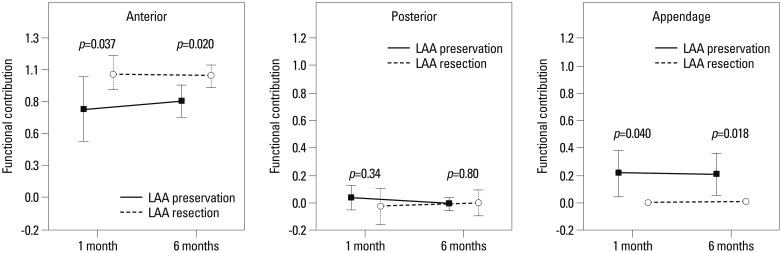
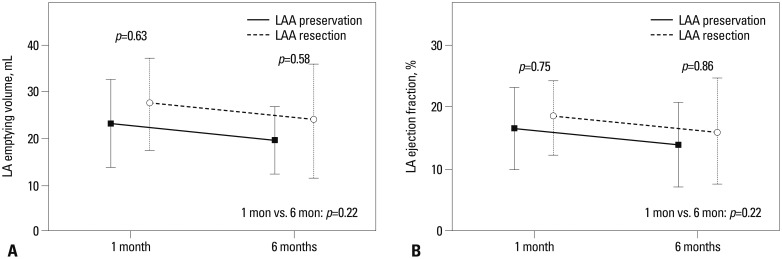
At one month after surgery, ejection fraction (EF) and emptying volume (EV) of the LA were 14.9±7.4% and 21.3±9.7 mL, respectively, and they were significantly lower than those of the control group (EF, 47.9±11.2%; EV, 46.0±10.7%; p<0001). These values did not significantly change throughout late periods (p=0.22 and 0.21, respectively). Functional contributions of the anterior, posterior, and appendage compartments (EV of each compartment/overall EV) were 80.4%, -0.9%, and 20.5%, respectively, for those with LAA preservation (n=6); 100.1%, -0.1%, and 0% for those with LAA resection (n=6; p<0.05); and 62.2%, 28.2%, and 9.7% in the control subjects (p<0.001).
Contractile functions of the LA significantly decreased after the Maze procedure. Functional contributions of three compartments of the LA were also altered. The influence of LAA preservation on postoperative LA functions needs to be evaluated through studies of larger populations.
迷宫手术在消除心房颤动(AF)方面已显示出卓越疗效;然而,对于迷宫手术成功恢复窦性心律后左心房(LA)功能恢复的质量了解甚少。
我们前瞻性纳入了12例(年龄52.5±10.1岁,1例女性)接受二尖瓣手术并联合迷宫手术的瓣膜性AF患者。在术后1个月和6个月时,使用心电图门控双源心脏CT评估左心房三个解剖区域[前部、后部和左心耳(LAA)]的功能参数。选取12名年龄、性别和体表面积相匹配的受试者作为对照。
术后1个月时,左心房射血分数(EF)和排空容积(EV)分别为14.9±7.4%和21.3±9.7 mL,显著低于对照组(EF,47.9±11.2%;EV,46.0±10.7%;p<0.001)。在整个后期这些值无显著变化(p分别为0.22和0.21)。对于保留LAA的患者(n = 6),前部、后部和心耳区域的功能贡献(每个区域的EV/总体EV)分别为80.4%、-0.9%和20.5%;对于切除LAA的患者(n = 6;p<0.05),分别为100.1%、-0.1%和0%;对照组受试者分别为62.2%、28.2%和9.7%(p<0.001)。
迷宫手术后左心房的收缩功能显著下降。左心房三个区域的功能贡献也发生了改变。需要通过更大规模人群的研究来评估保留LAA对术后左心房功能的影响。