Ndiaye Abdou Kader, Diop Pape Amadou Mbathio, Diop Ousmane Madiagne
National Reference Center for Enteric Viruses, Medical Virology Unit, Institut Pasteur de Dakar, Senegal.
Pan Afr Med J. 2014 Nov 4;19:243. doi: 10.11604/pamj.2014.19.243.3538. eCollection 2014.
Global poliomyelitis eradication initiative relies on (i) laboratory based surveillance of acute flaccid surveillance (AFP) to monitor the circulation of wild poliovirus in a population, and (ii) vaccination to prevent its diffusion. However, as poliovirus can survive in the environment namely in sewage, environmental surveillance (ES) is of growing importance as the eradication target is close. This study aimed to assess polioviruses and non polio enteroviruses circulation in sewage drains covering a significant population of Dakar.
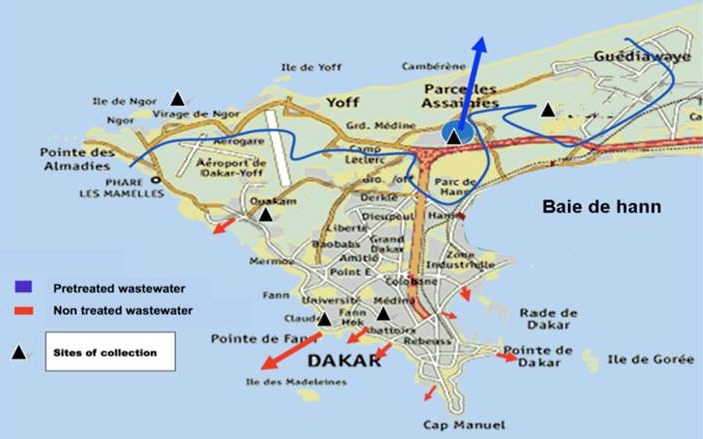
From April 2007 to May 2013, 271 specimens of raw sewage were collected using the grab method in 6 neighborhoods of Dakar. Samples were processed to extract and concentrate viruses using polyethylene glycol and Dextran (two-phase separation method). Isolation of enteroviruses was attempted in RD, L20B and Hep2 cell lines. Polioviruses were identified by RT-PCR and Elisa. Non Polio Enteroviruses (NPEVs) were identified by RT-PCR and microneutralisation tests.
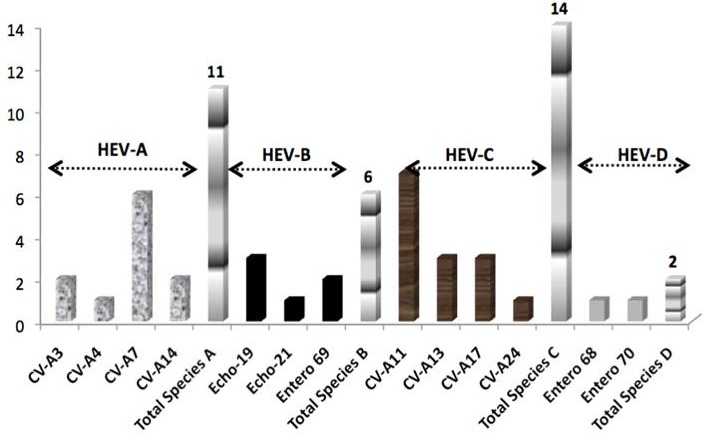
Polioviruses and NPEVs were respectively detected in 34,3% and 42,8% sewage samples. No wild poliovirus neither circulating vaccine-derived Poliovirus (cVDPV) was detected. Neutralization assays have identified 49 non polio enteroviruses that were subsequently classified in 13 serotypes belonging to HEV-A (22, 4%), HEV-B (12, 24%), HEV-C (26, 53%) and HEV-D (6, 12%) species.
This study is the first documentation of enteroviruses environmental detection in Senegal. It shows the usefulness of environmental surveillance for indirect monitoring of the circulation and distribution of enteroviruses in the community.
全球根除脊髓灰质炎行动依赖于:(i)基于实验室的急性弛缓性麻痹监测(AFP),以监测人群中野生脊髓灰质炎病毒的传播;以及(ii)接种疫苗以防止其扩散。然而,由于脊髓灰质炎病毒能够在环境中存活,即在污水中存活,随着根除目标临近,环境监测(ES)的重要性日益增加。本研究旨在评估达喀尔大量人口聚居区污水排放管道中脊髓灰质炎病毒和非脊髓灰质炎肠道病毒的传播情况。
2007年4月至2013年5月,采用抓取法在达喀尔的6个街区收集了271份未经处理的污水样本。使用聚乙二醇和右旋糖酐(两相分离法)对样本进行处理,以提取和浓缩病毒。尝试在RD、L20B和Hep2细胞系中分离肠道病毒。通过逆转录聚合酶链反应(RT-PCR)和酶联免疫吸附测定(ELISA)鉴定脊髓灰质炎病毒。通过RT-PCR和微量中和试验鉴定非脊髓灰质炎肠道病毒(NPEV)。
分别在34.3%和42.8%的污水样本中检测到脊髓灰质炎病毒和NPEV。未检测到野生脊髓灰质炎病毒和循环疫苗衍生脊髓灰质炎病毒(cVDPV)。中和试验鉴定出49种非脊髓灰质炎肠道病毒,随后将其分为13个血清型,分别属于A组肠道病毒(HEV-A,22株,4%)、B组肠道病毒(HEV-B,12株,24%)、C组肠道病毒(HEV-C,26株,53%)和D组肠道病毒(HEV-D,6株,12%)。
本研究是塞内加尔环境中肠道病毒检测的首次记录。它显示了环境监测对于间接监测社区中肠道病毒传播和分布的有用性。