Pirone-Davies Cary, Hoffmann Maria, Roberts Richard J, Muruvanda Tim, Timme Ruth E, Strain Errol, Luo Yan, Payne Justin, Luong Khai, Song Yi, Tsai Yu-Chih, Boitano Matthew, Clark Tyson A, Korlach Jonas, Evans Peter S, Allard Marc W
Division of Microbiology, Office of Regulatory Science, Center for Food Safety and Applied Nutrition, U.S. Food and Drug Administration, College Park, Maryland, United States of America.
New England Biolabs, Ipswich, Massachusetts, United States of America.
PLoS One. 2015 Apr 10;10(4):e0123639. doi: 10.1371/journal.pone.0123639. eCollection 2015.
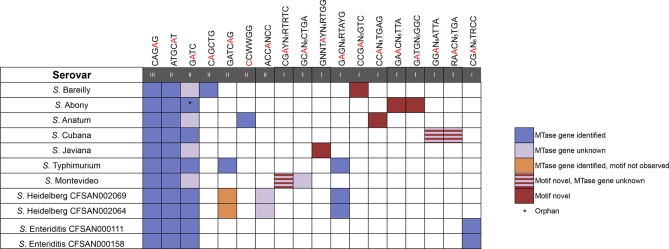
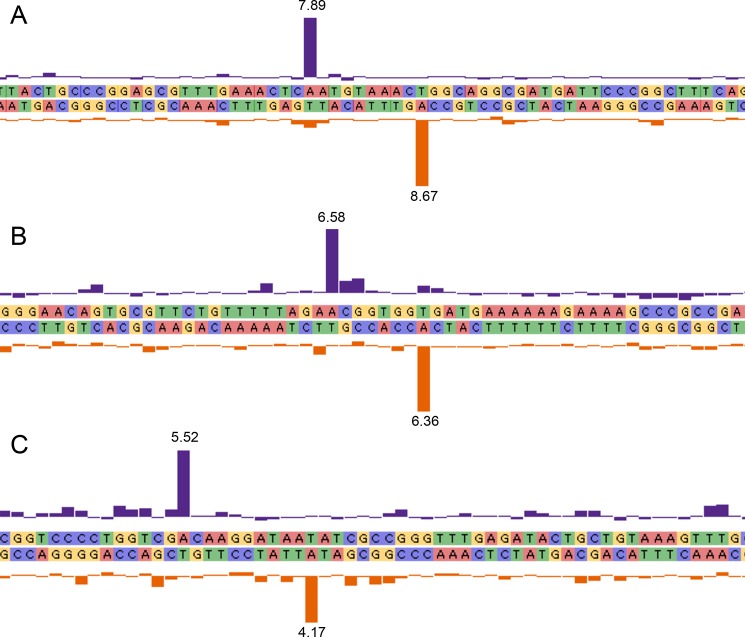
The methylation of DNA bases plays an important role in numerous biological processes including development, gene expression, and DNA replication. Salmonella is an important foodborne pathogen, and methylation in Salmonella is implicated in virulence. Using single molecule real-time (SMRT) DNA-sequencing, we sequenced and assembled the complete genomes of eleven Salmonella enterica isolates from nine different serovars, and analysed the whole-genome methylation patterns of each genome. We describe 16 distinct N6-methyladenine (m6A) methylated motifs, one N4-methylcytosine (m4C) motif, and one combined m6A-m4C motif. Eight of these motifs are novel, i.e., they have not been previously described. We also identified the methyltransferases (MTases) associated with 13 of the motifs. Some motifs are conserved across all Salmonella serovars tested, while others were found only in a subset of serovars. Eight of the nine serovars contained a unique methylated motif that was not found in any other serovar (most of these motifs were part of Type I restriction modification systems), indicating the high diversity of methylation patterns present in Salmonella.
DNA碱基的甲基化在包括发育、基因表达和DNA复制在内的众多生物学过程中发挥着重要作用。沙门氏菌是一种重要的食源性病原体,沙门氏菌中的甲基化与毒力有关。利用单分子实时(SMRT)DNA测序技术,我们对来自9个不同血清型的11株肠炎沙门氏菌分离株的完整基因组进行了测序和组装,并分析了每个基因组的全基因组甲基化模式。我们描述了16种不同的N6-甲基腺嘌呤(m6A)甲基化基序、1种N4-甲基胞嘧啶(m4C)基序和1种m6A-m4C组合基序。其中8种基序是新发现的,即此前未曾被描述过。我们还鉴定出了与其中13种基序相关的甲基转移酶(MTases)。一些基序在所有测试的沙门氏菌血清型中都是保守的,而其他基序仅在部分血清型中被发现。9个血清型中的8个含有一种独特的甲基化基序,该基序在其他任何血清型中都未被发现(这些基序中的大多数是I型限制修饰系统的一部分),这表明沙门氏菌中甲基化模式具有高度多样性。