Li Jingyuan, Feng Jifan, Liu Yang, Ho Thach-Vu, Grimes Weston, Ho Hoang Anh, Park Shery, Wang Songlin, Chai Yang
Center for Craniofacial Molecular Biology, Ostrow School of Dentistry, University of Southern California, Los Angeles, CA 90033, USA; Molecular Laboratory for Gene Therapy and Tooth Regeneration, Beijing Key Laboratory of Tooth Regeneration and Function Reconstruction, Capital Medical University School of Stomatology, Beijing 100050, PRC.
Center for Craniofacial Molecular Biology, Ostrow School of Dentistry, University of Southern California, Los Angeles, CA 90033, USA.
Dev Cell. 2015 Apr 20;33(2):125-35. doi: 10.1016/j.devcel.2015.02.021. Epub 2015 Apr 9.
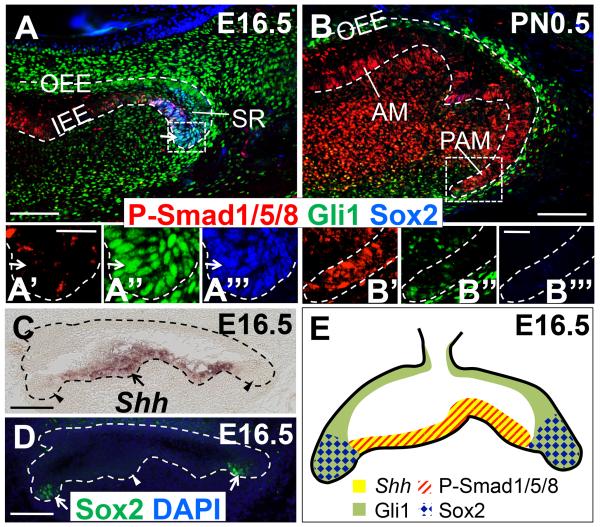
During embryogenesis, ectodermal stem cells adopt different fates and form diverse ectodermal organs, such as teeth, hair follicles, mammary glands, and salivary glands. Interestingly, these ectodermal organs differ in their tissue homeostasis, which leads to differential abilities for continuous growth postnatally. Mouse molars lose the ability to grow continuously, whereas incisors retain this ability. In this study, we found that a BMP-Smad4-SHH-Gli1 signaling network may provide a niche supporting transient Sox2+ dental epithelial stem cells in mouse molars. This mechanism also plays a role in continuously growing mouse incisors. The differential fate of epithelial stem cells in mouse molars and incisors is controlled by this BMP/SHH signaling network, which partially accounts for the different postnatal growth potential of molars and incisors. Collectively, our study highlights the importance of crosstalk between two signaling pathways, BMP and SHH, in regulating the fate of epithelial stem cells during organogenesis.
在胚胎发生过程中,外胚层干细胞会分化成不同的细胞命运,并形成多种外胚层器官,如牙齿、毛囊、乳腺和唾液腺。有趣的是,这些外胚层器官在组织稳态方面存在差异,这导致它们出生后持续生长的能力也有所不同。小鼠磨牙失去了持续生长的能力,而门牙则保留了这种能力。在本研究中,我们发现一个BMP-Smad4-SHH-Gli1信号网络可能为小鼠磨牙中短暂存在的Sox2+牙齿上皮干细胞提供一个微环境。这一机制在持续生长的小鼠门牙中也发挥作用。小鼠磨牙和门牙中上皮干细胞的不同命运受这个BMP/SHH信号网络的控制,这部分解释了磨牙和门牙出生后不同的生长潜力。总的来说,我们的研究突出了BMP和SHH这两条信号通路之间的相互作用在器官发生过程中调节上皮干细胞命运的重要性。