Teo Shu Mei, Mok Danny, Pham Kym, Kusel Merci, Serralha Michael, Troy Niamh, Holt Barbara J, Hales Belinda J, Walker Michael L, Hollams Elysia, Bochkov Yury A, Grindle Kristine, Johnston Sebastian L, Gern James E, Sly Peter D, Holt Patrick G, Holt Kathryn E, Inouye Michael
Medical Systems Biology, Department of Pathology and Department of Microbiology & Immunology, The University of Melbourne, Parkville, VIC 3010, Australia; Department of Biochemistry and Molecular Biology, Bio21 Molecular Science and Biotechnology Institute, The University of Melbourne, Parkville, VIC 3010, Australia.
Telethon Kids Institute, The University of Western Australia, West Perth, WA 6008, Australia.
Cell Host Microbe. 2015 May 13;17(5):704-15. doi: 10.1016/j.chom.2015.03.008. Epub 2015 Apr 9.
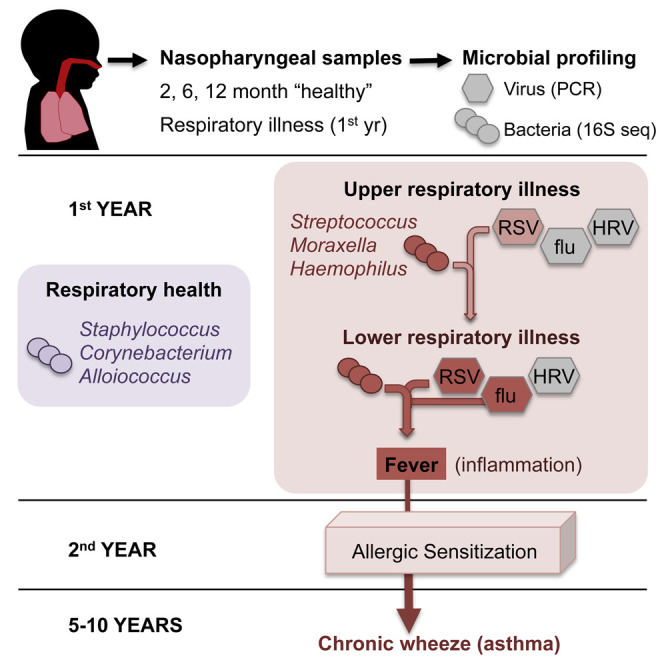
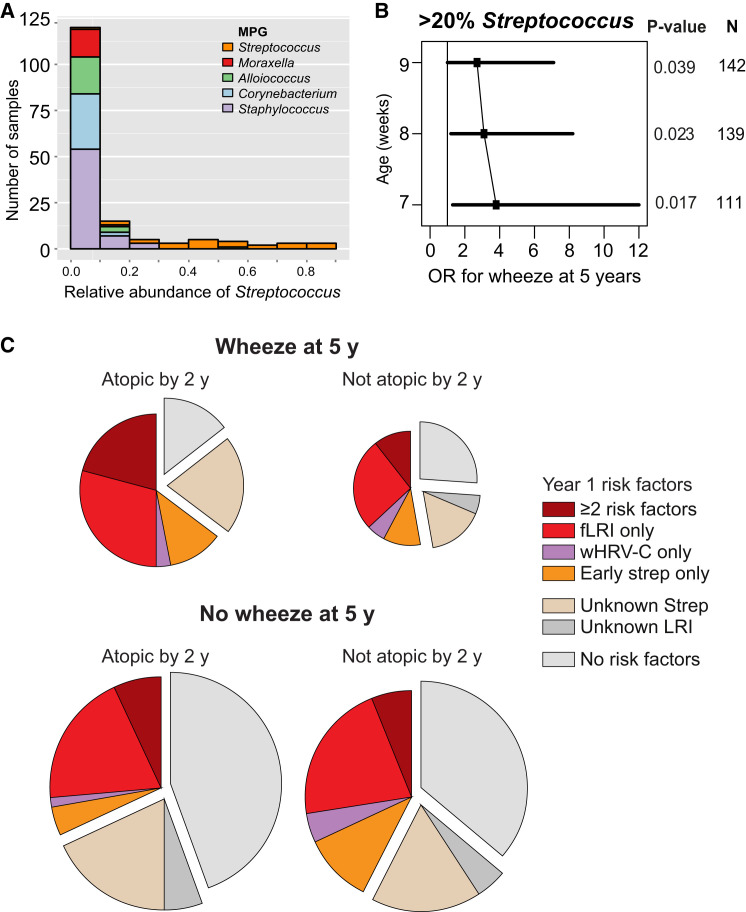
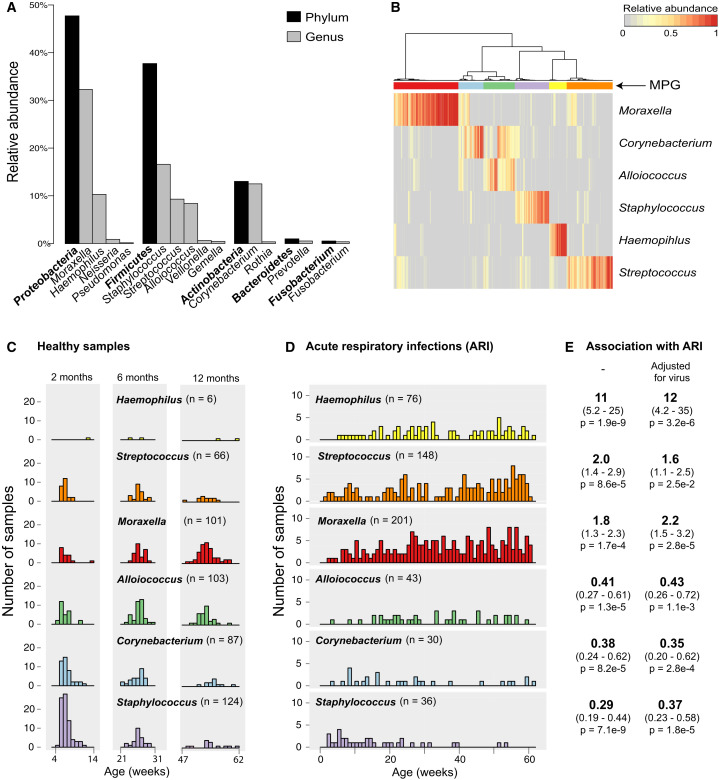
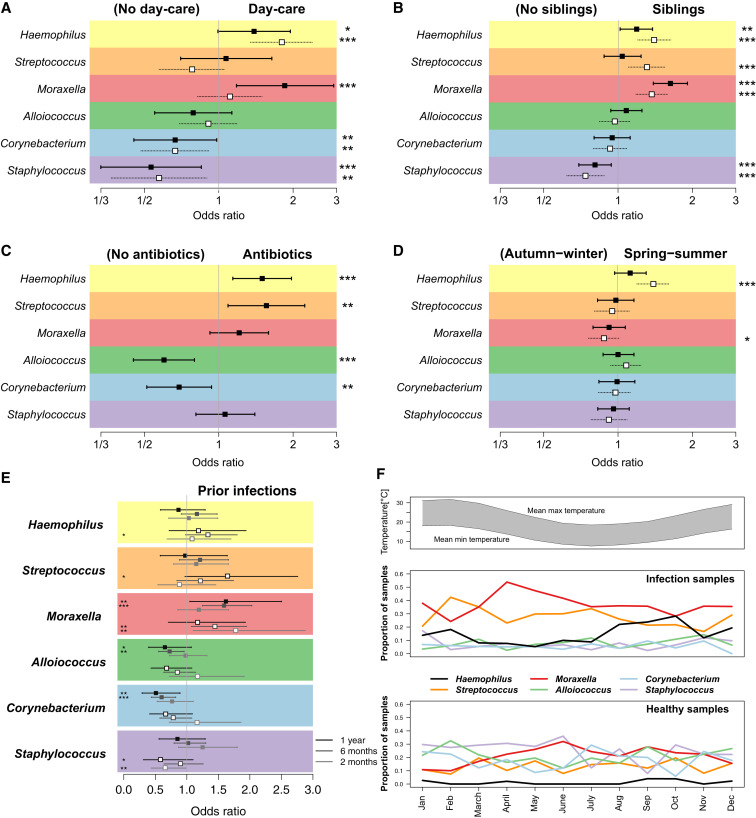
The nasopharynx (NP) is a reservoir for microbes associated with acute respiratory infections (ARIs). Lung inflammation resulting from ARIs during infancy is linked to asthma development. We examined the NP microbiome during the critical first year of life in a prospective cohort of 234 children, capturing both the viral and bacterial communities and documenting all incidents of ARIs. Most infants were initially colonized with Staphylococcus or Corynebacterium before stable colonization with Alloiococcus or Moraxella. Transient incursions of Streptococcus, Moraxella, or Haemophilus marked virus-associated ARIs. Our data identify the NP microbiome as a determinant for infection spread to the lower airways, severity of accompanying inflammatory symptoms, and risk for future asthma development. Early asymptomatic colonization with Streptococcus was a strong asthma predictor, and antibiotic usage disrupted asymptomatic colonization patterns. In the absence of effective anti-viral therapies, targeting pathogenic bacteria within the NP microbiome could represent a prophylactic approach to asthma.
鼻咽(NP)是与急性呼吸道感染(ARI)相关的微生物储存库。婴儿期ARI引起的肺部炎症与哮喘的发展有关。我们在一个有234名儿童的前瞻性队列中,研究了生命关键的第一年期间的NP微生物群,捕获了病毒和细菌群落,并记录了所有ARI事件。大多数婴儿最初由葡萄球菌或棒状杆菌定植,之后由异球菌或莫拉克斯氏菌稳定定植。链球菌、莫拉克斯氏菌或嗜血杆菌的短暂入侵标志着与病毒相关的ARI。我们的数据确定NP微生物群是感染扩散到下呼吸道、伴随炎症症状严重程度以及未来哮喘发展风险的决定因素。早期无症状的链球菌定植是哮喘的一个强有力的预测指标,而抗生素的使用扰乱了无症状定植模式。在缺乏有效抗病毒疗法的情况下,针对NP微生物群中的致病细菌可能是一种预防哮喘的方法。