Gallo L M, Iwasaki L R, Gonzalez Y M, Liu H, Marx D B, Nickel J C
Center of Dental Medicine, Clinic of Masticatory Disorders, Removable Prosthodontics, Geriatric and Special Care Dentistry, University of Zurich, Zurich, Switzerland.
Orthod Craniofac Res. 2015 Apr;18 Suppl 1(0 1):164-9. doi: 10.1111/ocr.12074.
Cartilage fatigue, due to mechanical work, may account for precocious development of degenerative joint disease in the temporomandibular joint (TMJ). This study compared energy densities (mJ/mm³) in TMJs of three diagnostic groups.
Sixty-eight subjects (44 women, 24 men) gave informed consent. Diagnostic criteria for temporomandibular disorders (DC/TMD) and imaging were used to group subjects according to presence of jaw muscle or joint pain (+P) and bilateral disk displacement (+DD).
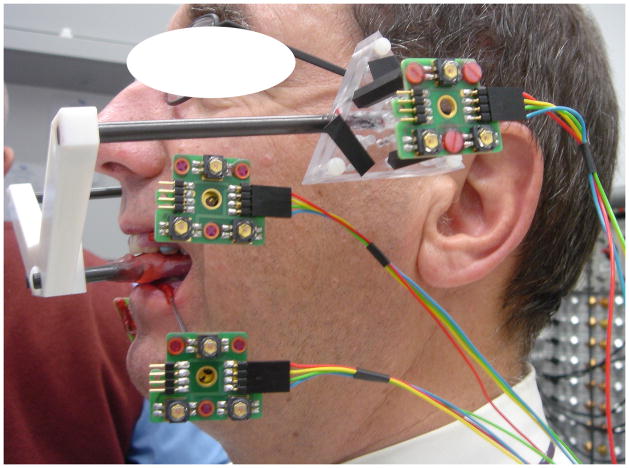
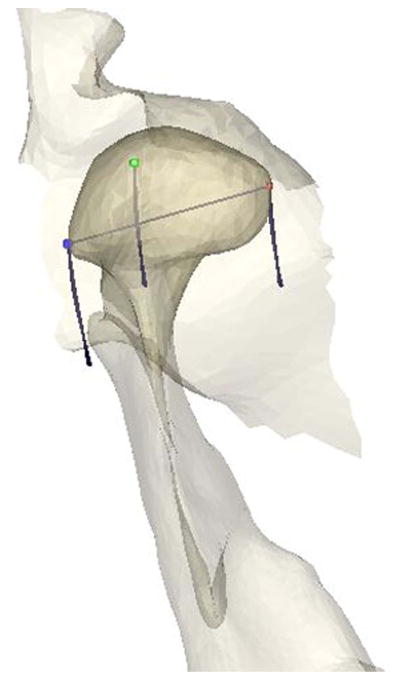
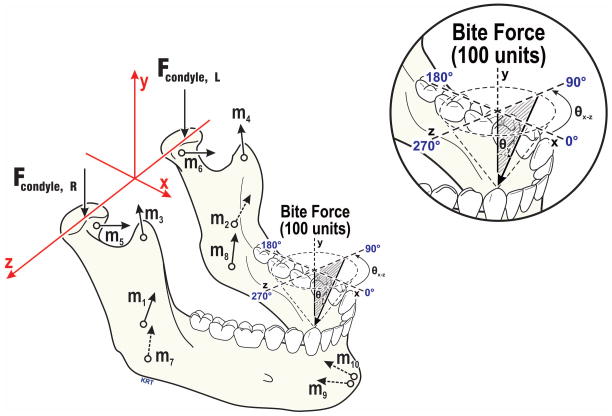
Subjects (+P+DD, n=16; -P+DD, n=16; and -P-DD, n=36) provided cone-beam computed tomography and magnetic resonance images, and jaw-tracking data. Numerical modeling was used to determine TMJ loads (Fnormal). Dynamic stereometry was used to characterize individual-specific data of stress-field dynamics during 10 symmetrical jaw-closing cycles. These data were used to estimate tractional forces (Ftraction). Energy densities were then calculated as W/Q (W=work done or mechanical energy input=tractional force×distance of stress-field translation, Q=volume of cartilage). anova and Tukey-Kramer post hoc analyses tested for intergroup differences.
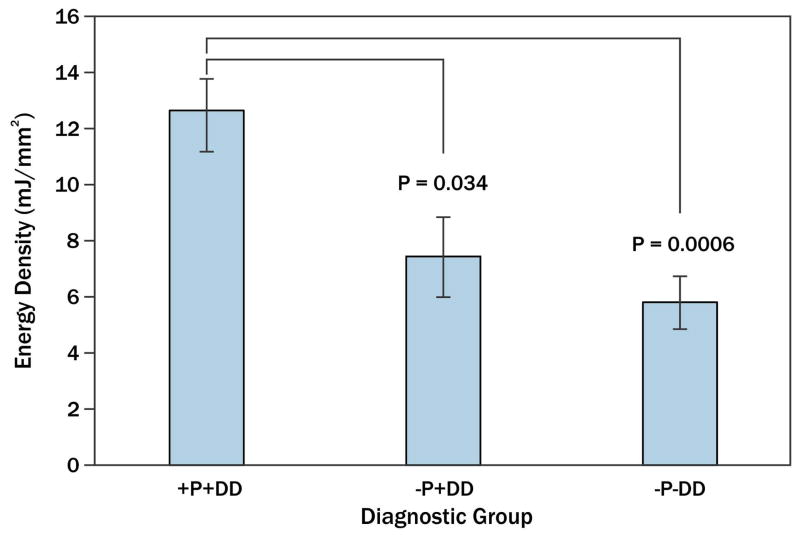
Mean±standard error energy density for the +P+DD group was 12.7±1.5 mJ/mm³ and significantly greater (all adjusted p<0.04) when compared to -P+DD (7.4±1.4 mJ/mm³) and -P-DD (5.8±0.9 mJ/mm³) groups. Energy densities in -P+DD and -P-DD groups were not significantly different.
Diagnostic group differences in energy densities suggest that mechanical work may be a unique mechanism, which contributes to cartilage fatigue in subjects with pain and disk displacement.
由于机械作用导致的软骨疲劳可能是颞下颌关节(TMJ)退行性关节疾病早熟发展的原因。本研究比较了三个诊断组颞下颌关节中的能量密度(mJ/mm³)。
68名受试者(44名女性,24名男性)签署了知情同意书。根据颞下颌关节紊乱病(DC/TMD)诊断标准及影像学检查,依据是否存在颌面部肌肉或关节疼痛(+P)以及双侧盘状移位(+DD)对受试者进行分组。
受试者(+P+DD组,n = 16;-P+DD组,n = 16;-P-DD组,n = 36)提供了锥形束计算机断层扫描和磁共振图像以及颌骨运动跟踪数据。采用数值建模来确定颞下颌关节负荷(法向力F)。运用动态立体测量法来表征10个对称闭口周期中应力场动力学的个体特异性数据。这些数据用于估计牵引力(Ftraction)。然后将能量密度计算为W/Q(W = 所做的功或机械能输入 = 牵引力×应力场平移距离,Q = 软骨体积)。采用方差分析和Tukey-Kramer事后检验分析组间差异。
+P+DD组的平均能量密度±标准误为12.7±1.5 mJ/mm³,与-P+DD组(7.4±1.4 mJ/mm³)和-P-DD组(5.8±0.9 mJ/mm³)相比,显著更高(所有校正p < 0.04)。-P+DD组和-P-DD组的能量密度无显著差异。
能量密度的诊断组差异表明,机械作用可能是导致疼痛和盘状移位患者软骨疲劳的一种独特机制。