Department of Dermatology & Allergology, University Medical Center Utrecht Utrecht, the Netherlands.
Biologics Discovery, Merck Research Laboratories Palo Alto, California.
Immun Inflamm Dis. 2015 Mar;3(1):32-43. doi: 10.1002/iid3.48. Epub 2015 Feb 16.
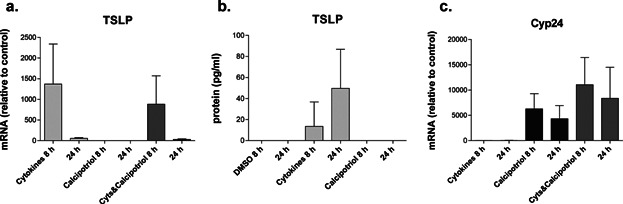
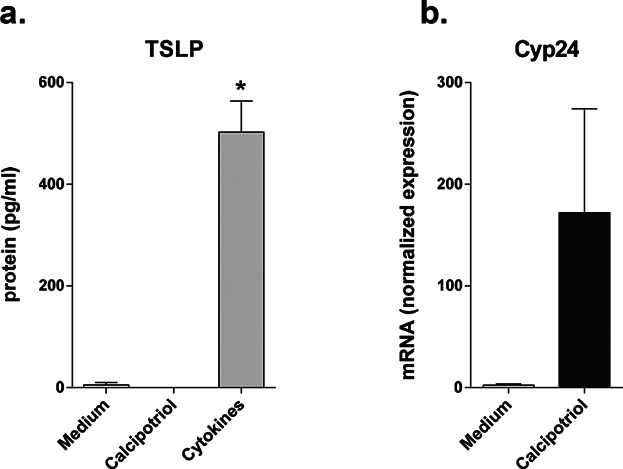
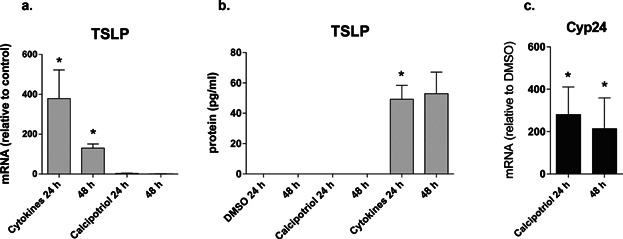
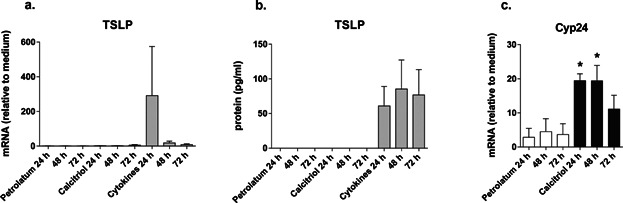
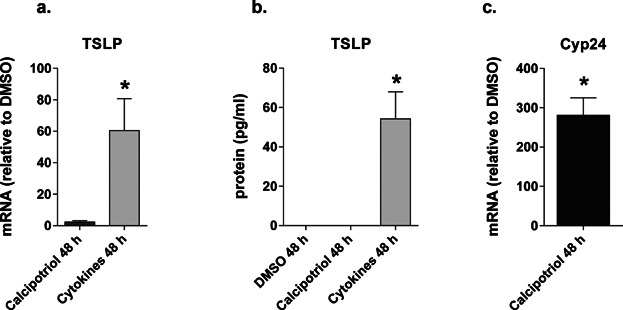
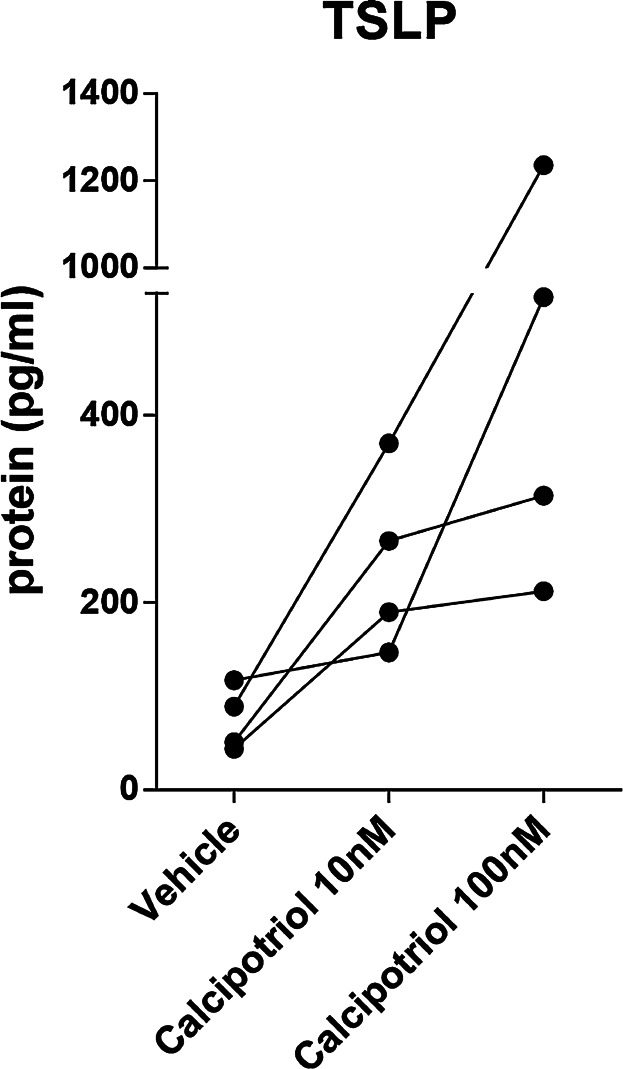
Thymic stromal lymphopoietin (TSLP) plays an important role in allergic diseases and is highly expressed in keratinocytes in human lesional atopic dermatitis (AD) skin. In nonlesional AD skin TSLP expression can be induced by applying house dust mite allergen onto the skin in the atopy patch test. Several studies have demonstrated that the induction of TSLP expression in mouse skin does not only lead to AD-like inflammation of the skin, but also predisposes to severe inflammation of the airways. In mice, TSLP expression can be induced by application of the 1,25-dihydroxyvitamin D3 (VD3) analogue calcipotriol and results in the development of eczema-like lesions. The objective is to investigate the effect of VD3 (calcitriol) or calcipotriol on TSLP expression in normal human skin and skin from AD patients. Using multiple ex vivo experimental setups, the effects of calci(po)triol on TSLP expression by normal human skin, and skin from AD patients were investigated and compared to effects of calcipotriol on mouse and non-human primates (NHP) skin. No induction of TSLP expression (mRNA or protein) was observed in human keratinocytes, normal human skin, nonlesional AD skin, or NHP skin samples after stimulation with calcipotriol or topical application of calcitriol. The biological activity of calci(po)triol in human skin samples was demonstrated by the increased expression of the VD3-responsive Cyp24a1 gene. TSLP expression was induced by cytokines (IL-4, IL-13, and TNF-α) in skin samples from all three species. In contrast to the findings in human and NHP, a consistent increase in TSLP expression was confirmed in mouse skin biopsies after stimulation with calcipotriol. VD3 failed to induce expression of TSLP in human or monkey skin in contrast to mouse, implicating careful extrapolation of this often-used mouse model to AD patients.
胸腺基质淋巴细胞生成素(TSLP)在过敏性疾病中起着重要作用,并且在人类病变特应性皮炎(AD)皮肤的角质形成细胞中高度表达。在非病变 AD 皮肤中,通过在特应性皮炎斑贴试验中将屋尘螨变应原应用于皮肤上,TSLP 表达可以被诱导。几项研究表明,在小鼠皮肤中诱导 TSLP 表达不仅导致皮肤类似 AD 的炎症,而且还容易导致气道严重炎症。在小鼠中,应用 1,25-二羟维生素 D3(VD3)类似物卡泊三醇可诱导 TSLP 表达,并导致类似湿疹的病变发展。目的是研究 VD3(骨化三醇)或卡泊三醇对正常人类皮肤和 AD 患者皮肤中 TSLP 表达的影响。使用多种离体实验装置,研究了卡泊三醇对正常人类皮肤和 AD 患者皮肤中 TSLP 表达的影响,并与卡泊三醇对小鼠和非人类灵长类动物(NHP)皮肤的影响进行了比较。用卡泊三醇或骨化三醇刺激后,未观察到人角质形成细胞、正常人类皮肤、非病变 AD 皮肤或 NHP 皮肤样本中 TSLP 表达(mRNA 或蛋白)的诱导。在人皮肤样本中,VD3 反应性 Cyp24a1 基因的表达增加证明了 calci(po)triol 的生物学活性。在来自所有三种物种的皮肤样本中,细胞因子(IL-4、IL-13 和 TNF-α)诱导 TSLP 表达。与在人类和 NHP 中的发现相反,在用卡泊三醇刺激后,在小鼠皮肤活检中证实 TSLP 表达一致增加。与小鼠相比,VD3 未能诱导人类或猴子皮肤中 TSLP 的表达,这暗示需要谨慎推断这种常用于 AD 患者的常用小鼠模型。