Gräske Johannes, Meyer Saskia, Worch Andreas, Wolf-Ostermann Karin
BMC Geriatr. 2015 Feb 25;15:14. doi: 10.1186/s12877-015-0012-5.
Shared-housing arrangements (SHA) are a German type of small-scale living arrangements for people with dementia (PwD). The involvement of family members is one core domain of SHA. But it has not been investigated yet, what are factors associated with family visits and if family involvement within SHA contributes to better residents' quality of life (QoL).
A cross-sectional study including all SHA in Berlin/Germany was performed. Main parameters of interest were residents' QoL (QUALIDEM) and frequencies of family visits within the SHA. Besides descriptive analyses we used logistic regression and ANCOVA to analyze the data.
58 SHA with 396 residents (78.4 years, 69.4% female) participated in the study. Older (OR: 1.034; 95% CI: 1.005; 1.064) and female residents (OR: 2.006; 95% CI: 1.018; 3.950) got more often visited by family members. An active participation of family members in SHA contributes on average to a better QoL in terms of social relationship and social isolation (all ANCOVA p < 0.005). A decreased QoL was found for people without family visits compared to those without family members.
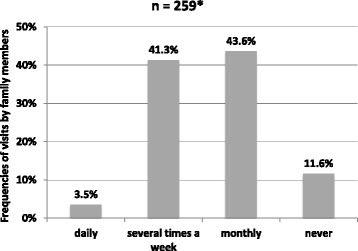
The involvement of family members in SHA is common but on a similar level compared to other care arrangements. Staff should convince available family members to visit PwD, in order to improve residents QoL. However, the response rate in the present study was about 13%, which may limit the results.
共享住房安排(SHA)是德国为痴呆症患者(PwD)提供的一种小规模居住安排形式。家庭成员的参与是SHA的一个核心领域。但尚未有人研究哪些因素与家庭探访相关,以及SHA中家庭成员的参与是否有助于提高居民的生活质量(QoL)。
对德国柏林所有的SHA进行了一项横断面研究。主要关注参数为居民的生活质量(QUALIDEM)以及SHA内家庭探访的频率。除了描述性分析外,我们还使用逻辑回归和协方差分析来分析数据。
58个SHA的396名居民(年龄78.4岁,69.4%为女性)参与了该研究。年龄较大的居民(OR:1.034;95%置信区间:1.005;1.064)和女性居民(OR:2.006;95%置信区间:1.018;3.950)更常被家庭成员探访。家庭成员积极参与SHA平均而言在社会关系和社会隔离方面有助于提高生活质量(所有协方差分析p<0.005)。与没有家庭成员的人相比,没有家庭探访的人的生活质量有所下降。
家庭成员参与SHA很常见,但与其他护理安排处于相似水平。工作人员应说服有条件的家庭成员探访痴呆症患者,以提高居民的生活质量。然而,本研究的回应率约为13%,这可能会限制研究结果。