Coccia Eliana M, Battistini Angela
Department of Infectious, Parasitic and Immune-Mediated Diseases, Istituto Superiore di Sanità, Viale Regina Elena, 299, Rome 00161, Italy.
Department of Infectious, Parasitic and Immune-Mediated Diseases, Istituto Superiore di Sanità, Viale Regina Elena, 299, Rome 00161, Italy.
Semin Immunol. 2015 Mar;27(2):85-101. doi: 10.1016/j.smim.2015.03.005. Epub 2015 Apr 11.
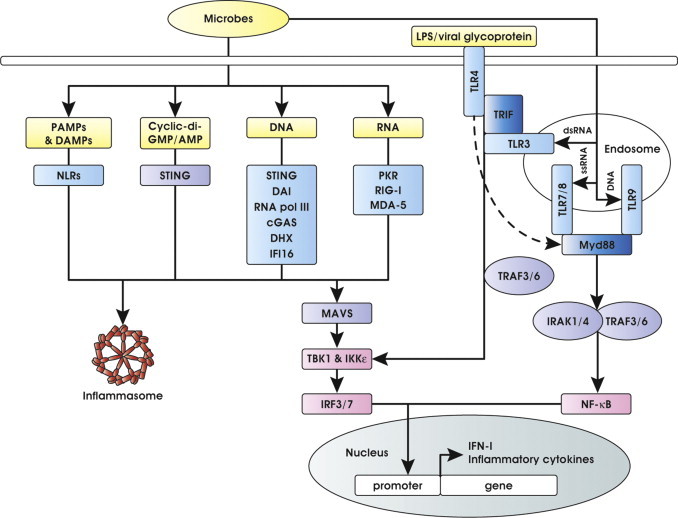
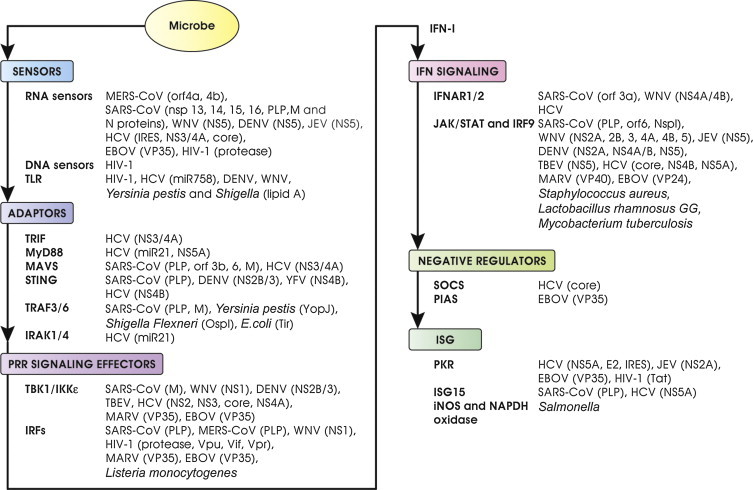
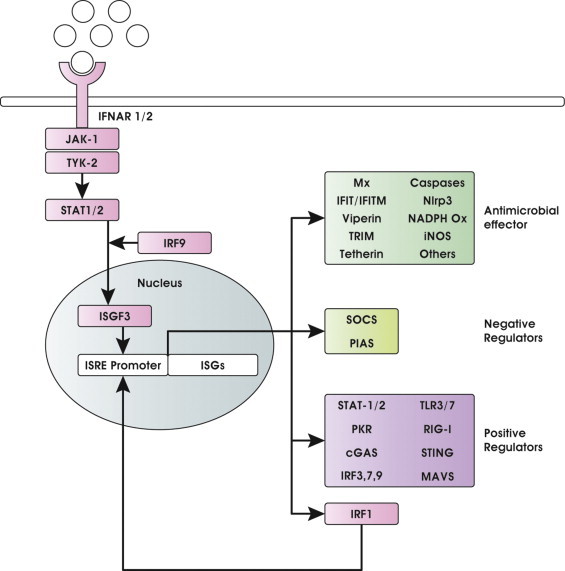
Type I interferon (IFN) comprises a class of cytokines first discovered more than 50 years ago and initially characterized for their ability to interfere with viral replication and restrict locally viral propagation. As such, their induction downstream of germ-line encoded pattern recognition receptors (PRRs) upon recognition of pathogen-associated molecular patterns (PAMPs) is a hallmark of the host antiviral response. The acknowledgment that several PAMPs, not just of viral origin, may induce IFN, pinpoints at these molecules as a first line of host defense against a number of invading pathogens. Acting in both autocrine and paracrine manner, IFN interferes with viral replication by inducing hundreds of different IFN-stimulated genes with both direct anti-pathogenic as well as immunomodulatory activities, therefore functioning as a bridge between innate and adaptive immunity. On the other hand an inverse interference to escape the IFN system is largely exploited by pathogens through a number of tactics and tricks aimed at evading, inhibiting or manipulating the IFN pathway, that result in progression of infection or establishment of chronic disease. In this review we discuss the interplay between the IFN system and some selected clinically important and challenging viruses and bacteria, highlighting the wide array of pathogen-triggered molecular mechanisms involved in evasion strategies.
I型干扰素(IFN)是一类细胞因子,50多年前首次被发现,最初因其干扰病毒复制和限制局部病毒传播的能力而被鉴定。因此,在种系编码的模式识别受体(PRR)识别病原体相关分子模式(PAMP)后,它们的诱导是宿主抗病毒反应的一个标志。认识到几种不仅来源于病毒的PAMP可能诱导IFN,这突出了这些分子作为宿主抵御多种入侵病原体的第一道防线。IFN以自分泌和旁分泌方式发挥作用,通过诱导数百种具有直接抗病原体和免疫调节活性的不同IFN刺激基因来干扰病毒复制,因此作为先天免疫和适应性免疫之间的桥梁发挥作用。另一方面,病原体通过许多旨在逃避、抑制或操纵IFN途径的策略和手段,大量利用反向干扰来逃避IFN系统,这会导致感染进展或慢性病的发生。在这篇综述中,我们讨论了IFN系统与一些选定的具有临床重要性和挑战性的病毒和细菌之间的相互作用,强调了逃避策略中涉及的多种病原体触发的分子机制。