Daly Michael, Delaney Liam, Egan Mark, Baumeister Roy F
Behavioural Science Centre, University of Stirling UCD Geary Institute, University College Dublin
Behavioural Science Centre, University of Stirling UCD Geary Institute, University College Dublin.
Psychol Sci. 2015 Jun;26(6):709-23. doi: 10.1177/0956797615569001. Epub 2015 Apr 13.
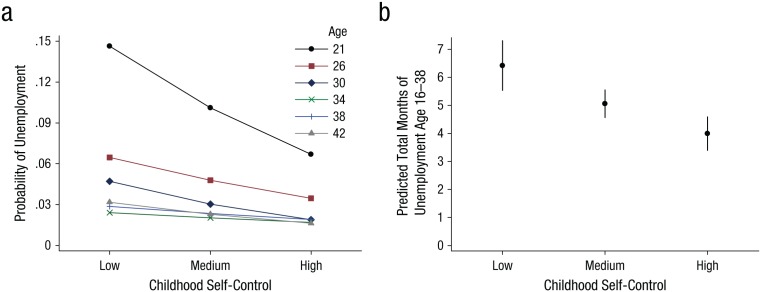
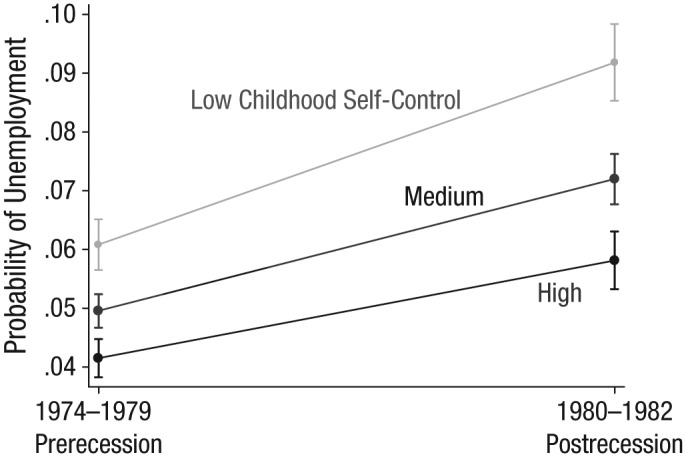
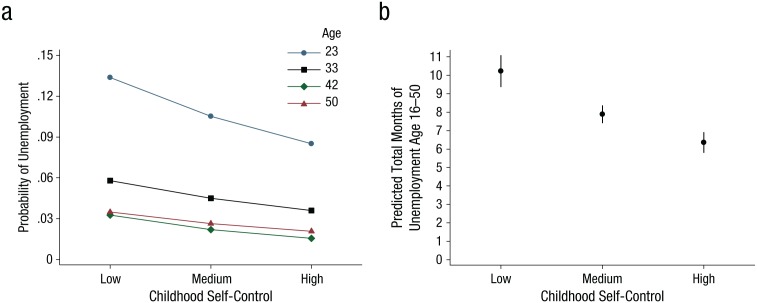
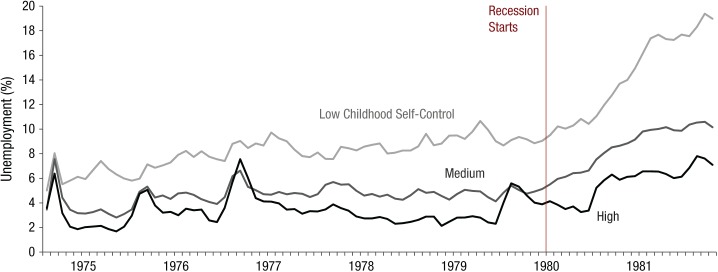
The capacity for self-control may underlie successful labor-force entry and job retention, particularly in times of economic uncertainty. Analyzing unemployment data from two nationally representative British cohorts (N = 16,780), we found that low self-control in childhood was associated with the emergence and persistence of unemployment across four decades. On average, a 1-SD increase in self-control was associated with a reduction in the probability of unemployment of 1.4 percentage points after adjustment for intelligence, social class, and gender. From labor-market entry to middle age, individuals with low self-control experienced 1.6 times as many months of unemployment as those with high self-control. Analysis of monthly unemployment data before and during the 1980s recession showed that individuals with low self-control experienced the greatest increases in unemployment during the recession. Our results underscore the critical role of self-control in shaping life-span trajectories of occupational success and in affecting how macroeconomic conditions affect unemployment levels in the population.
自我控制能力可能是成功进入劳动力市场并保住工作的基础,尤其是在经济不确定时期。通过分析来自两个具有全国代表性的英国队列(N = 16780)的失业数据,我们发现童年时期自我控制能力低与四十年来失业的出现和持续存在有关。平均而言,在对智力、社会阶层和性别进行调整后,自我控制能力每提高1个标准差,失业概率就会降低1.4个百分点。从进入劳动力市场到中年,自我控制能力低的人经历的失业月数是自我控制能力高的人的1.6倍。对20世纪80年代衰退之前和期间的月度失业数据的分析表明,自我控制能力低的人在衰退期间失业增加最多。我们的研究结果强调了自我控制在塑造职业成功的寿命轨迹以及影响宏观经济状况如何影响总体失业率方面的关键作用。