Ndong Christian, Toraya-Brown Seiko, Kekalo Katsiaryna, Baker Ian, Gerngross Tillman U, Fiering Steven N, Griswold Karl E
Thayer School of Engineering, Dartmouth, Hanover, NH, USA.
Department of Microbiology and Immunology, Geisel School of Medicine at Dartmouth, Hanover, NH, USA.
Int J Nanomedicine. 2015 Apr 1;10:2595-617. doi: 10.2147/IJN.S79367. eCollection 2015.
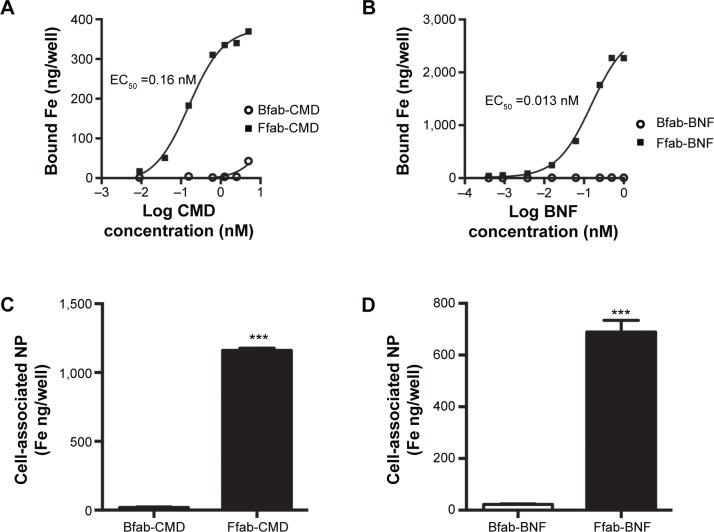
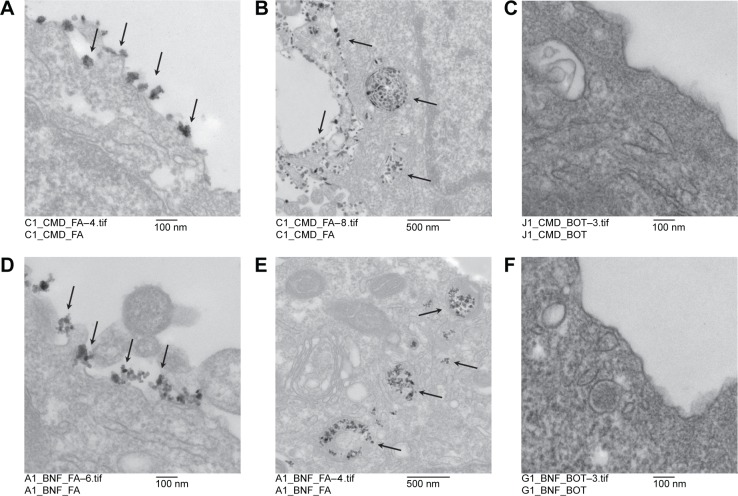
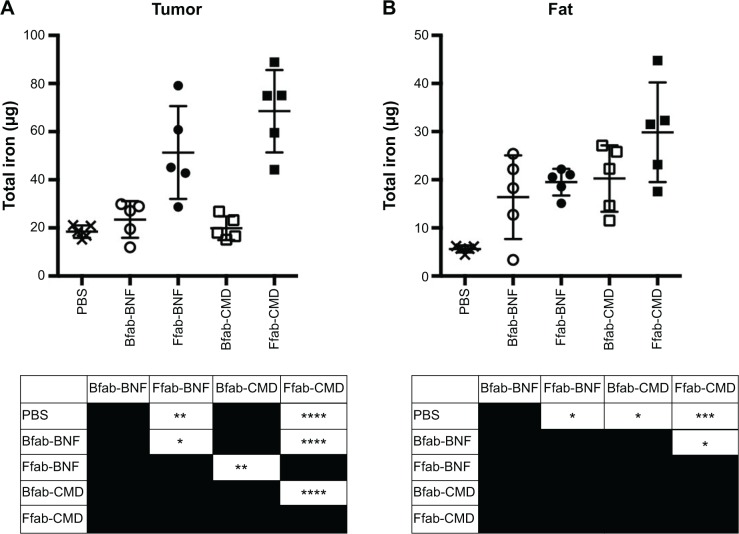
Active molecular targeting has become an important aspect of nanoparticle development for oncology indications. Here, we describe molecular targeting of iron oxide nanoparticles (IONPs) to the folate receptor alpha (FOLRα) using an engineered antibody fragment (Ffab). Compared to control nanoparticles targeting the non-relevant botulinum toxin, the Ffab-IONP constructs selectively accumulated on FOLRα-overexpressing cancer cells in vitro, where they exhibited the capacity to internalize into intracellular vesicles. Similarly, Ffab-IONPs homed to FOLRα-positive tumors upon intraperitoneal administration in an orthotopic murine xenograft model of ovarian cancer, whereas negative control particles showed no detectable tumor accumulation. Interestingly, Ffab-IONPs built with custom 120 nm nanoparticles exhibited lower in vitro targeting efficiency when compared to those built with commercially sourced 180 nm nanoparticles. In vivo, however, the two Ffab-IONP platforms achieved equivalent tumor homing, although the smaller 120 nm IONPs were more prone to liver sequestration. Overall, the results show that Ffab-mediated targeting of IONPs yields specific, high-level accumulation within cancer cells, and this fact suggests that Ffab-IONPs could have future utility in ovarian cancer diagnostics and therapy.
活性分子靶向已成为用于肿瘤适应症的纳米颗粒开发的一个重要方面。在此,我们描述了使用工程化抗体片段(Ffab)将氧化铁纳米颗粒(IONP)靶向叶酸受体α(FOLRα)。与靶向不相关肉毒杆菌毒素的对照纳米颗粒相比,Ffab-IONP构建体在体外选择性地积聚在FOLRα过表达的癌细胞上,在这些细胞中它们表现出内化到细胞内囊泡的能力。同样,在卵巢癌原位小鼠异种移植模型中腹腔注射后,Ffab-IONP归巢到FOLRα阳性肿瘤,而阴性对照颗粒未显示可检测到的肿瘤积聚。有趣的是,与用市售180 nm纳米颗粒构建的Ffab-IONP相比,用定制的120 nm纳米颗粒构建的Ffab-IONP在体外表现出较低的靶向效率。然而,在体内,尽管较小的120 nm IONP更容易被肝脏滞留,但这两种Ffab-IONP平台实现了等效的肿瘤归巢。总体而言,结果表明Ffab介导的IONP靶向在癌细胞内产生特异性、高水平的积聚,这一事实表明Ffab-IONP在卵巢癌诊断和治疗中可能具有未来应用价值。