Wyatt-Johnson Season K, Brutkiewicz Randy R
Department of Microbiology and Immunology, Stark Neurosciences Research Institute, Indiana University School of Medicine, Indianapolis, IN, United States.
Front Aging Neurosci. 2020 Nov 19;12:592359. doi: 10.3389/fnagi.2020.592359. eCollection 2020.
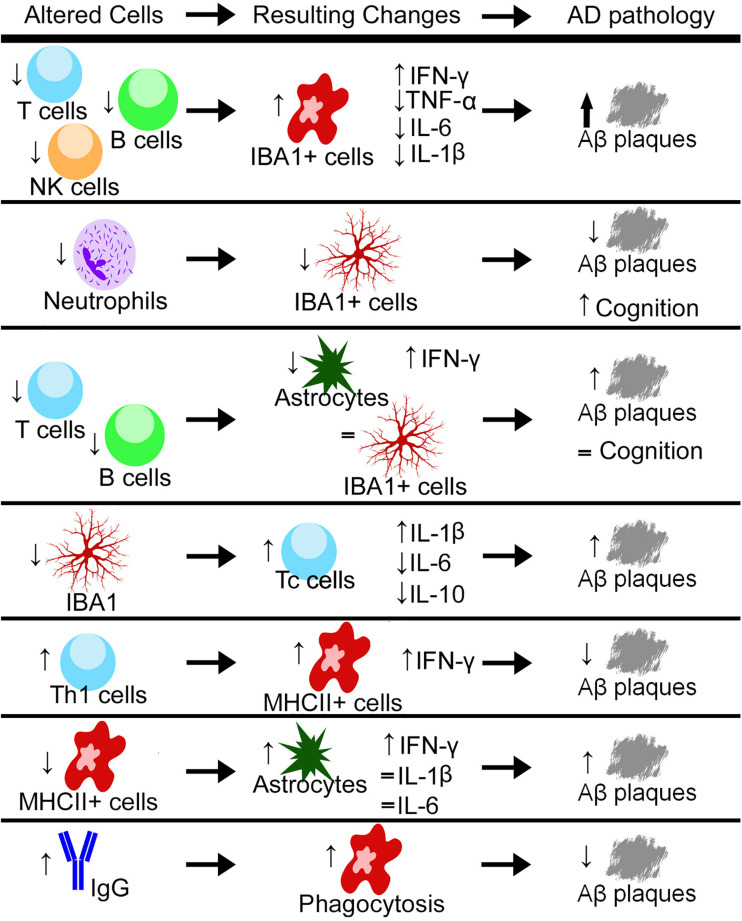
In the naïve mouse brain, microglia and astrocytes are the most abundant immune cells; however, there is a complexity of other immune cells present including monocytes, neutrophils, and lymphocytic cells, such as natural killer (NK) cells, T cells, and B cells. In Alzheimer's disease (AD), there is high inflammation, reactive microglia, and astrocytes, leaky blood-brain barrier, the buildup of amyloid-beta (Aβ) plaques, and neurofibrillary tangles which attract infiltrating peripheral immune cells that are interacting with the resident microglia. Limited studies have analyzed how these infiltrating immune cells contribute to the neuropathology of AD and even fewer have analyzed their interactions with the resident microglia. Understanding the complexity and dynamics of how these immune cells interact in AD will be important for identifying new and novel therapeutic targets. Thus, this review will focus on discussing our current understanding of how macrophages, neutrophils, NK cells, T cells, and B cells, alongside astrocytes, are altered in AD and what this means for the disorder, as well as how these cells are affected relative to the resident microglia.
在未接触抗原的小鼠大脑中,小胶质细胞和星形胶质细胞是最丰富的免疫细胞;然而,还存在其他多种免疫细胞,包括单核细胞、中性粒细胞以及淋巴细胞,如自然杀伤(NK)细胞、T细胞和B细胞。在阿尔茨海默病(AD)中,存在高度炎症、反应性小胶质细胞和星形胶质细胞、血脑屏障渗漏、β-淀粉样蛋白(Aβ)斑块堆积以及神经纤维缠结,这些会吸引浸润的外周免疫细胞,它们与驻留的小胶质细胞相互作用。有限的研究分析了这些浸润的免疫细胞如何导致AD的神经病理学变化,而分析它们与驻留小胶质细胞相互作用的研究更少。了解这些免疫细胞在AD中相互作用的复杂性和动态变化对于确定新的治疗靶点至关重要。因此,本综述将重点讨论我们目前对巨噬细胞、中性粒细胞、NK细胞、T细胞和B细胞以及星形胶质细胞在AD中如何发生改变及其对该疾病的意义的理解,以及这些细胞相对于驻留小胶质细胞是如何受到影响的。