Morgan Catherine, Novak Iona, Dale Russell C, Badawi Nadia
School of Medicine, University Of Notre Dame Australia, Darlinghurst, NSW, Australia.
Cerebral Palsy Alliance Research Institute, University of Notre Dame Australia, Darlinghurst, NSW, Australia.
BMC Pediatr. 2015 Apr 1;15:30. doi: 10.1186/s12887-015-0347-2.
The average age for the diagnosis of cerebral palsy (CP) is 19 months. Recent neuroplasticity literature suggests that intensive, task-specific intervention ought to commence as early as possible and in an enriched environment, during the critical period of neural development. Active motor interventions are effective in some populations, however the effects of active motor interventions on the motor outcomes of infants with CP have not been researched thoroughly, but pilot work is promising. The aim of this study was to determine the short- term effects of "GAME"; a new and novel goal-oriented activity-based, environmental enrichment therapy programme on the motor development of infants at high risk of CP and test study procedures for a randomized controlled trial (RCT).
Pragmatic 2-group pilot RCT to assess motor outcomes, goal attainment, parent well-being and home environment quality, after 12-weeks of GAME intervention versus standard care. GAME included: creation of movement environments to elicit motor behaviours; parent training in motor learning and task analysis; frequent practice of motor tasks using a programme that was individualised to the child, was varied and focused on self-initiated movement. Data were analyzed using multiple regression.
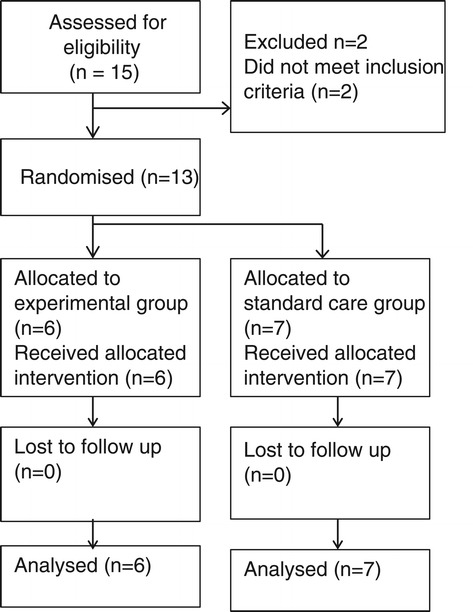
Thirteen infants were consented, randomised, treated and completed the study. At study conclusion, the GAME group (n = 6) demonstrated an advantage in Total Motor Quotient of 8.05 points on the Peabody Developmental Motor Scale-2 (PDMS-2) compared to the standard care group (n = 7) (p < .001). No significant differences existed between groups on any other measure.
GAME appears to offer a promising and feasible new motor intervention for CP, with favourable short-term motor outcomes. A pressing need exists for an adequately powered RCT with long-term end points, to determine if GAME may advance these children's motor trajectory.
脑瘫(CP)的平均诊断年龄为19个月。近期神经可塑性文献表明,在神经发育的关键期,强化的、针对特定任务的干预应尽早在丰富的环境中开始。主动运动干预在某些人群中是有效的,然而,主动运动干预对CP婴儿运动结局的影响尚未得到充分研究,但初步工作很有前景。本研究的目的是确定“GAME”(一种新的、以目标为导向的基于活动的环境丰富治疗方案)对CP高危婴儿运动发育的短期影响,并测试随机对照试验(RCT)的研究程序。
进行务实的两组试点RCT,以评估在接受12周的GAME干预与标准护理后,运动结局、目标达成情况、家长幸福感和家庭环境质量。GAME包括:创建运动环境以引发运动行为;对家长进行运动学习和任务分析培训;使用针对儿童个体化、多样化且专注于自主运动的方案频繁练习运动任务。数据采用多元回归分析。
13名婴儿同意参与、被随机分组、接受治疗并完成了研究。在研究结束时,与标准护理组(n = 7)相比,GAME组(n = 6)在皮博迪发育运动量表-2(PDMS-2)上的总运动商数优势为8.05分(p <.001)。在其他任何测量指标上,两组之间均无显著差异。
GAME似乎为CP提供了一种有前景且可行的新运动干预方法,具有良好的短期运动结局。迫切需要进行一项具有足够样本量且有长期终点的RCT,以确定GAME是否可以改善这些儿童的运动轨迹。