Queensland Cerebral Palsy and Rehabilitation Research Centre, Child Health Research Centre, The University of Queensland, Brisbane, Queensland, Australia.
Cerebral Palsy Alliance Research Institute, Discipline of Child and Adolescent Health, The University of Sydney, Sydney, New South Wales, Australia.
BMJ Open. 2018 Jun 22;8(6):e021186. doi: 10.1136/bmjopen-2017-021186.
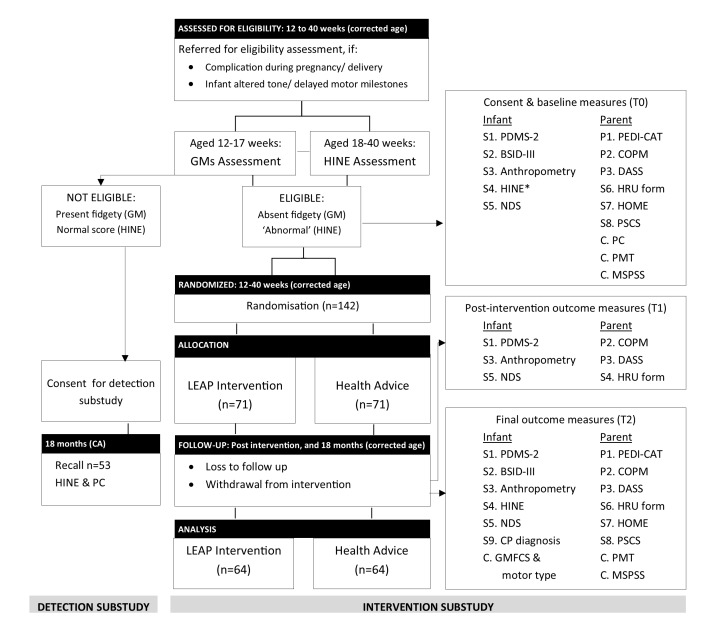
Cerebral palsy (CP) is the most common childhood physical disability, with 80% estimated to be in low-middle-income countries. This study aims to (1) determine the accuracy of General Movements (GMs)/Hammersmith Infant Neurological Examination (HINE) for detecting CP at 18 months corrected age (CA); (2) determine the effectiveness of a community-based parent-delivered early intervention for infants at high risk of CP in West Bengal, India (Learning through Everyday Activities with Parents for infants with CP; LEAP-CP).
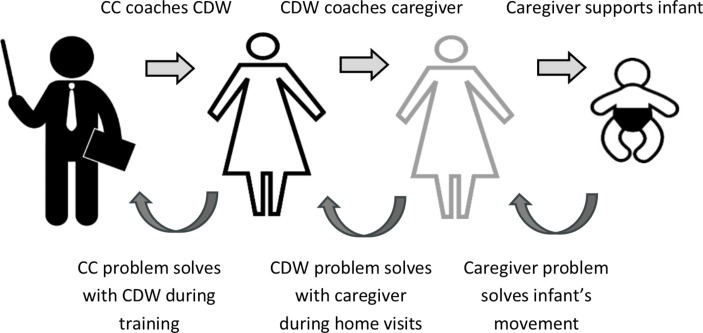
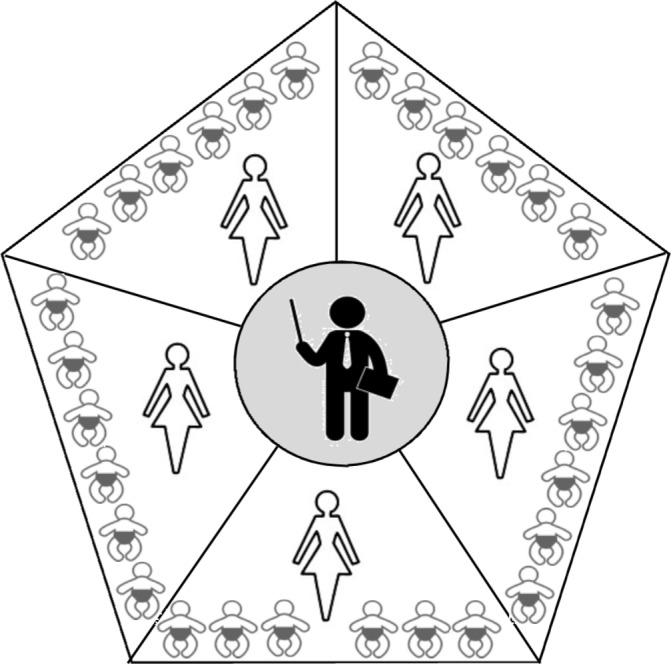
This study comprises two substudies: (1) a study of the predictive validity of the GMs and HINE for detecting CP; (2) randomised, double-blinded controlled trial of a novel intervention delivered through peer trainers (Community Disability Workers, CDW) compared with health advice (15 fortnightly visits). 142 infants at high risk of CP ('absent fidgety' GMs; 'high risk score' on HINE) aged 12-40 weeks CA will be recruited to the intervention substudy, with infants randomised based on a computer-generated sequence. Researchers will be masked to group allocation, and caregivers and CDWs naïve to intervention status. Visits will include therapeutic modules (goal-directed active motor/cognitive strategies and LEAP-CP games) and parent education. Health advice is based on the Integrated Management of Childhood Illness, WHO. Infants will be evaluated at baseline, post intervention and 18 months CA. The primary hypothesis is that infants receiving LEAP-CP will have greater scaled scores on the Pediatric Evaluation of Disability Inventory-Computer Adaptive Test (mobility domain) at 18 months compared with health advice. Secondary outcomes include infant functional motor, cognitive, visual and communication development; infant growth; maternal mental health.
This study is approved through appropriate Australian and Indian ethics committees (see in text) with families providing written informed consent. Findings from this trial will be disseminated through peer-reviewed journal publications and conference presentations.
12616000653460p; Pre-results.
脑瘫(CP)是最常见的儿童身体残疾,据估计,80%的脑瘫发生在中低收入国家。本研究旨在:(1)确定一般运动(GMs)/哈默史密斯婴儿神经检查(HINE)在 18 个月校正年龄(CA)时检测脑瘫的准确性;(2)确定在印度西孟加拉邦对脑瘫高危婴儿进行基于社区的家长提供的早期干预(通过与父母一起进行日常活动学习治疗脑瘫;LEAP-CP)的效果。
本研究包括两项子研究:(1)GMs 和 HINE 预测脑瘫的效价研究;(2)一项新干预措施(通过同伴培训师(社区残疾工作者,CDW)提供)与健康建议(15 次双周访问)的随机、双盲对照试验。将招募 142 名脑瘫高危婴儿(GMs“烦躁不安”;HINE“高风险评分”)入组干预子研究,根据计算机生成的序列对婴儿进行随机分组。研究人员将对分组分配进行盲法,照顾者和 CDW 对干预状态不知情。访视将包括治疗模块(有针对性的主动运动/认知策略和 LEAP-CP 游戏)和家长教育。健康建议基于世卫组织《儿童期疾病综合管理》。婴儿将在基线、干预后和 18 个月 CA 时进行评估。主要假设是接受 LEAP-CP 的婴儿在 18 个月时在残疾儿童评估量表-计算机自适应测试(运动领域)的评分量表上得分更高,与健康建议相比。次要结局包括婴儿功能运动、认知、视觉和交流发育;婴儿生长;产妇心理健康。
本研究已通过适当的澳大利亚和印度伦理委员会批准(见正文),并得到了家庭的书面知情同意。这项试验的结果将通过同行评议的期刊发表和会议报告传播。
12616000653460p;预结果。