Department of Respiratory Medicine, The Second Affiliated Hospital, Dalian Medical University, Dalian, China.
Department of Respiratory Medicine, The North Area of Suzhou Municipal Hospital, Suzhou, China.
Cancer Med. 2018 Feb;7(2):325-335. doi: 10.1002/cam4.1292. Epub 2018 Jan 22.
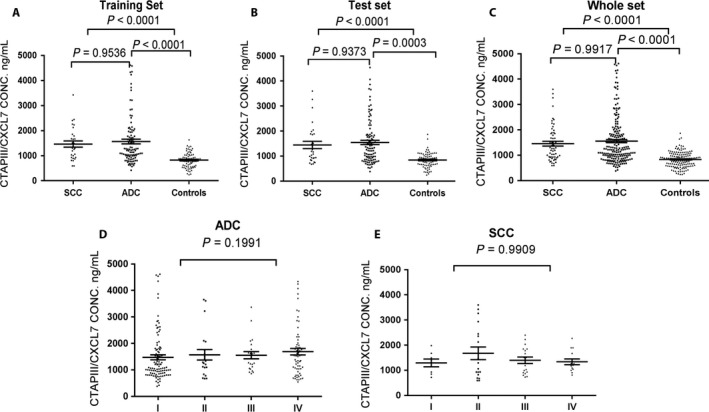
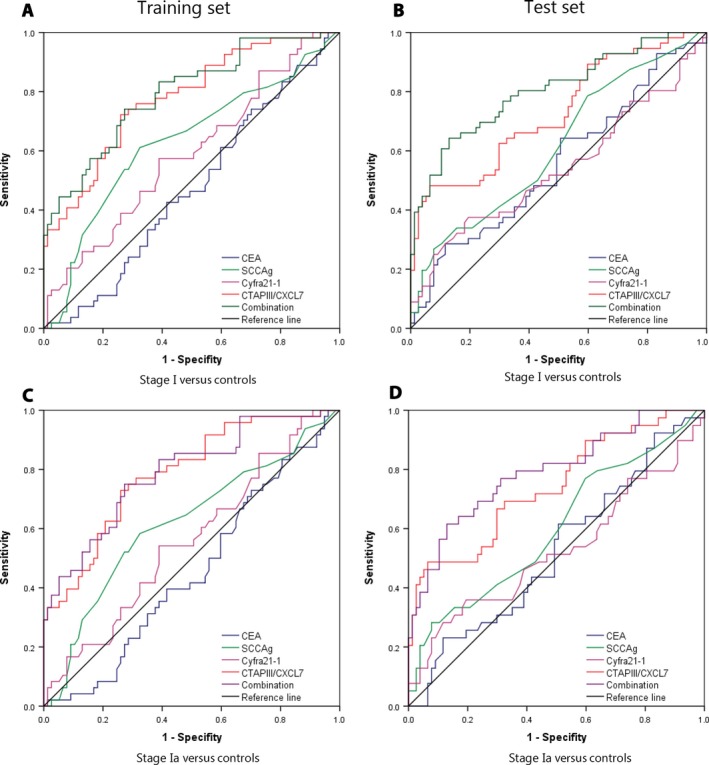
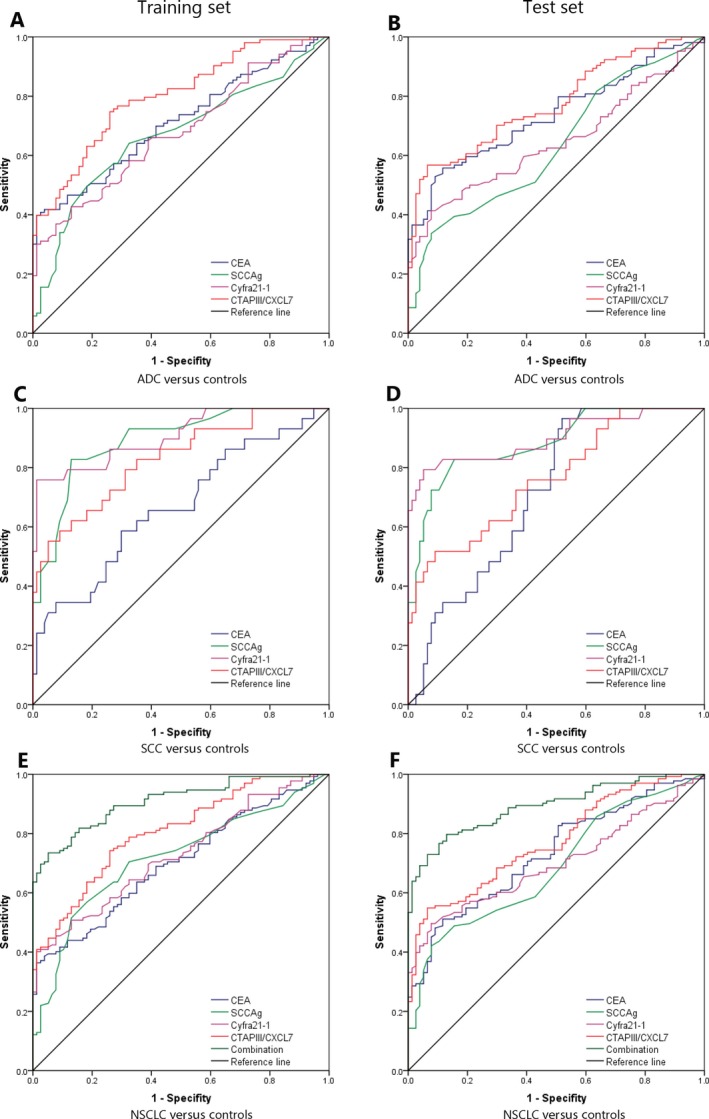
It is desirable to have a biomarker which can facilitate low-dose CT in diagnosis of early stage lung cancer. CTAPIII/CXCL7 is reported to be a potential biomarker for diagnosis of early lung cancer. In this study, we investigated the serum level of CTAPIII/CXCL7 in patients at different stage of lung cancer and the diagnostic efficacy of CTAPIII/CXCL7 in NSCLC. The plasma level of CTAPIII/CXCL7 was assayed by ELISA. CEA, SCCAg, and Cyfra211 were measured using a commercial chemiluminescent microparticle immunoassay. A total of 419 subjects were recruited, including 265 NSCLC patients and 154 healthy individuals. The subjects were randomly assigned to a training set and a test set. Receiver operating characteristic (ROC) and binary logistic regression analyses were conducted to evaluate the diagnostic efficacy and establish diagnostic mathematical model. Plasma CTAPIII/CXCL7 levels were significantly higher in NSCLC patients than in controls, which was independent of the stage of NSCLC. The diagnostic efficiency of CTAPIII/CXCL7 in NSCLC (training set: area under ROC curve (AUC) 0.806, 95% CI: 0.748-0.863; test set: AUC 0.773, 95% CI: 0.711-0.835) was greater than that of SCCAg, Cyfra21-1, or CEA. The model combining CTAPIII/CXCL7 with CEA, SCCAg, and Cyfra21-1 was more effective for NSCLC diagnosis than CTAPIII/CXCL7 alone. In addition, plasma level of CTAPIII/CXCL7 may contribute to the early diagnosis of NSCLC. CTAPIII/CXCL7 can be used as a plasma biomarker for the diagnosis of NSCLCs, particularly early stage lung cancer, with relatively high sensitivity and specificity.
理想情况下,我们希望有一种生物标志物可以帮助进行低剂量 CT 以诊断早期肺癌。CTAPIII/CXCL7 被报道为诊断早期肺癌的潜在生物标志物。在这项研究中,我们研究了不同阶段肺癌患者的血清 CTAPIII/CXCL7 水平,以及 CTAPIII/CXCL7 对非小细胞肺癌(NSCLC)的诊断效果。通过 ELISA 检测 CTAPIII/CXCL7 的血浆水平。使用商业化学发光微粒子免疫测定法测量 CEA、SCCAg 和 Cyfra211。共招募了 419 名受试者,包括 265 名 NSCLC 患者和 154 名健康个体。将受试者随机分配到训练集和测试集中。进行接收者操作特征(ROC)和二元逻辑回归分析以评估诊断效果并建立诊断数学模型。与对照组相比,NSCLC 患者的血浆 CTAPIII/CXCL7 水平显著升高,且与 NSCLC 的分期无关。CTAPIII/CXCL7 在 NSCLC 中的诊断效率(训练集:ROC 曲线下面积(AUC)为 0.806,95%CI:0.748-0.863;测试集:AUC 为 0.773,95%CI:0.711-0.835)大于 SCCAg、Cyfra21-1 或 CEA。与单独使用 CTAPIII/CXCL7 相比,将 CTAPIII/CXCL7 与 CEA、SCCAg 和 Cyfra21-1 相结合的模型更有利于 NSCLC 的诊断。此外,CTAPIII/CXCL7 血浆水平可能有助于 NSCLC 的早期诊断。CTAPIII/CXCL7 可作为 NSCLC 的血浆生物标志物,用于诊断 NSCLC,尤其是早期肺癌,具有较高的灵敏度和特异性。