Pan Yu, Zhang Ji, Shen Tao, Zhao Yan-Li, Wang Yuan-Zhong, Li Wan-Yi
Institute of Medicinal Plants, Yunnan Academy of Agricultural Sciences, 2238, Beijing Road, Panlong District, Kunming, 650200, China.
College of Traditional Chinese Medicine, Yunnan University of Traditional Chinese Medicine, Kunming, 650500, China.
BMC Biochem. 2015 Mar 28;16:9. doi: 10.1186/s12858-015-0038-5.
Gentiana rhodantha, a rich source of iridoids and polyphenols, is a traditional ethnomedicine widely used in China. Metabolic fingerprinting based on a LC-UV-MS/MS method was applied to explore the chemical markers for discrimination of G. rhodantha from different geographical origins.
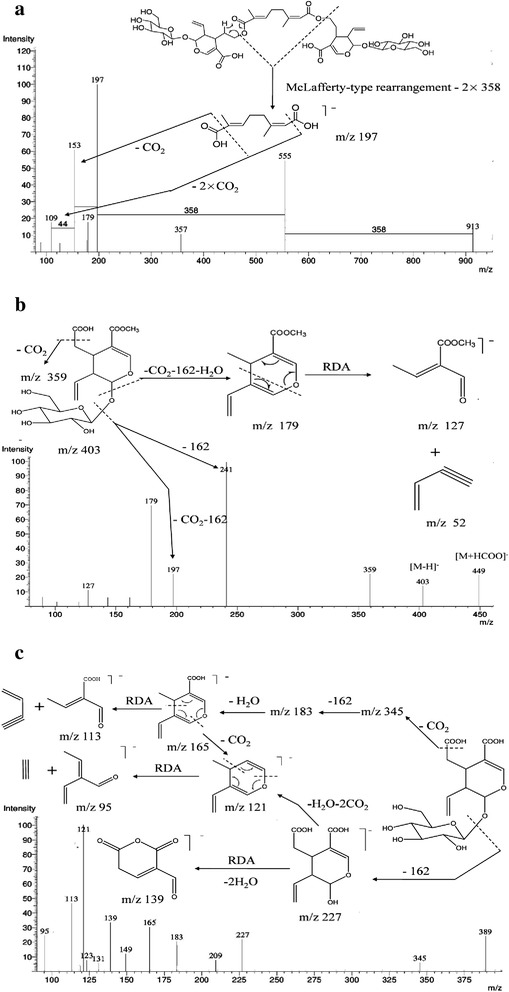
Targeted compounds were separated on a Shim-pack XR-ODS III (150 × 2.0 mm, 2.2 μm), with a mobile phase consisted of acetonitrile and 0.1% formic acid in water, under gradient elution. In quantitative analysis, all of the calibration curves showed good linear regression (R(2) < less than 0.9991) within the tested ranges, and accuracy ranged from 97.8% to 104.2% and the %RSD of precision (less than 3%) were all within the required limits. The most abundant mangiferin (82.21 mg/g) found in sample from Zunyi, Guizhou province. Furthermore, 64 samples according to their geographical origins, could be classified by partial least-squares discriminate analysis (PLS-DA) and nine compounds including two new compounds identified by mass spectrometry could be regarded as characteristic compounds for discriminating samples from different geographical origins.
The developed method appears to be a useful tool for analysis of G. rhodantha, which could provide potential indicators for differentiation of different geographical origins.
滇龙胆富含环烯醚萜类化合物和多酚类化合物,是中国广泛使用的一种传统民族药物。基于液相色谱 - 紫外 - 串联质谱法的代谢指纹图谱被用于探索区分不同地理来源滇龙胆的化学标志物。
目标化合物在Shim-pack XR-ODS III(150×2.0 mm,2.2 μm)色谱柱上分离,流动相由乙腈和0.1%甲酸水溶液组成,采用梯度洗脱。在定量分析中,所有校准曲线在测试范围内均显示出良好的线性回归(R²小于0.9991),准确度在97.8%至104.2%之间,精密度的相对标准偏差(小于3%)均在规定范围内。在贵州遵义的样品中发现含量最高的芒果苷(82.21 mg/g)。此外,根据地理来源对64个样品进行偏最小二乘判别分析(PLS-DA)分类,包括两种通过质谱鉴定的新化合物在内的9种化合物可被视为区分不同地理来源样品的特征化合物。
所建立的方法似乎是分析滇龙胆的一种有用工具,可为区分不同地理来源提供潜在指标。