van der Velden Maarten, Rijpma Sanna R, Russel Frans G M, Sauerwein Robert W, Koenderink Jan B
Department of Pharmacology and Toxicology, Radboud University Medical Center, Nijmegen, The Netherlands.
Department of Medical Microbiology, Radboud University Medical Center, Nijmegen, The Netherlands.
Malar J. 2015 Feb 14;14:76. doi: 10.1186/s12936-015-0581-y.
Membrane-associated ATP binding cassette (ABC) transport proteins hydrolyze ATP in order to translocate a broad spectrum of substrates, from single ions to macromolecules across membranes. In humans, members from this transport family have been linked to drug resistance phenotypes, e.g., tumour resistance by enhanced export of chemotherapeutic agents from cancer cells due to gene amplifications or polymorphisms in multidrug resistance (MDR) protein 1. Similar mechanisms have linked the Plasmodium falciparum PfMDR1 transporter to anti-malarial drug resistance acquisition. In this study, the possible involvement of two related MDR proteins, PfMDR2 and PfMDR5, to emerging drug resistance is investigated by a reverse genetics approach.
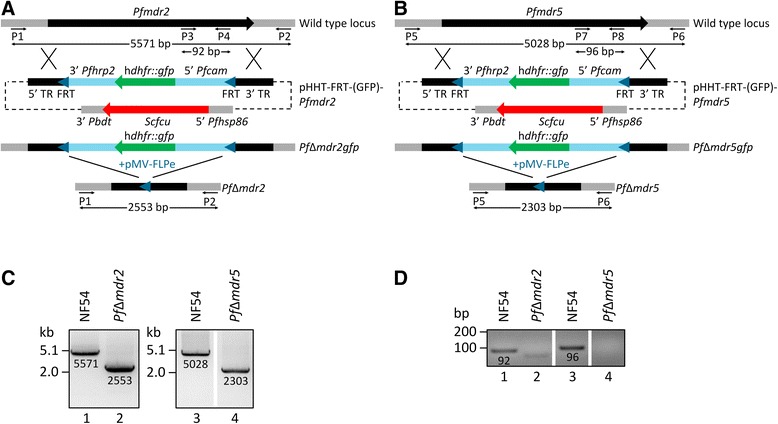
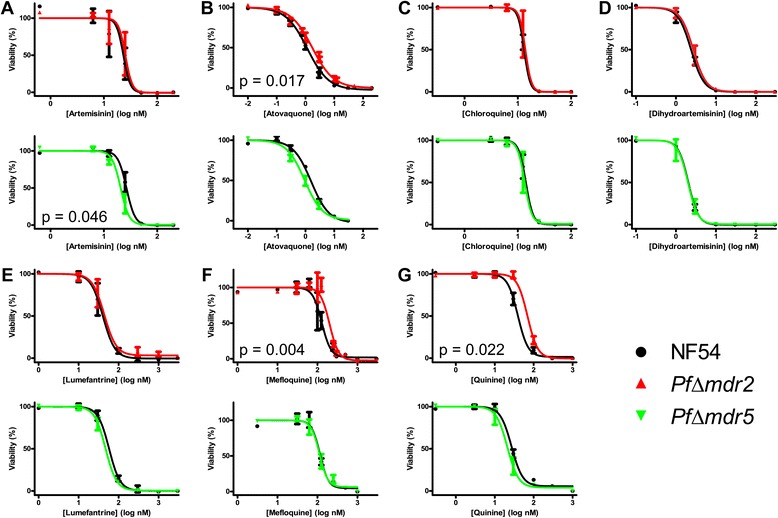
A homologous double crossover strategy was used to generate P. falciparum parasites lacking the Pfmdr2 (PfΔmdr2) or Pfmdr5 (PfΔmdr5) gene. Plasmodium lactate dehydrogenase activity was used as read-out for sensitivity to artemisinin (ART), atovaquone (ATO), dihydroartemisinin (DHA), chloroquine (CQ), lumefantrine (LUM), mefloquine (MQ), and quinine (QN). Differences in half maximal inhibitory concentration (IC₅₀) values between wild type and each mutant line were determined using a paired t-test.
Both PfΔmdr2 and PfΔmdr5 clones were capable of asexual multiplication. Upon drug exposure, PfΔmdr2 showed a marginally decreased sensitivity to ATO (IC₅₀ of 1.2 nM to 1.8 nM), MQ (124 nM to 185 nM) and QN (40 nM to 70 nM), as compared to wild type (NF54) parasites. On the other hand, PfΔmdr5 showed slightly increased sensitivity to ART (IC₅₀ of 26 nM to 19 nM).
Both Pfmdr2 and Pfmdr5 are dispensable for blood stage development while the deletion lines show altered sensitivity profiles to commonly used anti-malarial drugs. The findings show for the first time that next to PfMDR2, the PfMDR5 transport protein could play a role in emerging drug resistance.
膜相关ATP结合盒(ABC)转运蛋白水解ATP,以便跨膜转运从单离子到大分子等广泛的底物。在人类中,这个转运家族的成员与耐药表型有关,例如,由于多药耐药(MDR)蛋白1的基因扩增或多态性导致癌细胞中化疗药物的输出增强,从而产生肿瘤耐药性。类似的机制已将恶性疟原虫PfMDR1转运蛋白与抗疟药物耐药性的获得联系起来。在本研究中,通过反向遗传学方法研究了两种相关的MDR蛋白PfMDR2和PfMDR5与新出现的耐药性的可能关联。
采用同源双交换策略来产生缺乏Pfmdr2(PfΔmdr2)或Pfmdr5(PfΔmdr5)基因的恶性疟原虫。疟原虫乳酸脱氢酶活性用作对青蒿素(ART)、阿托伐醌(ATO)、双氢青蒿素(DHA)、氯喹(CQ)、本芴醇(LUM)、甲氟喹(MQ)和奎宁(QN)敏感性的读出指标。使用配对t检验确定野生型和每个突变株之间半数最大抑制浓度(IC₅₀)值的差异。
PfΔmdr2和PfΔmdr5克隆均能够进行无性繁殖。在药物暴露后,与野生型(NF54)疟原虫相比,PfΔmdr2对ATO(IC₅₀从1.2 nM降至1.8 nM)、MQ(从124 nM降至185 nM)和QN(从40 nM降至70 nM)的敏感性略有降低。另一方面,PfΔmdr5对ART的敏感性略有增加(IC₅₀从26 nM降至19 nM)。
Pfmdr2和Pfmdr5对于血液阶段的发育都是可有可无的,而缺失株对常用抗疟药物的敏感性谱发生了改变。研究结果首次表明,除了PfMDR2之外,PfMDR5转运蛋白可能在新出现的耐药性中起作用。