Power Thomas G, Hughes Sheryl O, Goodell L Suzanne, Johnson Susan L, Duran J Andrea Jaramillo, Williams Kimberly, Beck Ashley D, Frankel Leslie A
Washington State University, Pullman, WA, USA.
Children's Nutrition Research Center, Baylor College of Medicine, 1100 Bates, Houston, TX, 77030-2600, USA.
Int J Behav Nutr Phys Act. 2015 Mar 7;12:34. doi: 10.1186/s12966-015-0179-3.
Despite a growing consensus on the feeding practices associated with healthy eating patterns, few observational studies of maternal feeding practices with young children have been conducted, especially in low-income populations. The aim of this study was to provide such data on a low income sample to determine the degree to which observed maternal feeding practices compare with current recommendations.
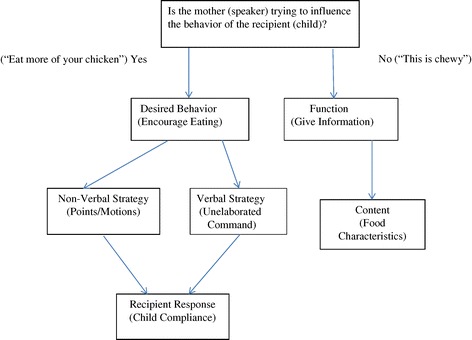
Eighty low-income mothers and their preschool children were videotaped at dinner in their homes. Mothers were chosen from a larger study to create a 2 X 2 X 2 design: maternal ethnicity (African American vs. Latina) by child gender by child weight status (healthy weight vs. overweight/obese). Observers coded videotapes for a range of maternal feeding strategies and other behaviors.
Many mothers spent considerable time encouraging eating--often in spite of the child's insistence that he or she was finished. Mothers talked little about food characteristics, rarely referred to feelings of hunger and fullness, and made more attempts to enforce table manners than to teach eating skills. Latina mothers showed higher levels of teaching eating skills and encouraging their children to eat; African American mothers showed higher levels of enforcing table manners and getting children to clear their plates. Mothers of boys used more unelaborated commands and less questions/suggestions than mothers of girls. Finally, compared to mothers of overweight/obese children, mothers of healthy weight children showed higher levels of encouraging eating and lower levels of discouraging eating.
Most of the mothers in this study did not engage in feeding practices that are consistent with current recommendations. They did this, despite the fact that they knew they were being observed. These results should be used to inform future research about the motivations behind mothers' feeding practices and the development of interventions by helping identify areas in greatest need of change.
尽管对于与健康饮食模式相关的喂养方式已达成越来越多的共识,但针对母亲对幼儿的喂养方式所开展的观察性研究却很少,尤其是在低收入人群中。本研究的目的是提供关于低收入样本的此类数据,以确定观察到的母亲喂养方式与当前建议的相符程度。
80位低收入母亲及其学龄前儿童在自家晚餐时被录像。母亲们是从一项规模更大的研究中挑选出来的,以形成2×2×2设计:母亲种族(非裔美国人与拉丁裔)×孩子性别×孩子体重状况(健康体重与超重/肥胖)。观察者对录像带中一系列母亲的喂养策略及其他行为进行编码。
许多母亲花费大量时间鼓励孩子进食——通常不顾孩子坚持表示自己已吃完。母亲们很少谈论食物特性,很少提及饥饿和饱腹感,且更多地尝试强化餐桌礼仪而非教授进食技巧。拉丁裔母亲在教授进食技巧和鼓励孩子进食方面表现出更高水平;非裔美国母亲在强化餐桌礼仪和让孩子清理餐盘方面表现出更高水平。男孩的母亲比女孩的母亲使用更多简单的指令,提出的问题/建议更少。最后,与超重/肥胖孩子的母亲相比,健康体重孩子的母亲在鼓励进食方面表现出更高水平,在阻碍进食方面表现出更低水平。
本研究中的大多数母亲并未采用与当前建议相符的喂养方式。尽管她们知道自己正在被观察,但仍这样做。这些结果应用于为未来关于母亲喂养方式背后的动机以及干预措施制定的研究提供信息,帮助确定最需要改变的领域。