Kihu Simon M, Gachohi John M, Ndungu Eunice K, Gitao George C, Bebora Lily C, John Njenga M, Wairire Gidraph G, Maingi Ndichu, Wahome Raphael G, Ireri Ricky
Faculty of Veterinary Medicine, University of Nairobi, PO Box 29053-00625, Uthiru, Kenya.
Vetworks Eastern Africa, PO Box 10431-00200, Nairobi, Kenya.
BMC Vet Res. 2015 Apr 8;11:87. doi: 10.1186/s12917-015-0401-1.
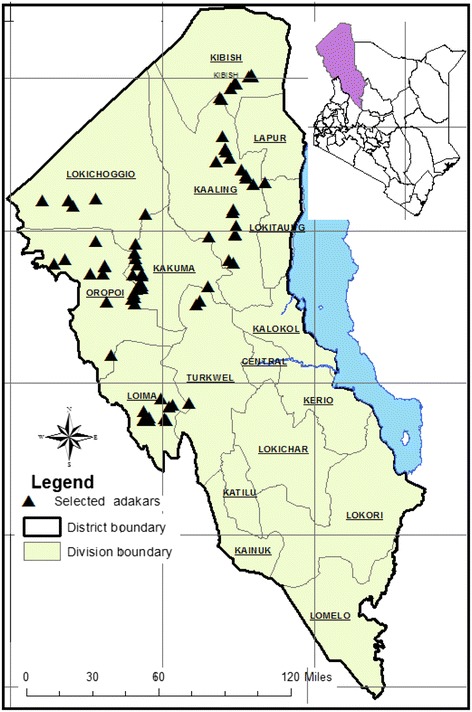
Peste des petits ruminants (PPR) is a contagious viral disease of small ruminants. Serum samples from sheep (n = 431) and goats (n = 538) of all ages were collected in a cross-sectional study in Turkana County, Kenya. The objective was to estimate the sero-prevalence of PPR virus (PPRV) infection and associated risk factors in both species. PPRV competitive enzyme-linked immuno-sorbent assay (c-ELISA) analysed the presence of antibodies in the samples. All analyses were conducted for each species separately. Multivariable logistic regression models were fitted to the data to assess the relationship between the risk factors and PPRV sero-positivity. Mixed-effect models using an administrative sub-location as a random effect were also fitted to adjust for possible clustering of PPRV sero-positivity. Intra-cluster correlation coefficients (ρ) that described the degree of similarity among sero-positive responses for each species in each of the six administrative divisions were estimated.
Goats had a significantly higher sero-prevalence of 40% [95% confidence interval (CI): 36%, 44%] compared to sheep with 32% [95% CI: 27%, 36%] (P = 0.008). Combined sero-prevalence estimates were heterogeneous across administrative divisions (n = 6) (range 22% to 65%) and even more across sub-locations (n = 46) (range 0% to 78%). Assuming that PPRV antibodies are protective of infection, a large pool of PPRV susceptible middle age group (>6 months and < 24 months) in both species was estimated. This was based on the low sero-prevalence in this group in goats (14% [95% CI: 10%, 20%]) and in sheep (18% [95% CI: 13%, 25%]). Regression analysis returned significant risk factors across species: in sheep - vaccination status, age and administrative division; in goats - sex, age, administrative division and sex*age interaction. The intra-sub-location correlation coefficients varied widely across divisions (range <0.001 to 0.42) and across species within divisions.
Biological, spatial and socio-ecological factors are hypothesized as possible explanations for variation in PPRV sero-positivity in the Turkana pastoral ecosystem.
小反刍兽疫(PPR)是小反刍动物的一种传染性病毒病。在肯尼亚图尔卡纳县开展的一项横断面研究中,收集了各年龄段绵羊(n = 431)和山羊(n = 538)的血清样本。目的是估计PPR病毒(PPRV)感染在这两个物种中的血清流行率以及相关风险因素。通过PPRV竞争酶联免疫吸附测定(c-ELISA)分析样本中抗体的存在情况。所有分析均分别针对每个物种进行。对数据拟合多变量逻辑回归模型,以评估风险因素与PPRV血清阳性之间的关系。还拟合了以行政子区域为随机效应的混合效应模型,以调整PPRV血清阳性可能存在的聚集情况。估计了六个行政区中每个物种血清阳性反应之间相似程度的聚类内相关系数(ρ)。
山羊的血清流行率显著更高,为40%[95%置信区间(CI):36%,44%]。相比之下,绵羊的血清流行率为32%[95%CI:27%,36%](P = 0.008)。各行政区(n = 6)的综合血清流行率估计值存在异质性(范围为22%至65%),在子区域(n = 46)中甚至差异更大(范围为0%至78%)。假设PPRV抗体具有抗感染保护作用,估计两个物种中都有大量PPRV易感的中年组(>6个月且<24个月)。这是基于该组山羊(14%[95%CI:10%,20%])和绵羊(18%[95%CI:13%,25%])的低血清流行率得出的。回归分析得出了两个物种的显著风险因素:绵羊方面——疫苗接种状况、年龄和行政区;山羊方面——性别、年龄、行政区以及性别*年龄交互作用。子区域内相关系数在各行政区之间差异很大(范围<0.001至0.42),且在行政区内的不同物种之间也存在差异。
生物学、空间和社会生态因素被假定为图尔卡纳牧区生态系统中PPRV血清阳性存在差异的可能解释。