Rasheed Suhail Ahmed Kabeer, Teo Cui Rong, Beillard Emmanuel Jean, Voorhoeve P Mathijs, Zhou Wei, Ghosh Sujoy, Casey Patrick J
Program in Cancer and Stem Cell Biology, Duke-NUS Graduate Medical School, 8 College Road, 169857, Singapore, Singapore.
Program in Cardiovascular and Metabolic Disorders, Duke-NUS Graduate Medical School, 8 College Road, 169857, Singapore, Singapore.
Mol Cancer. 2015 Mar 26;14:67. doi: 10.1186/s12943-015-0337-x.
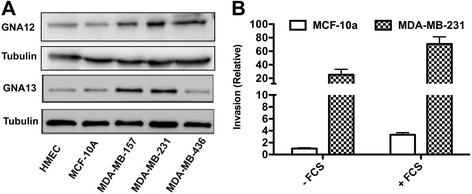
Gα13 (GNA13) is the α subunit of a heterotrimeric G protein that mediates signaling through specific G protein-coupled receptors (GPCRs). Our recent study showed that control of GNA13 expression by specific microRNAs (miRNAs or miRs) is important for prostate cancer cell invasion. However, little is known about the control of GNA13 expression in breast cancers. This project was carried out to determine (i) whether enhanced GNA13 expression is important for breast cancer cell invasion, and (ii) if so, the mechanism of deregulation of GNA13 expression in breast cancers.
To determine the probable miRNAs regulating GNA13, online miRNA target prediction tool Targetscan and Luciferase assays with GNA13-3'-UTR were used. Effect of miRNAs on GNA13 mRNA, protein and invasion was studied using RT-PCR, western blotting and in vitro Boyden chamber assay respectively. Cell proliferation was done using MTT assays.
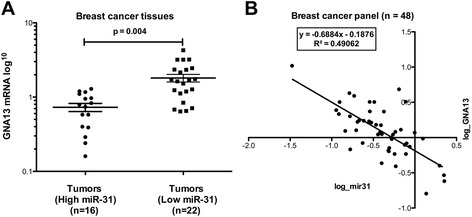
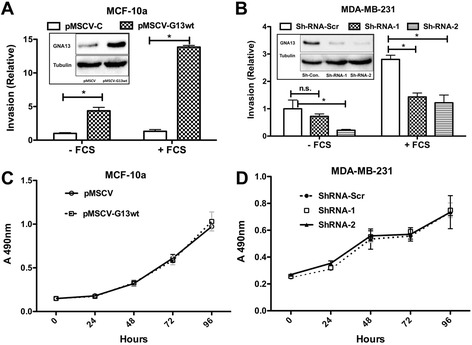
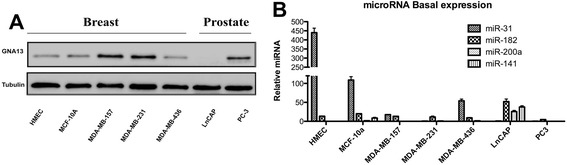
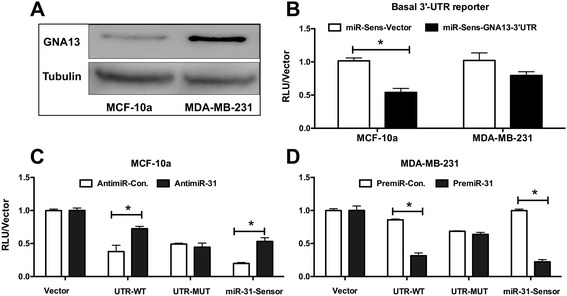
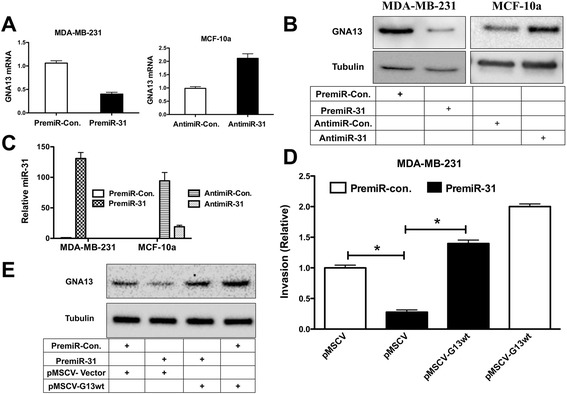
Overexpression of GNA13 in MCF-10a cells induced invasion, whereas knockdown of GNA13 expression in MDA-MB-231 cells inhibited invasion. Expression analysis of miRNAs predicted to bind the 3'-UTR of GNA13 revealed that miR-31 exhibited an inverse correlation to GNA13 protein expression in breast cancer cells. Ectopic expression of miR-31 in MDA-MB-231 cells significantly reduced GNA13 mRNA and protein levels, as well as GNA13-3'-UTR-reporter activity. Conversely, blocking miR-31 activity in MCF-10a cells induced GNA13 mRNA, protein and 3'-UTR reporter activity. Further, expression of miR-31 significantly inhibited MDA-MB-231 cell invasion, and this effect was partly rescued by ectopic expression of GNA13 in these cells. Examination of 48 human breast cancer tissues revealed that GNA13 mRNA levels were inversely correlated to miR-31 levels.
These data provide strong evidence that GNA13 expression in breast cancer cells is regulated by post-transcriptional mechanisms involving miR-31. Additionally our data shows that miR-31 regulates breast cancer cell invasion partially via targeting GNA13 expression in breast cancer cells. Loss of miR-31 expression and increased GNA13 expression could be used as biomarkers of breast cancer progression.
Gα13(GNA13)是一种异源三聚体G蛋白的α亚基,通过特定的G蛋白偶联受体(GPCR)介导信号传导。我们最近的研究表明,特定微小RNA(miRNA或miR)对GNA13表达的调控对前列腺癌细胞侵袭很重要。然而,关于乳腺癌中GNA13表达的调控知之甚少。开展本项目以确定:(i)GNA13表达增强对乳腺癌细胞侵袭是否重要;(ii)如果是,乳腺癌中GNA13表达失调的机制。
为确定可能调控GNA13的miRNA,使用在线miRNA靶标预测工具Targetscan和GNA13 - 3'-UTR荧光素酶报告基因检测。分别使用RT-PCR、蛋白质印迹法和体外Boyden小室检测研究miRNA对GNA13 mRNA、蛋白质和侵袭的影响。使用MTT检测进行细胞增殖实验。
MCF-10a细胞中GNA13过表达诱导侵袭,而MDA-MB-231细胞中GNA13表达敲低则抑制侵袭。对预测可结合GNA13 3'-UTR的miRNA进行表达分析,结果显示miR-31在乳腺癌细胞中的表达与GNA13蛋白表达呈负相关。MDA-MB-231细胞中miR-31的异位表达显著降低了GNA13 mRNA和蛋白质水平以及GNA13 - 3'-UTR报告基因活性。相反,在MCF-10a细胞中阻断miR-31活性可诱导GNA13 mRNA、蛋白质和3'-UTR报告基因活性。此外,miR-31的表达显著抑制了MDA-MB-231细胞的侵袭,而这些细胞中GNA13的异位表达部分挽救了这种作用。对48个人类乳腺癌组织的检测显示,GNA13 mRNA水平与miR-31水平呈负相关。
这些数据提供了强有力的证据,表明乳腺癌细胞中GNA13的表达受涉及miR-31的转录后机制调控。此外,我们的数据表明miR-31部分通过靶向乳腺癌细胞中GNA13的表达来调节乳腺癌细胞的侵袭。miR-31表达缺失和GNA13表达增加可作为乳腺癌进展的生物标志物。