Wächter Miriam, Wölfel Silke, Pfeffer Martin, Dobler Gerhard, Kohn Barbara, Moritz Andreas, Pachnicke Stefan, Silaghi Cornelia
Comparative Tropical Medicine and Parasitology, Ludwig-Maximilians-University Munich, Leopoldstrasse 5, 80802, Munich, Germany.
Department of Virology and Rickettsiology, Bundeswehr Institute of Microbiology, Neuherbergstrasse 11, 80937, Munich, Germany.
Parasit Vectors. 2015 Mar 23;8:126. doi: 10.1186/s13071-015-0745-1.
Spotted Fever Group (SFG) Rickettsiae can cause febrile diseases with or without rash in humans worldwide. In Germany only limited data are available about their medical significance. Serological screening tests for antibodies against rickettsiae usually only distinguish between SFG and Typhus Group (TG) Rickettsiae due to the strong cross reactivities within the groups. Seroprevalence rates in dogs, as possible sentinels for tick-borne diseases, could serve as an indicator for the distribution of different Rickettsia species.
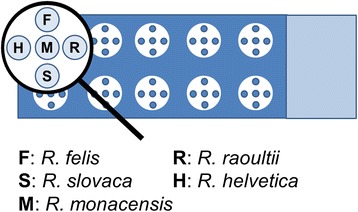
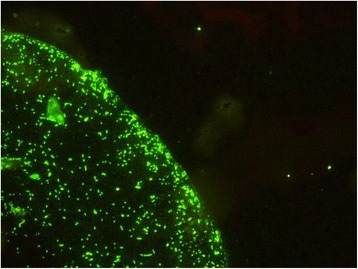
In this study, a micro-immunofluorescence assay (micro-IFA) was established for detection and differentiation of antibodies against five Rickettsia species in dogs (R. helvetica, R. raoultii, R. slovaca, R. monacensis and R. felis). Dogs that never left Germany (n = 605) previously investigated with an SFG-ELISA were included in this study and screened at a 1:128 dilution. Endpoint titres of fifty randomly selected seropositive samples of each of the five investigated regions in Germany were determined in order to allow a differentiation of the causative Rickettsia species. Sensitivity and specificity of the micro-IFA were compared with ELISA results of the previous study.
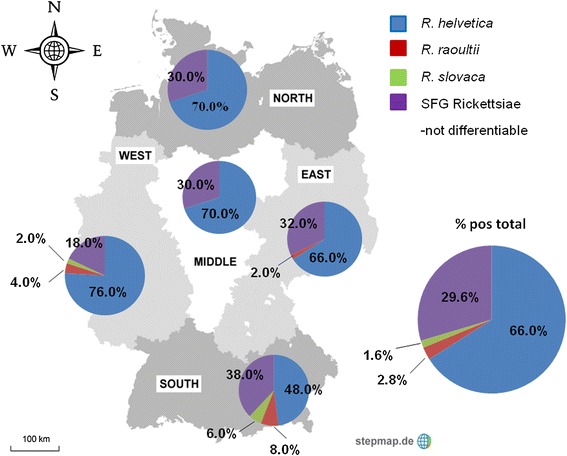
A total of 93.9% of the dogs were positive for antibodies of the SFG Rickettsiae at the screening titer of 1:128. Differentiation of SFG Rickettsiae with the micro-IFA was possible in 70.4%, but in 29.6% of the cases the detected antibodies were not differentiable. Considering a clear differentiation by a twofold titre difference between observed reactions, the seroprevalence rates were 66.0% for R. helvetica, 2.8% for R. raoultii, 1.6% for R. slovaca, but no serological reaction could be clearly attributed to R. monacensis or R. felis. No statistically significant regional differences were found for R. helvetica, R. slovaca and R. raoultii comparing the five regions of Germany. Comparison of micro-IFA with ELISA revealed a sensitivity of 82.0% and a specificity of 83.8% for the Rickettsia SFG ELISA.
The micro-IFA is a useful serological tool to differentiate antibodies against different Rickettsia species in dogs. Seroprevalence rates in dogs correspond to the prevalence rates and distribution of Rickettsia-carrying tick species.
斑点热群(SFG)立克次氏体可在全球范围内导致人类出现伴有或不伴有皮疹的发热性疾病。在德国,关于其医学意义的可用数据有限。由于各群内存在强烈的交叉反应,针对立克次氏体抗体的血清学筛查试验通常仅区分SFG和斑疹伤寒群(TG)立克次氏体。犬类作为蜱传疾病的潜在哨兵,其血清阳性率可作为不同立克次氏体物种分布的指标。
在本研究中,建立了一种微量免疫荧光测定法(微量IFA),用于检测和区分犬类针对五种立克次氏体物种(瑞士立克次氏体、拉乌尔蒂立克次氏体、斯洛伐克立克次氏体、蒙纳森立克次氏体和费氏立克次氏体)的抗体。本研究纳入了605只从未离开过德国且先前用SFG-ELISA进行过检测的犬类,并以1:128的稀释度进行筛查。测定了德国五个被调查地区中每种立克次氏体的五十个随机选择的血清阳性样本的终点滴度,以便区分致病立克次氏体物种。将微量IFA的敏感性和特异性与先前研究的ELISA结果进行比较。
在1:128的筛查滴度下,共有93.9%的犬类SFG立克次氏体抗体呈阳性。用微量IFA可区分70.4%的SFG立克次氏体,但在29.6%的病例中,检测到的抗体无法区分。考虑到通过观察反应之间两倍滴度差异进行明确区分,瑞士立克次氏体的血清阳性率为66.0%,拉乌尔蒂立克次氏体为2.8%,斯洛伐克立克次氏体为1.6%,但没有血清学反应可明确归因于蒙纳森立克次氏体或费氏立克次氏体。比较德国的五个地区,瑞士立克次氏体、斯洛伐克立克次氏体和拉乌尔蒂立克次氏体未发现统计学上的显著区域差异。微量IFA与ELISA的比较显示,SFG立克次氏体ELISA的敏感性为82.0%,特异性为83.8%。
微量IFA是一种用于区分犬类针对不同立克次氏体物种抗体的有用血清学工具。犬类的血清阳性率与携带立克次氏体的蜱类物种的流行率和分布相对应。