Pilakka-Kanthikeel Sudheesh, Raymond Andrea, Atluri Venkata Subba Rao, Sagar Vidya, Saxena Shailendra K, Diaz Patricia, Chevelon Semithe, Concepcion Michael, Nair Madhavan
Department of Immunology, Herbert Wertheim College of Medicine, Florida International University, AHC-1, 418A, 11200 SW 8th Street, Miami, FL, 33199, USA.
Institute of NeuroImmune Pharmacology, Herbert Wertheim College of Medicine, Florida International University, AHC-1, 418A, 11200 SW 8th Street, Miami, FL, 33199, USA.
J Neuroinflammation. 2015 Apr 8;12:66. doi: 10.1186/s12974-015-0285-9.
Although highly active antiretroviral therapy (HAART) has significantly reduced the morbidity and mortality in HIV patients, virus continues to reside in the central nervous system (CNS) reservoir. Hence, a complete eradication of virus remains a challenge. HIV productively infects microglia/macrophages, but astrocytes are generally restricted to HIV infection. The relative importance of the possible replication blocks in astrocytes, however, is yet to be delineated. A recently identified restriction factor, sterile alpha motif and histidine/aspartic acid domain-containing protein 1 (SAMHD1), restricts HIV infection in resting CD4(+)T cells and in monocyte-derived dendritic cells. However, SAMHD1 expression and HIV-1 restriction activity regulation in the CNS cells are unknown. Though, certain miRNAs have been implicated in HIV restriction in resting CD4(+)T cells, their role in the CNS HIV restriction and their mode of action are not established. We hypothesized that varying SAMHD1 expression would lead to restricted HIV infection and host miRNAs would regulate SAMHD1 expression in astrocytes.
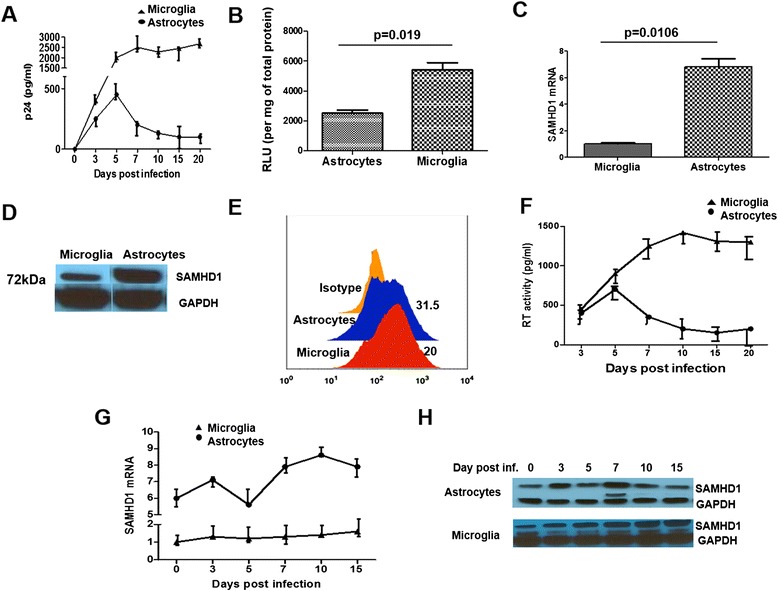
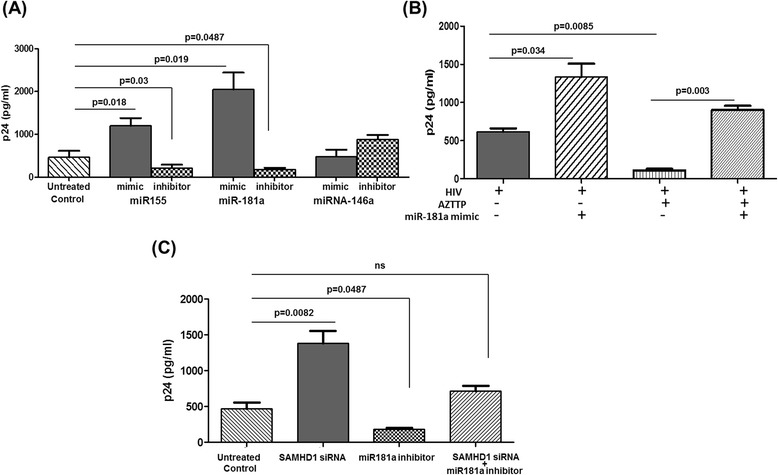
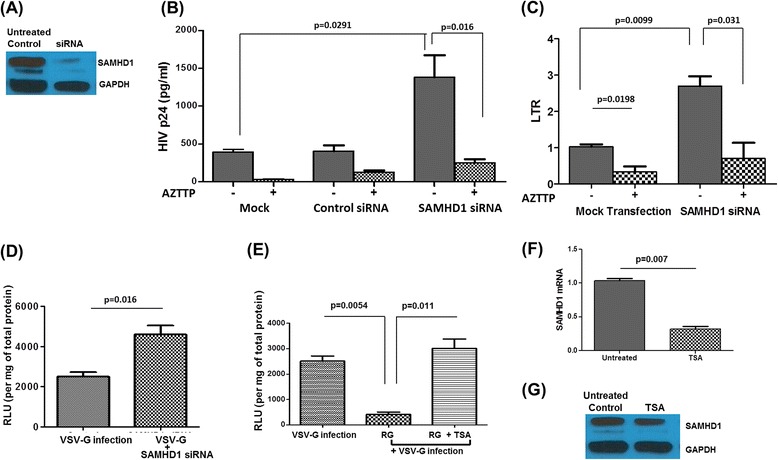
We found increased SAMHD1 expression and decreased miRNA expression (miR-181a and miR-155) in the astrocytes compared to microglia. We report for the first time that miR-155 and miR-181a regulated the SAMHD1 expression. Overexpression of these cellular miRNAs increased viral replication in the astrocytes, through SAMHD1 modulation. Reactivation of HIV replication was accompanied by decrease in SAMHD1 expression.
Here, we provide a proof of concept that increased SAMHD1 in human astrocytes is in part responsible for the HIV restriction, silencing of which relieves this restriction. At this time, this concept is of theoretical nature. Further experiments are needed to confirm if HIV replication can be reactivated in the CNS reservoir.
尽管高效抗逆转录病毒疗法(HAART)显著降低了HIV患者的发病率和死亡率,但病毒仍存在于中枢神经系统(CNS)储存库中。因此,彻底根除病毒仍然是一项挑战。HIV可有效感染小胶质细胞/巨噬细胞,但星形胶质细胞通常受到HIV感染的限制。然而,星形胶质细胞中可能存在的复制阻滞的相对重要性尚待明确。最近发现的一种限制因子,即含无菌α基序和组氨酸/天冬氨酸结构域蛋白1(SAMHD1),可限制HIV在静息CD4(+)T细胞和单核细胞衍生的树突状细胞中的感染。然而,CNS细胞中SAMHD1的表达及HIV-1限制活性调控尚不清楚。虽然某些微小RNA(miRNA)已被证明与静息CD4(+)T细胞中的HIV限制有关,但其在CNS中对HIV的限制作用及其作用方式尚未明确。我们推测,SAMHD1表达的变化会导致HIV感染受限,且宿主miRNA会调节星形胶质细胞中SAMHD1的表达。
我们发现与小胶质细胞相比,星形胶质细胞中SAMHD1表达增加,而miRNA(miR-181a和miR-155)表达降低。我们首次报道miR-155和miR-181a可调节SAMHD1的表达。这些细胞miRNA的过表达通过调节SAMHD1增加了星形胶质细胞中的病毒复制。HIV复制的重新激活伴随着SAMHD1表达的降低。
在此,我们提供了一个概念验证,即人星形胶质细胞中SAMHD1增加部分导致了HIV限制,其沉默可解除这种限制。目前,这一概念仅具有理论性质。需要进一步实验来确认HIV复制是否能在CNS储存库中重新激活。