Ferguson Ty, Rowlands Alex V, Olds Tim, Maher Carol
Alliance for Research in Exercise, Nutrition and Activity (ARENA), Sansom Institute, University of South Australia, GPO Box 2471, 5001, Adelaide, Australia.
Int J Behav Nutr Phys Act. 2015 Mar 27;12:42. doi: 10.1186/s12966-015-0201-9.
Technological advances have seen a burgeoning industry for accelerometer-based wearable activity monitors targeted at the consumer market. The purpose of this study was to determine the convergent validity of a selection of consumer-level accelerometer-based activity monitors.
21 healthy adults wore seven consumer-level activity monitors (Fitbit One, Fitbit Zip, Jawbone UP, Misfit Shine, Nike Fuelband, Striiv Smart Pedometer and Withings Pulse) and two research-grade accelerometers/multi-sensor devices (BodyMedia SenseWear, and ActiGraph GT3X+) for 48-hours. Participants went about their daily life in free-living conditions during data collection. The validity of the consumer-level activity monitors relative to the research devices for step count, moderate to vigorous physical activity (MVPA), sleep and total daily energy expenditure (TDEE) was quantified using Bland-Altman analysis, median absolute difference and Pearson's correlation.
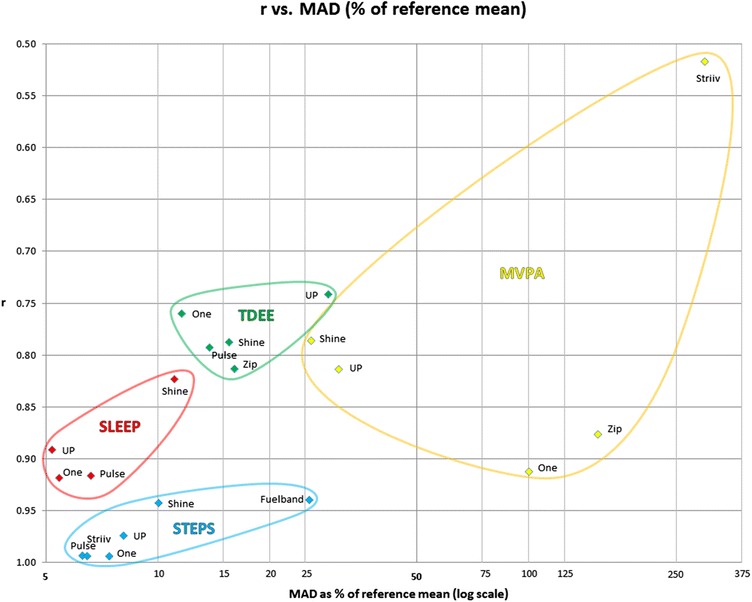
All consumer-level activity monitors correlated strongly (r > 0.8) with research-grade devices for step count and sleep time, but only moderately-to-strongly for TDEE (r = 0.74-0.81) and MVPA (r = 0.52-0.91). Median absolute differences were generally modest for sleep and steps (<10% of research device mean values for the majority of devices) moderate for TDEE (<30% of research device mean values), and large for MVPA (26-298%). Across the constructs examined, the Fitbit One, Fitbit Zip and Withings Pulse performed most strongly.
In free-living conditions, the consumer-level activity monitors showed strong validity for the measurement of steps and sleep duration, and moderate valid for measurement of TDEE and MVPA. Validity for each construct ranged widely between devices, with the Fitbit One, Fitbit Zip and Withings Pulse being the strongest performers.
随着技术进步,面向消费市场的基于加速度计的可穿戴活动监测器行业蓬勃发展。本研究的目的是确定一系列消费级基于加速度计的活动监测器的收敛效度。
21名健康成年人佩戴7种消费级活动监测器(Fitbit One、Fitbit Zip、Jawbone UP、Misfit Shine、Nike Fuelband、Striiv智能计步器和Withings Pulse)以及2种研究级加速度计/多传感器设备(BodyMedia SenseWear和ActiGraph GT3X+),持续48小时。在数据收集期间,参与者在自由生活条件下进行日常生活。使用Bland-Altman分析、中位数绝对差和Pearson相关性对消费级活动监测器相对于研究设备在步数、中度至剧烈身体活动(MVPA)、睡眠和每日总能量消耗(TDEE)方面的效度进行量化。
所有消费级活动监测器在步数和睡眠时间方面与研究级设备高度相关(r>0.8),但在TDEE(r = 0.74 - 0.81)和MVPA(r = 0.52 - 0.91)方面仅为中度至高度相关。睡眠和步数的中位数绝对差通常较小(大多数设备<研究设备平均值的10%),TDEE的中位数绝对差适中(<研究设备平均值的30%),MVPA的中位数绝对差较大(26 - 298%)。在所检查的各项指标中,Fitbit One、Fitbit Zip和Withings Pulse表现最为出色。
在自由生活条件下,消费级活动监测器在步数和睡眠时间测量方面显示出较高的效度,在TDEE和MVPA测量方面显示出中等效度。各设备在每项指标上的效度差异很大,Fitbit One、Fitbit Zip和Withings Pulse表现最强。