Guo Xingyi, Xu Yaomin, Zhao Zhongming
Department of Biomedical Informatics, Vanderbilt University School of Medicine, Nashville, TN, 37203, USA.
Division of Epidemiology, Department of Medicine, Vanderbilt Epidemiology Center, Vanderbilt-Ingram Cancer Center, Vanderbilt University School of Medicine, Nashville, TN, 37232, USA.
Mol Cancer. 2015 Mar 14;14:60. doi: 10.1186/s12943-015-0328-y.
The recurrent BRAF driver mutation V600E (BRAF (V600E)) is currently one of the most clinically relevant mutations in melanoma. However, the genome-wide transcriptional and epigenetic dysregulations induced by BRAF (V600E) are still unclear. The investigation of this driver mutation's functional consequences is critical to the understanding of tumorigenesis and the development of therapeutic strategies.
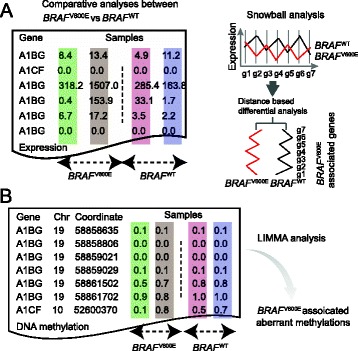
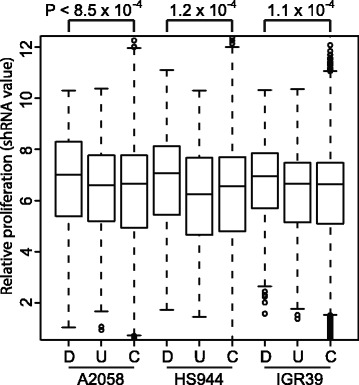
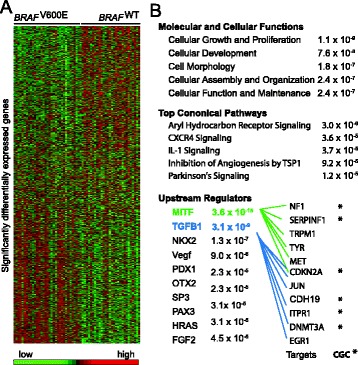
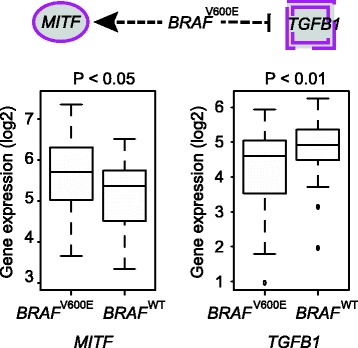
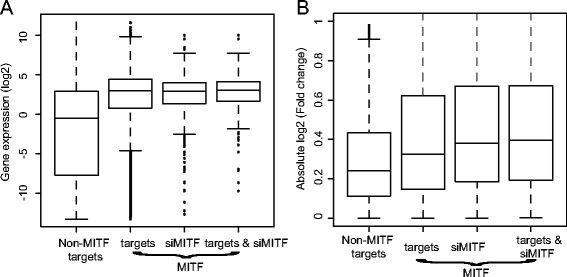
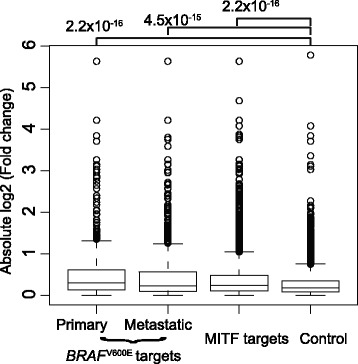
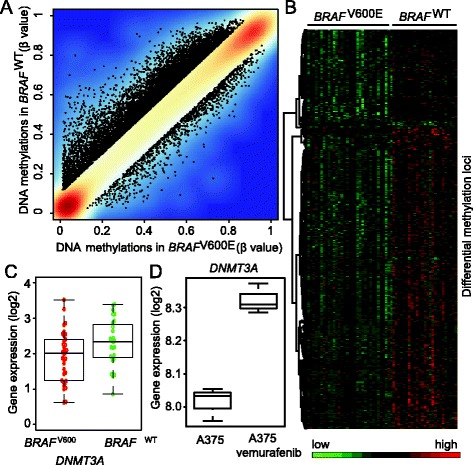
We performed an integrative analysis of transcriptomic and epigenomic changes disturbed by BRAF (V600E) by comparing the gene expression and methylation profiles of 34 primary cutaneous melanoma tumors harboring BRAF (V600E) with those of 27 BRAF (WT) samples available from The Cancer Genome Atlas (TCGA). A total of 711 significantly differentially expressed genes were identified as putative BRAF (V600E) target genes. Functional enrichment analyses revealed the transcription factor MITF (p < 3.6 × 10(-16)) and growth factor TGFB1 (p < 3.1 × 10(-9)) were the most significantly enriched up-regulators, with MITF being significantly up-regulated, whereas TGFB1 was significantly down-regulated in BRAF (V600E), suggesting that they may mediate tumorigenesis driven by BRAF (V600E). Further investigation using the MITF ChIP-Seq data confirmed that BRAF (V600E) led to an overall increased level of gene expression for the MITF targets. Furthermore, DNA methylation analysis revealed a global DNA methylation loss in BRAF (V600E) relative to BRAF (WT). This might be due to BRAF dysregulation of DNMT3A, which was identified as a potential target with significant down-regulation in BRAF (V600E). Finally, we demonstrated that BRAF (V600E) targets may play essential functional roles in cell growth and proliferation, measured by their effects on melanoma tumor growth using a short hairpin RNA silencing experimental dataset.
Our integrative analysis identified a set of BRAF (V600E) target genes. Further analyses suggested a complex mechanism driven by mutation BRAF (V600E) on melanoma tumorigenesis that disturbs specific cancer-related genes, pathways, and methylation modifications.
复发性BRAF驱动基因突变V600E(BRAF(V600E))是目前黑色素瘤中临床相关性最高的突变之一。然而,由BRAF(V600E)诱导的全基因组转录和表观遗传失调仍不清楚。研究这种驱动基因突变的功能后果对于理解肿瘤发生和制定治疗策略至关重要。
我们通过比较34例携带BRAF(V600E)的原发性皮肤黑色素瘤肿瘤与来自癌症基因组图谱(TCGA)的27例BRAF(野生型)样本的基因表达和甲基化谱,对受BRAF(V600E)干扰的转录组和表观基因组变化进行了综合分析。共鉴定出711个显著差异表达基因作为假定的BRAF(V600E)靶基因。功能富集分析显示转录因子MITF(p < 3.6 × 10^(-16))和生长因子TGFB1(p < 3.1 × 10^(-9))是最显著富集的上调因子,其中MITF显著上调,而TGFB1在BRAF(V600E)中显著下调,这表明它们可能介导由BRAF(V600E)驱动的肿瘤发生。使用MITF染色质免疫沉淀测序(ChIP-Seq)数据的进一步研究证实,BRAF(V600E)导致MITF靶基因的整体基因表达水平升高。此外,DNA甲基化分析显示,相对于BRAF(野生型),BRAF(V600E)存在全基因组DNA甲基化缺失。这可能是由于BRAF对DNMT3A的失调,DNMT3A被确定为在BRAF(V600E)中显著下调的潜在靶点。最后,我们证明了BRAF(V600E)靶基因可能在细胞生长和增殖中发挥重要功能作用,这通过使用短发夹RNA沉默实验数据集对黑色素瘤肿瘤生长的影响来衡量。
我们的综合分析鉴定出一组BRAF(V600E)靶基因。进一步分析表明,BRAF(V600E)突变驱动黑色素瘤肿瘤发生的机制复杂,扰乱了特定的癌症相关基因、信号通路和甲基化修饰。