Bhakta Samir A, Evans Elizabeth, Benavidez Tomás E, Garcia Carlos D
Department of Chemistry, The University of Texas at San Antonio, One UTSA Circle, San Antonio, TX 78249, USA.
Department of Chemistry, The University of Texas at San Antonio, One UTSA Circle, San Antonio, TX 78249, USA.
Anal Chim Acta. 2015 May 4;872:7-25. doi: 10.1016/j.aca.2014.10.031. Epub 2014 Oct 29.
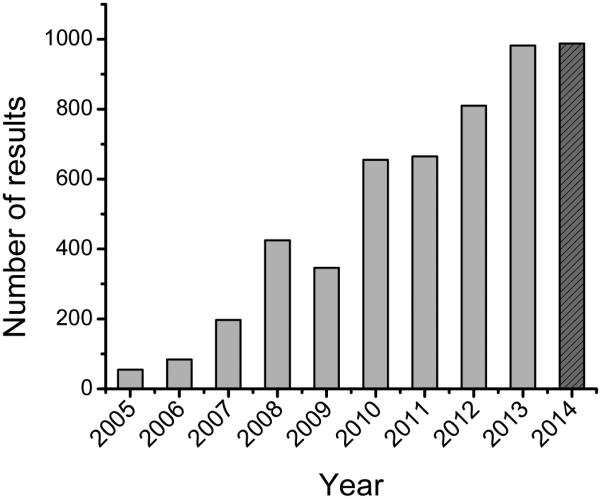
An important consideration for the development of biosensors is the adsorption of the biorecognition element to the surface of a substrate. As the first step in the immobilization process, adsorption affects most immobilization routes and much attention is given into the research of this process to maximize the overall activity of the biosensor. The use of nanomaterials, specifically nanoparticles and nanostructured films, offers advantageous properties that can be fine-tuned to maximize interactions with specific proteins to maximize activity, minimize structural changes, and enhance the catalytic step. In the biosensor field, protein-nanomaterial interactions are an emerging trend that span across many disciplines. This review addresses recent publications about the proteins most frequently used, their most relevant characteristics, and the conditions required to adsorb them to nanomaterials. When relevant and available, subsequent analytical figures of merits are discussed for selected biosensors. The general trend amongst the research papers allows concluding that the use of nanomaterials has already provided significant improvements in the analytical performance of many biosensors and that this research field will continue to grow.
生物传感器开发中的一个重要考虑因素是生物识别元件在基底表面的吸附。作为固定化过程的第一步,吸附影响大多数固定化途径,并且人们对该过程的研究给予了很多关注,以最大化生物传感器的整体活性。纳米材料的使用,特别是纳米颗粒和纳米结构薄膜,具有可微调的有利特性,以最大化与特定蛋白质的相互作用,从而最大化活性、最小化结构变化并增强催化步骤。在生物传感器领域,蛋白质 - 纳米材料相互作用是一个跨越许多学科的新兴趋势。本综述讨论了有关最常用蛋白质的近期出版物、它们最相关的特性以及将它们吸附到纳米材料上所需的条件。在相关且可用的情况下,还讨论了所选生物传感器的后续分析性能指标。研究论文中的总体趋势表明,纳米材料的使用已经在许多生物传感器的分析性能方面带来了显著改进,并且这个研究领域将继续发展。