de Munnik Sabrina M, Kooistra Albert J, van Offenbeek Jody, Nijmeijer Saskia, de Graaf Chris, Smit Martine J, Leurs Rob, Vischer Henry F
Department of Chemistry and Pharmaceutical Sciences, Division of Medicinal Chemistry, Amsterdam Institute for Molecules, Medicines and Systems (AIMMS), VU University Amsterdam, Amsterdam, The Netherlands.
PLoS One. 2015 Apr 20;10(4):e0124486. doi: 10.1371/journal.pone.0124486. eCollection 2015.
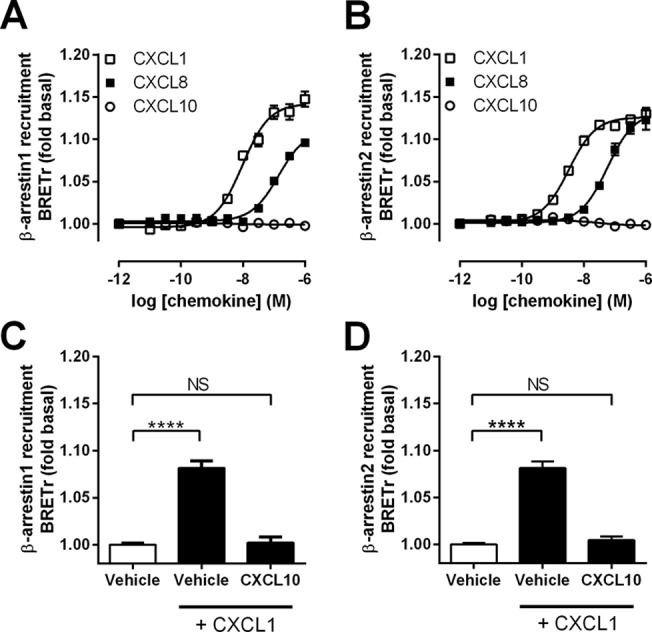
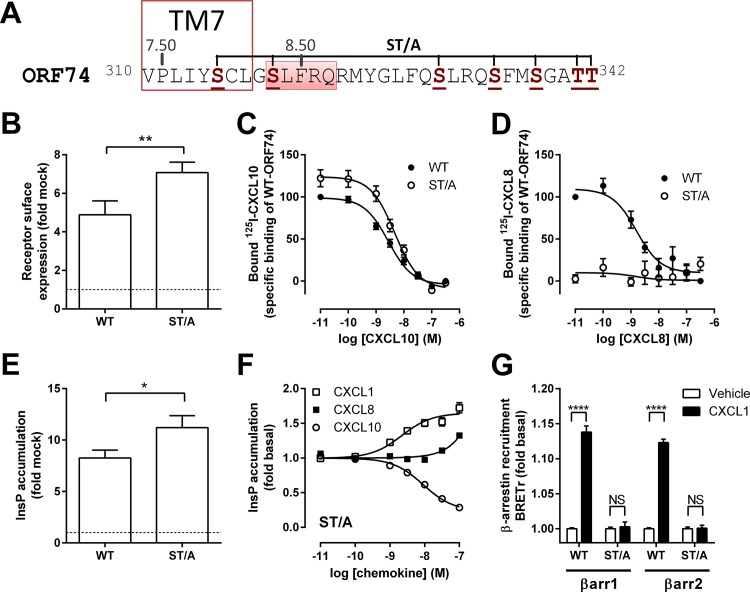
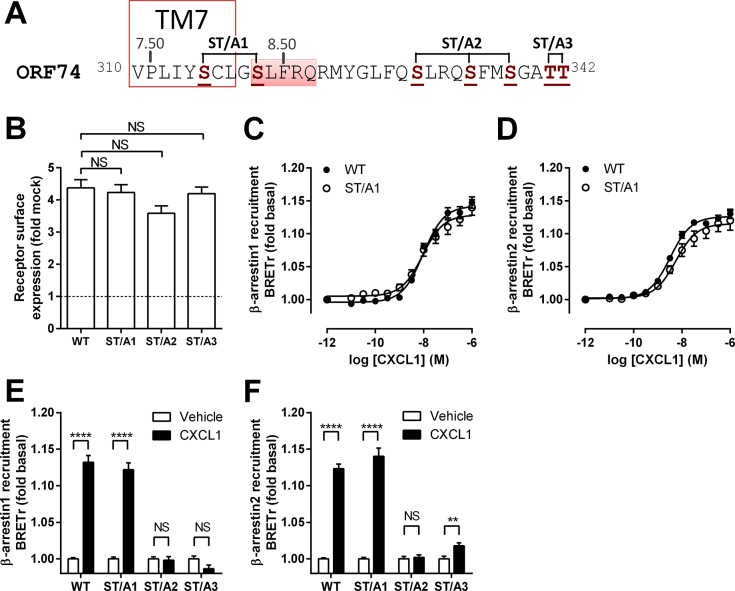
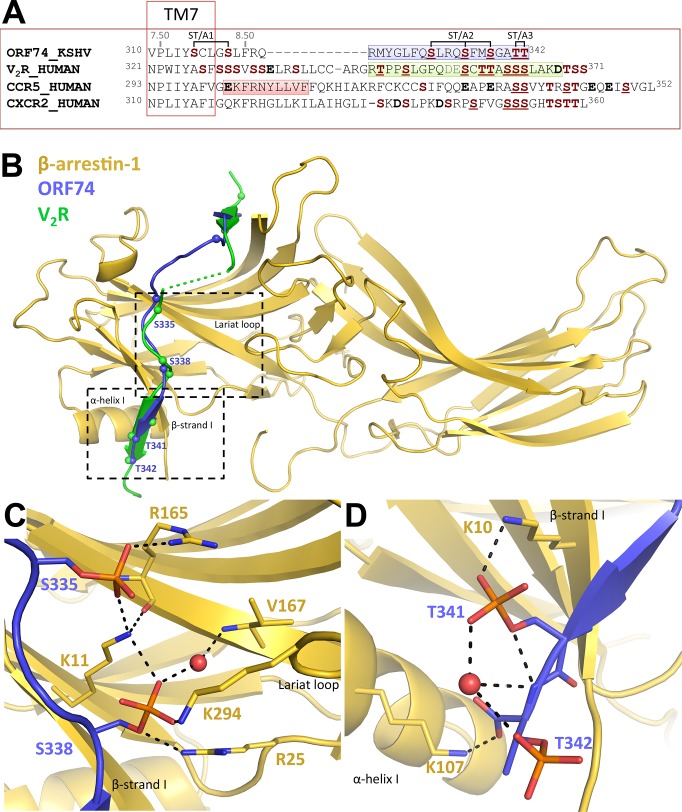
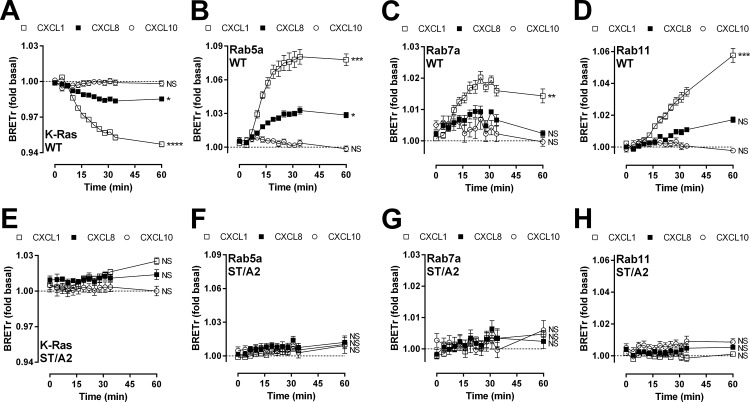
Kaposi's sarcoma-associated herpesvirus-infected cells express the virally encoded G protein-coupled receptor ORF74. Although ORF74 is constitutively active, it binds human CXC chemokines that modulate this basal activity. ORF74-induced signaling has been demonstrated to underlie the development of the angioproliferative tumor Kaposi's sarcoma. Whereas G protein-dependent signaling of ORF74 has been the subject of several studies, the interaction of this viral GPCR with β-arrestins has hitherto not been investigated. Bioluminescence resonance energy transfer experiments demonstrate that ORF74 recruits β-arrestins and subsequently internalizes in response to human CXCL1 and CXCL8, but not CXCL10. Internalized ORF74 traffics via early endosomes to recycling and late endosomes. Site-directed mutagenesis and homology modeling identified four serine and threonine residues at the distal end of the intracellular carboxyl-terminal of ORF74 that are required for β-arrestin recruitment and subsequent endocytic trafficking. Hijacking of the human endocytic trafficking machinery is a previously unrecognized action of ORF74.
卡波西肉瘤相关疱疹病毒感染的细胞表达病毒编码的G蛋白偶联受体ORF74。尽管ORF74组成性激活,但它能结合人类CXC趋化因子,从而调节这种基础活性。已证明ORF74诱导的信号传导是血管增殖性肿瘤卡波西肉瘤发生发展的基础。虽然ORF74的G蛋白依赖性信号传导已成为多项研究的主题,但迄今为止尚未研究这种病毒GPCR与β-抑制蛋白的相互作用。生物发光共振能量转移实验表明,ORF74能募集β-抑制蛋白,并随后在人类CXCL1和CXCL8作用下内化,但对CXCL10无反应。内化的ORF74通过早期内体转运至再循环内体和晚期内体。定点诱变和同源建模确定了ORF74细胞内羧基末端远端的四个丝氨酸和苏氨酸残基,它们是募集β-抑制蛋白及随后进行内吞转运所必需的。劫持人类内吞转运机制是ORF74以前未被认识到的作用。