Saw Phei Er, Park Jinho, Lee Eunbeol, Ahn Sukyung, Lee Jinju, Kim Hyungjun, Kim Jinjoo, Choi Minsuk, Farokhzad Omid C, Jon Sangyong
1. KAIST Institute for the BioCentury, Department of Biological Sciences, Korea Advanced Institute of Science and technology (KAIST), 291 Daehak-ro, Daejeon 305-701, Republic of Korea. ; 2. Laboratory of Nanomedicine and Biomaterials, Department of Anesthesiology, Brigham and Women's Hospital Harvard Medical School, Boston, MA 02115, U.S.A.
1. KAIST Institute for the BioCentury, Department of Biological Sciences, Korea Advanced Institute of Science and technology (KAIST), 291 Daehak-ro, Daejeon 305-701, Republic of Korea.
Theranostics. 2015 Apr 5;5(7):746-54. doi: 10.7150/thno.10732. eCollection 2015.
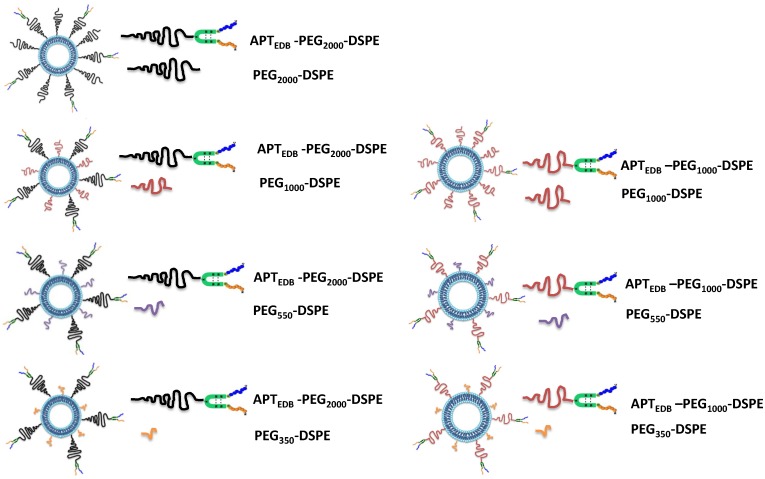
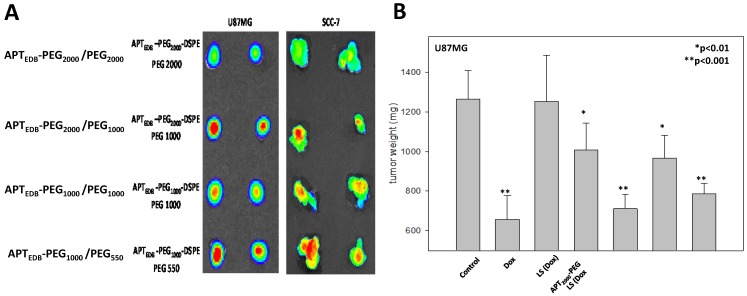
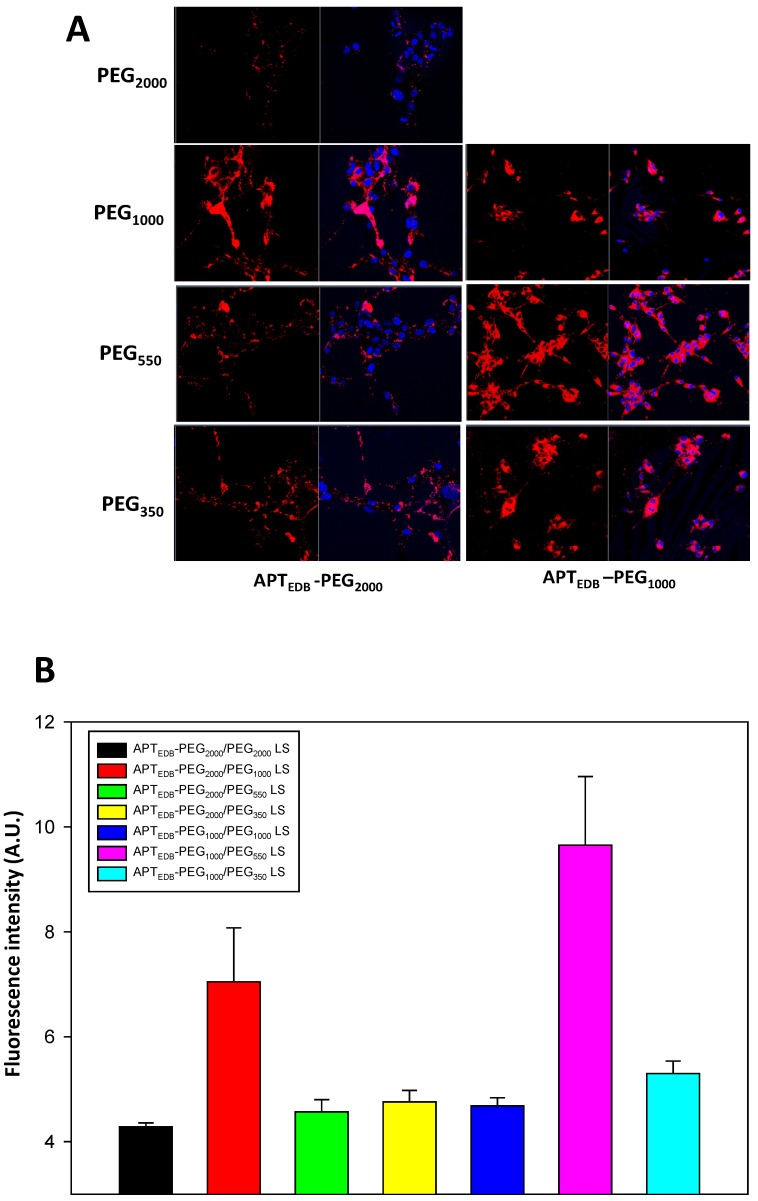
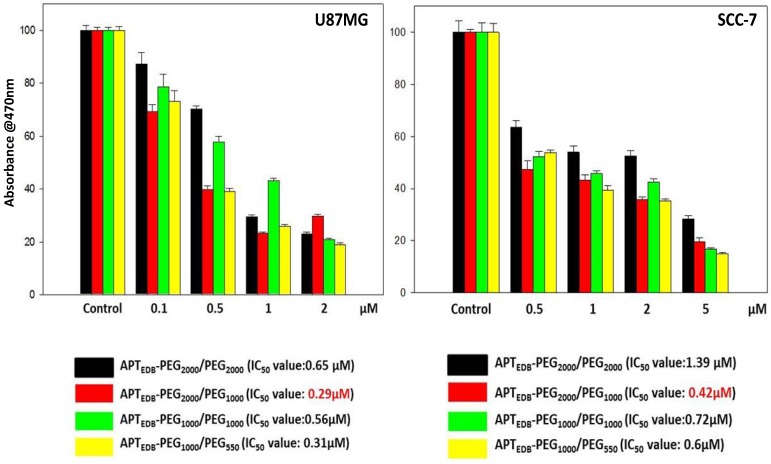
Standardized poly(ethylene glycol)-modified (PEGylated) liposomes, which have been widely used in research as well as in pre-clinical and clinical studies, are typically constructed using PEG with a molecular weight of 2000 Da (PEG(2000)). Targeting ligands are also generally conjugated using various functionalized PEG(2000)). However, although standardized protocols have routinely used PEG(2000), it is not because this molecular weight PEG has been optimized to enhance tumor uptake of nanoparticles. Herein, we investigated the effect of various PEG lipid pairings--that is, PEG lipids for targeting-ligand conjugation and PEG lipids for achieving 'stealth' function--on in vitro cancer cell- and in vivo tumor-targeting efficacy. A class of high-affinity peptides (aptides) specific to extra domain B of fibronectin (APT(EDB)) was used as a representative model for a cancer-targeting ligand. We synthesized a set of aptide-conjugated PEGylated phospholipids (APT(EDB)‑PEG(2000))‑DSPE and APT(EDB)‑PEG(2000))‑DSPE) and then paired them with methoxy-capped PEGylated phospholipids with diverse molecular weights (PEG(2000)), PEG(2000)), PEG(2000)), and PEG(2000))) to construct various aptide-conjugated PEGylated liposomes. The liposomes with APT(EDB)‑PEG(2000))/PEG(2000)) and APT(EDB)‑PEG(2000))/PEG(2000)) pairings had the highest uptake in EDB-positive cancer cells. Furthermore, in a U87MG xenograft model, APT(EDB)‑PEG(2000))/PEG(2000)) liposomes retarded tumor growth to the greatest extent, followed closely by APT(EDB)‑PEG(2000))/PEG(2000)) liposomes. Among the PEGylated liposomes tested, pairs in which the methoxy-capped PEG length was about half that of the targeting ligand-displaying PEG exhibited the best performance, suggesting that PEG pairing is a key consideration in the design of drug-delivery vehicles.
标准化的聚乙二醇修饰(聚乙二醇化)脂质体已广泛应用于研究以及临床前和临床研究,通常使用分子量为2000道尔顿的聚乙二醇(PEG(2000))构建。靶向配体通常也使用各种功能化的PEG(2000)进行偶联。然而,尽管标准化方案通常使用PEG(2000),但并非因为这种分子量的聚乙二醇已被优化以增强纳米颗粒的肿瘤摄取。在此,我们研究了各种PEG脂质配对——即用于靶向配体偶联的PEG脂质和用于实现“隐身”功能的PEG脂质——对体外癌细胞和体内肿瘤靶向疗效的影响。一类对纤连蛋白额外结构域B特异的高亲和力肽(适配肽)(APT(EDB))被用作癌症靶向配体的代表性模型。我们合成了一组适配肽偶联的聚乙二醇化磷脂(APT(EDB)‑PEG(2000))‑DSPE和APT(EDB)‑PEG(2000))‑DSPE),然后将它们与具有不同分子量的甲氧基封端的聚乙二醇化磷脂(PEG(2000))、PEG(2000))、PEG(2000))和PEG(2000))配对,以构建各种适配肽偶联的聚乙二醇化脂质体。具有APT(EDB)‑PEG(2000))/PEG(2000))和APT(EDB)‑PEG(2000))/PEG(2000))配对的脂质体在EDB阳性癌细胞中的摄取量最高。此外,在U87MG异种移植模型中,APT(EDB)‑PEG(2000))/PEG(2000))脂质体对肿瘤生长的抑制作用最大,其次是APT(EDB)‑PEG(2000))/PEG(2000))脂质体。在所测试的聚乙二醇化脂质体中,甲氧基封端的PEG长度约为展示靶向配体的PEG长度一半的配对表现最佳,这表明PEG配对是药物递送载体设计中的关键考虑因素。