Kim Sung Han, Kim Soo Hee, Joung Jae Young, Lee Geon Kook, Hong Eun Kyung, Kang Kyung Min, Yu Ami, Nam Byung Ho, Chung Jinsoo, Seo Ho Kyung, Park Weon Seo, Lee Kang Hyun
Department of Urology, Center for Prostate Cancer, Research Institute and Hospital of National Cancer Center, Goyang, Gyeonggi-do, Korea.
Department of Pathology, Yonsei University Severance Hospital, Seoul.
PLoS One. 2015 Apr 21;10(4):e0122498. doi: 10.1371/journal.pone.0122498. eCollection 2015.
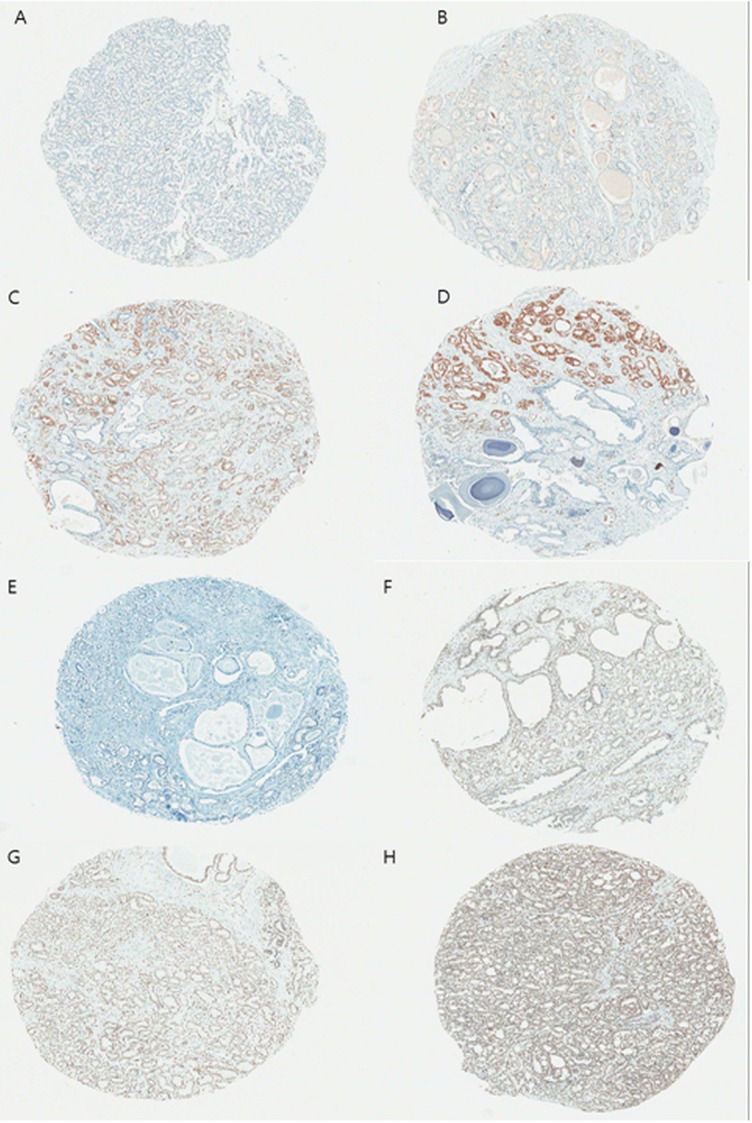
The aim of this study was to investigate the expression of two commonly altered genes ERG and PTEN in prostate cancer (PC) and evaluate their prognostic significance. Despite conflicting published results, TMPRSS2-ERG gene fusion and PTEN loss are generally considered unfavorable markers for PC progression.
Of the 762 prostatic adenocarcinoma specimens obtained from radical prostatectomy, 613 without neoadjuvant hormone therapy were included in tissue microarrays for quantitatively assessment of ERG and PTEN expression via immunohistochemistry. Statistical analysis of the association between such expression and clinicopathological parameters, including clinical prognosis, was performed with a p-value of <0.05 considered significant.
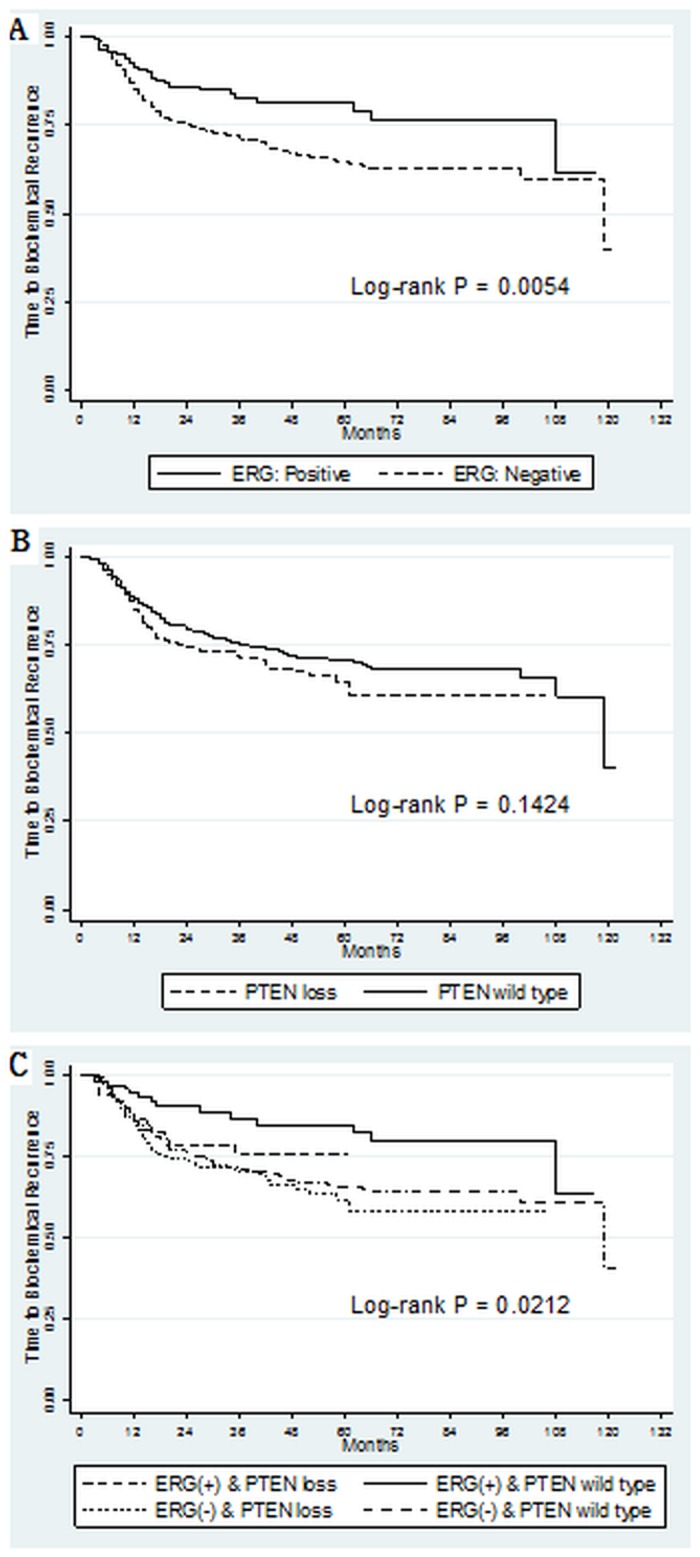
During a median follow-up period of 44.0 months, 132 (21.5%) patients developed biochemical recurrence (BCR). ERG overexpression and PTEN loss were observed in 145 (23.7%) and 253 (41.3%) cases, respectively. BCR-free survival was significantly better in patients with ERG overexpression (p=0.005), but unfavorable among those with PTEN loss (p=0.142). Sub-group analysis revealed that patients with PTEN loss and negative ERG expression had the worst BCR-free survival outcome (p=0.021). Furthermore, multivariate analysis identified prostate-specific antigen level (≥10 ng/mL), Gleason score (>6), pathologic T stage (≥T3), positive surgical margin, and extraprostatic capsule extension as significant risk factors for BCR (p<0.05).
Our results indicated that ERG overexpression was associated with favorable BCR-free survival after radical prostatectomy for PC, whereas PTEN loss was with unfavorable outcomes.
本研究旨在调查两种常见的基因ERG和PTEN在前列腺癌(PC)中的表达情况,并评估其预后意义。尽管已发表的结果存在矛盾,但TMPRSS2-ERG基因融合和PTEN缺失通常被认为是PC进展的不良标志物。
从根治性前列腺切除术中获得的762例前列腺腺癌标本中,613例未经新辅助激素治疗的标本被纳入组织微阵列,通过免疫组织化学定量评估ERG和PTEN的表达。对这种表达与临床病理参数(包括临床预后)之间的关联进行统计分析,p值<0.05被认为具有统计学意义。
在中位随访期44.0个月期间,132例(21.5%)患者出现生化复发(BCR)。分别在145例(23.7%)和253例(41.3%)病例中观察到ERG过表达和PTEN缺失。ERG过表达的患者无BCR生存期明显更好(p=0.005),但PTEN缺失的患者预后不佳(p=0.142)。亚组分析显示,PTEN缺失且ERG表达阴性的患者无BCR生存期最差(p=0.021)。此外,多变量分析确定前列腺特异性抗原水平(≥10 ng/mL)、Gleason评分(>6)、病理T分期(≥T3)、手术切缘阳性和前列腺外膜延伸是BCR的重要危险因素(p<0.05)。
我们的结果表明,ERG过表达与PC根治性前列腺切除术后良好的无BCR生存期相关,而PTEN缺失则与不良预后相关。