Wang Chi, Dominici Francesca, Parmigiani Giovanni, Zigler Corwin Matthew
Department of Biostatistics, University of Kentucky, Lexington, Kentucky, U.S.A.
Markey Cancer Center, University of Kentucky, Lexington, Kentucky, U.S.A.
Biometrics. 2015 Sep;71(3):654-65. doi: 10.1111/biom.12315. Epub 2015 Apr 20.
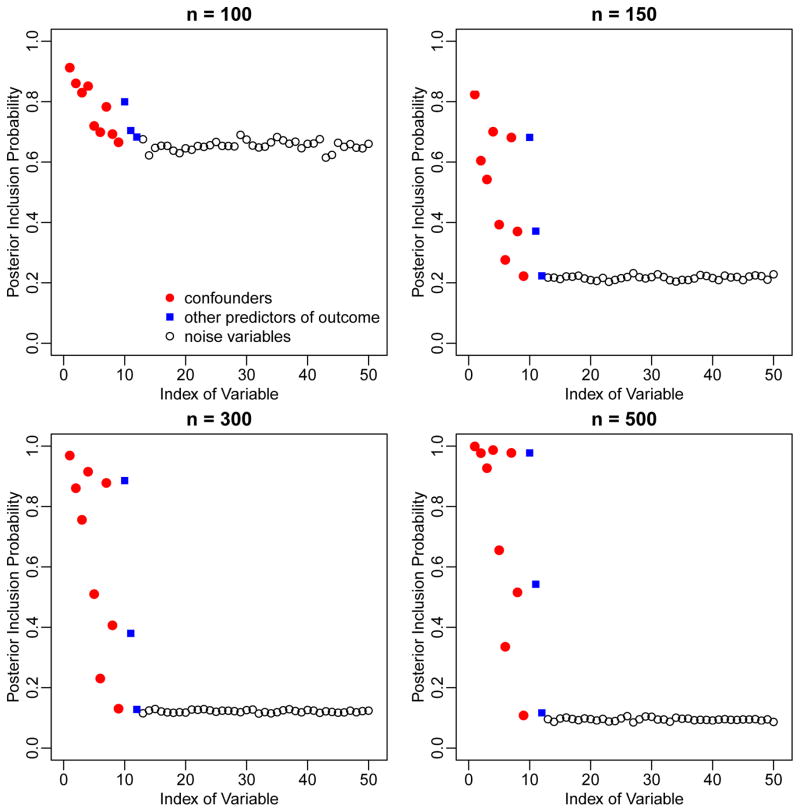
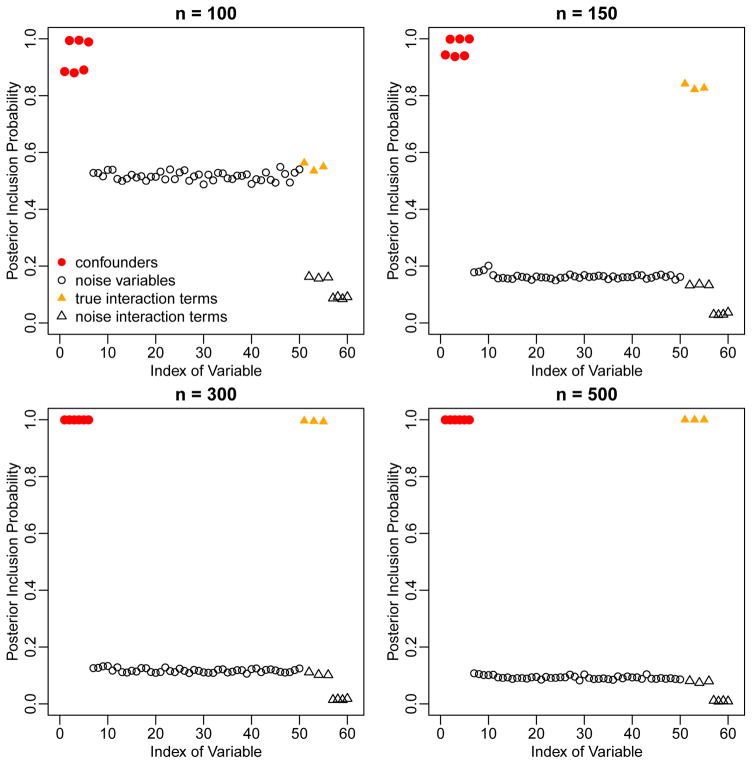
Confounder selection and adjustment are essential elements of assessing the causal effect of an exposure or treatment in observational studies. Building upon work by Wang et al. (2012, Biometrics 68, 661-671) and Lefebvre et al. (2014, Statistics in Medicine 33, 2797-2813), we propose and evaluate a Bayesian method to estimate average causal effects in studies with a large number of potential confounders, relatively few observations, likely interactions between confounders and the exposure of interest, and uncertainty on which confounders and interaction terms should be included. Our method is applicable across all exposures and outcomes that can be handled through generalized linear models. In this general setting, estimation of the average causal effect is different from estimation of the exposure coefficient in the outcome model due to noncollapsibility. We implement a Bayesian bootstrap procedure to integrate over the distribution of potential confounders and to estimate the causal effect. Our method permits estimation of both the overall population causal effect and effects in specified subpopulations, providing clear characterization of heterogeneous exposure effects that may vary considerably across different covariate profiles. Simulation studies demonstrate that the proposed method performs well in small sample size situations with 100-150 observations and 50 covariates. The method is applied to data on 15,060 US Medicare beneficiaries diagnosed with a malignant brain tumor between 2000 and 2009 to evaluate whether surgery reduces hospital readmissions within 30 days of diagnosis.
在观察性研究中,混杂因素的选择和调整是评估暴露或治疗因果效应的关键要素。基于Wang等人(2012年,《生物统计学》68卷,661 - 671页)以及Lefebvre等人(2014年,《医学统计学》33卷,2797 - 2813页)的研究成果,我们提出并评估了一种贝叶斯方法,用于在存在大量潜在混杂因素、观测值相对较少、混杂因素与感兴趣的暴露之间可能存在相互作用,以及对于应纳入哪些混杂因素和相互作用项存在不确定性的研究中估计平均因果效应。我们的方法适用于所有可通过广义线性模型处理的暴露和结局。在这种一般情况下,由于不可折叠性,平均因果效应的估计与结局模型中暴露系数的估计不同。我们实施了一种贝叶斯自助程序,以对潜在混杂因素的分布进行积分并估计因果效应。我们的方法允许估计总体人群的因果效应以及特定亚组中的效应,从而清晰地刻画不同协变量分布下可能有很大差异的异质性暴露效应。模拟研究表明,所提出的方法在样本量为100 - 150个观测值和50个协变量的小样本情况下表现良好。该方法应用于2000年至2009年间被诊断患有恶性脑肿瘤的15,060名美国医疗保险受益人的数据,以评估手术是否能降低诊断后30天内的医院再入院率。