Emran Talha Bin, Rahman Md Atiar, Uddin Mir Muhammad Nasir, Rahman Md Mominur, Uddin Md Zia, Dash Raju, Layzu Chadny
Department of Pharmacy, BGC Trust University Bangladesh, Chittagong, 4000, Bangladesh.
Department of Biochemistry and Molecular Biology, University of Chittagong, Chittagong, 4331, Bangladesh.
BMC Complement Altern Med. 2015 Apr 23;15:128. doi: 10.1186/s12906-015-0643-2.
The increasingly high incidence of ischemic stroke caused by thrombosis of the arterial vessels is one of the major factors that threaten people's health and lives in the world. The present treatments for thrombosis are still unsatisfactory. Herbal preparations have been used since ancient times for the treatment of several diseases. The aim of this study was to investigate whether herbal preparations possess thrombolytic activity or not.
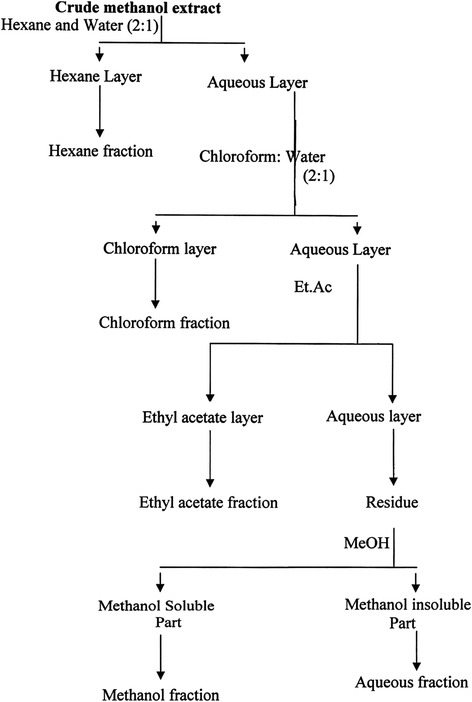
An in vitro thrombolytic model was used to check the clot lysis effect of the crude extracts and fractions of five Bangladeshi plant viz., Trema orientalis L., Bacopa monnieri L., Capsicum frutescens L., Brassica oleracea L. and Urena sinuata L. using streptokinase as a positive control and water as a negative control. Briefly, venous blood drawn from twenty healthy volunteers was allowed to form clots which were weighed and treated with the test plant materials to disrupt the clots. Weight of clot after and before treatment provided a percentage of clot lysis.
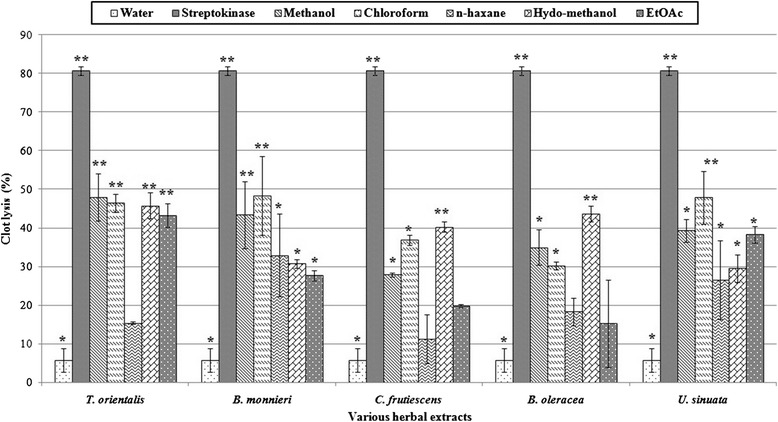
Using an in vitro thrombolytic model, different fractions of five Bangladeshi medicinal plants namely T. orientalis, B. monnieri, C. frutescens, B. oleracea and U. sinuata showed various range of clot lysis activity. Chloroform fractions of T. orientalis, B. monnieri, C. frutescens, B. oleracea and U. sinuata showed highest significant (P < 0.05 and P < 0.001) clot lysis activity viz., 46.44 ± 2.44%, 48.39 ± 10.12%, 36.87 ± .27%, 30.24 ± 0.95% and 47.89 ± 6.83% respectively compared with positive control standard streptokinase (80.77 ± 1.12%) and negative control sterile distilled water (5.69 ± 3.09%). Other fractions showed moderate to low clot lysis activity. Order of clot lysis activity was found to be: Streptokinase > Chloroform fractions > Methanol (crude) extract > Hydro-methanol fractions > Ethyl acetate fractions > n-hexane fractions > Water.
Our study suggests that thrombolytic activity of T. orientalis, B. monnieri and U. sinuata could be considered as very promising and beneficial for the Bangladeshi traditional medicine. Lower effects of other extracts might suggest the lack of bio-active components and/or insufficient quantities in the extract. In vivo clot dissolving property and active component(s) of T. orientalis and B. monnieri for clot lysis could lead the plants for their therapeutic uses. However, further work will establish whether or not, chloroform soluble phytochemicals from these plants could be incorporated as a thrombolytic agent for the improvement of the patients suffering from atherothrombotic diseases.
动脉血管血栓形成导致的缺血性中风发病率日益增高,是威胁全球人们健康和生命的主要因素之一。目前针对血栓形成的治疗方法仍不尽人意。草药制剂自古以来就被用于治疗多种疾病。本研究旨在探究草药制剂是否具有溶栓活性。
采用体外溶栓模型,以链激酶为阳性对照、水为阴性对照,检测五种孟加拉植物即山黄麻、假马齿苋、辣椒、甘蓝和刺蒴麻的粗提物及其馏分的凝块溶解效果。简要来说,采集20名健康志愿者的静脉血使其形成凝块,称重后用受试植物材料处理以破坏凝块。处理前后凝块的重量得出凝块溶解百分比。
使用体外溶栓模型,五种孟加拉药用植物即山黄麻、假马齿苋、辣椒、甘蓝和刺蒴麻的不同馏分表现出不同程度的凝块溶解活性。山黄麻、假马齿苋、辣椒、甘蓝和刺蒴麻的氯仿馏分显示出最高的显著(P < 0.05和P < 0.001)凝块溶解活性,分别为46.44 ± 2.44%、48.39 ± 10.12%、36.87 ± 0.27%、30.24 ± 0.95%和47.89 ± 6.83%,与阳性对照标准链激酶(80.77 ± 1.12%)和阴性对照无菌蒸馏水(5.69 ± 3.09%)相比。其他馏分表现出中度至低度的凝块溶解活性。发现凝块溶解活性顺序为:链激酶 > 氯仿馏分 > 甲醇(粗)提取物 > 氢甲醇馏分 > 乙酸乙酯馏分 > 正己烷馏分 > 水。
我们的数据表明,山黄麻、假马齿苋和刺蒴麻的溶栓活性对于孟加拉传统医学而言可能非常有前景且有益。其他提取物效果较低可能表明提取物中缺乏生物活性成分和/或含量不足。山黄麻和假马齿苋的体内凝块溶解特性及用于凝块溶解的活性成分可能使其具有治疗用途。然而,进一步的研究将确定这些植物中氯仿可溶的植物化学物质是否可作为溶栓剂用于改善患有动脉粥样血栓形成疾病的患者。