Musat Florin
Helmholtz Centre for Environmental Research - UFZ, Permoserstr. 15, 04318 Leipzig, Germany.
Comput Struct Biotechnol J. 2015 Mar 19;13:222-8. doi: 10.1016/j.csbj.2015.03.002. eCollection 2015.
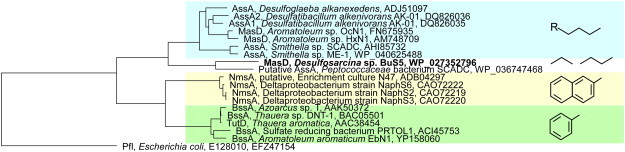
The short chain, gaseous alkanes ethane, propane, n- and iso-butane are released in significant amounts into the atmosphere, where they contribute to tropospheric chemistry and ozone formation. Biodegradation of gaseous alkanes by aerobic microorganisms, mostly bacteria and fungi isolated from terrestrial environments, has been known for several decades. The first indications for short chain alkane anaerobic degradation were provided by geochemical studies of deep-sea environments around hydrocarbon seeps, and included the uncoupling of the sulfate-reduction and anaerobic oxidation of methane rates, the consumption of gaseous alkanes in anoxic sediments, or the enrichment in (13)C of gases in interstitial water vs. the source gas. Microorganisms able to degrade gaseous alkanes were recently obtained from deep-sea and terrestrial sediments around hydrocarbon seeps. Up to date, only sulfate-reducing pure or enriched cultures with ethane, propane and n-butane have been reported. The only pure culture presently available, strain BuS5, is affiliated to the Desulfosarcina-Desulfococcus cluster of the Deltaproteobacteria. Other phylotypes involved in gaseous alkane degradation have been identified based on stable-isotope labeling and whole-cell hybridization. Under anoxic conditions, propane and n-butane are activated similar to the higher alkanes, by homolytic cleavage of the C-H bond of a subterminal carbon atom, and addition of the ensuing radical to fumarate, yielding methylalkylsuccinates. An additional mechanism of activation at the terminal carbon atoms was demonstrated for propane, which could in principle be employed also for the activation of ethane.
短链气态烷烃乙烷、丙烷、正丁烷和异丁烷大量释放到大气中,在那里它们参与对流层化学和臭氧形成。几十年来,人们已知需氧微生物(主要是从陆地环境中分离出的细菌和真菌)对气态烷烃具有生物降解作用。对烃类渗漏周围深海环境的地球化学研究首次提供了短链烷烃厌氧降解的迹象,包括硫酸盐还原与甲烷厌氧氧化速率的解耦、缺氧沉积物中气态烷烃的消耗,或孔隙水中气体相对于源气体的(13)C富集。最近从烃类渗漏周围的深海和陆地沉积物中获得了能够降解气态烷烃的微生物。到目前为止,仅报道了能降解乙烷、丙烷和正丁烷的硫酸盐还原纯培养物或富集培养物。目前唯一可用的纯培养物菌株BuS5属于δ-变形菌纲的脱硫八叠球菌-脱硫球菌簇。基于稳定同位素标记和全细胞杂交已鉴定出参与气态烷烃降解的其他系统发育型。在缺氧条件下,丙烷和正丁烷与高级烷烃类似,通过亚末端碳原子的C-H键均裂活化,并将产生的自由基加成到富马酸酯上,生成甲基烷基琥珀酸酯。已证明丙烷在末端碳原子处存在另一种活化机制,原则上该机制也可用于乙烷的活化。