Chang Cindy M, Corey Catherine G, Rostron Brian L, Apelberg Benjamin J
Office of Science, Center for Tobacco Products, Food and Drug Administration, Document Control Center, Building 71, Room G335, 10903 ,New Hampshire Avenue, Silver Spring, MD, 20993-0002, USA.
BMC Public Health. 2015 Apr 24;15:390. doi: 10.1186/s12889-015-1617-5.
Cigars are a growing public health concern, given the changes in cigar use patterns in the US and elsewhere since the 1960s. We conducted a systematic review of published studies on current cigar smoking and all-cause and cause-specific mortality risks to inform potential regulatory approaches and future research that would strengthen the body of evidence.
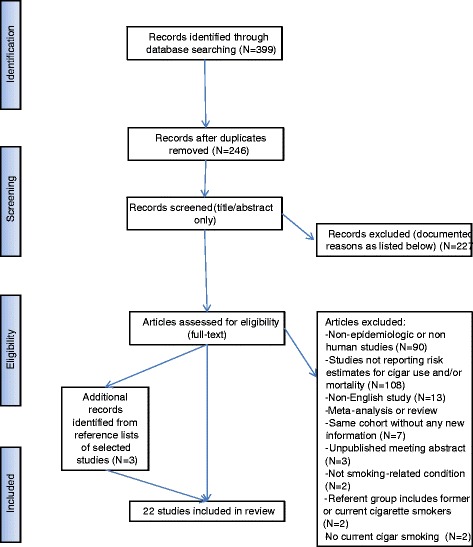
Using 3 different databases and handsearching, we identified epidemiological studies published prior to June 2014 that examined the association between cigar smoking and all-cause mortality and smoking-related mortality. Detailed study characteristics as well as association-level characteristics, including effect estimates and 95% confidence intervals, were abstracted or calculated from each selected study.
A total of 22 studies from 16 different prospective cohorts were identified. Primary cigar smoking (current, exclusive cigar smoking with no history of previous cigarette or pipe smoking) was associated with all cause-mortality, oral cancer, esophageal cancer, pancreatic cancer, laryngeal cancer, lung cancer, coronary heart disease (CHD), and aortic aneurysm. Strong dose trends by cigars per day and inhalation level for primary cigar smoking were observed for oral, esophageal, laryngeal, and lung cancers. Among primary cigar smokers reporting no inhalation, relative mortality risk was still highly elevated for oral, esophageal, and laryngeal cancers.
In summary, cigar smoking carries many of the same health risks as cigarette smoking. Mortality risks from cigar smoking vary by level of exposure as measured by cigars per day and inhalation level and can be as high as or exceed those of cigarette smoking. The body of evidence would be strengthened by future studies that focus on the health effects of primary cigar smoking and incorporate more contemporary and diverse study populations to better reflect the current patterns of cigar use in the US. Ideally, these studies would also collect detailed information on cigar type, exposure level, and biomarkers of exposure and potential harm.
鉴于自20世纪60年代以来美国及其他地区雪茄使用模式的变化,雪茄日益引起公众对健康的关注。我们对已发表的关于当前雪茄吸烟与全因死亡率及特定病因死亡率风险的研究进行了系统综述,以为潜在的监管方法和未来研究提供信息,从而加强证据体系。
我们使用3个不同的数据库并进行手工检索,确定了2014年6月之前发表的流行病学研究,这些研究考察了雪茄吸烟与全因死亡率及吸烟相关死亡率之间的关联。从每项选定研究中提取或计算详细的研究特征以及关联水平特征,包括效应估计值和95%置信区间。
共识别出16个不同前瞻性队列的22项研究。原发性雪茄吸烟(当前,仅吸雪茄且无既往卷烟或烟斗吸烟史)与全因死亡率、口腔癌、食管癌、胰腺癌、喉癌、肺癌、冠心病和主动脉瘤相关。观察到原发性雪茄吸烟在口腔癌、食管癌、喉癌和肺癌方面,按每日雪茄数量和吸入水平呈现出强烈的剂量趋势。在报告不吸入的原发性雪茄吸烟者中口腔癌、食管癌和喉癌的相对死亡风险仍然大幅升高。
总之,吸雪茄带来许多与吸烟相同的健康风险。雪茄吸烟的死亡风险因每日雪茄数量和吸入水平所衡量的暴露程度而异,可能高达或超过吸烟的风险。未来聚焦于原发性雪茄吸烟健康影响并纳入更具当代性和多样性研究人群以更好反映美国当前雪茄使用模式的研究将加强证据体系。理想情况下,这些研究还将收集有关雪茄类型、暴露水平以及暴露和潜在危害生物标志物的详细信息。