Crisp Ryan W, Kroupa Daniel M, Marshall Ashley R, Miller Elisa M, Zhang Jianbing, Beard Matthew C, Luther Joseph M
1] National Renewable Energy Laboratory, Golden, CO 80401 USA [2] Department of Physics, Colorado School of Mines, Golden, CO 80401 USA.
1] National Renewable Energy Laboratory, Golden, CO 80401 USA [2] Department of Chemistry and Biochemistry, University of Colorado, Boulder, CO 80309 USA.
Sci Rep. 2015 Apr 24;5:9945. doi: 10.1038/srep09945.
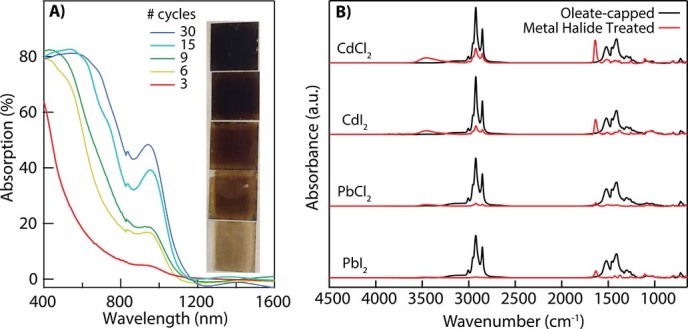
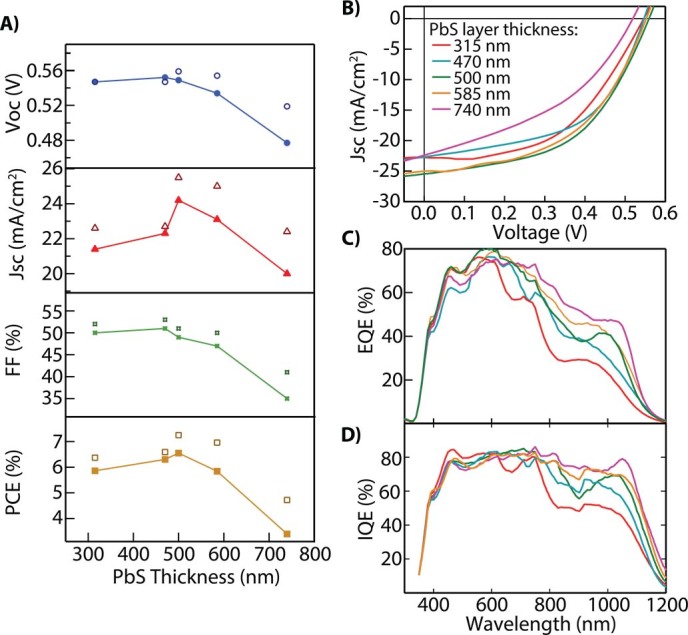
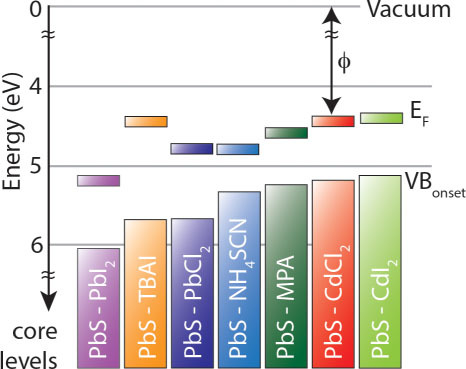
We developed a layer-by-layer method of preparing PbE (E = S or Se) quantum dot (QD) solar cells using metal halide (PbI2, PbCl2, CdI2, or CdCl2) salts dissolved in dimethylformamide to displace oleate surface ligands and form conductive QD solids. The resulting QD solids have a significant reduction in the carbon content compared to films treated with thiols and organic halides. We find that the PbI2 treatment is the most successful in removing alkyl surface ligands and also replaces most surface bound Cl(-) with I(-). The treatment protocol results in PbS QD films exhibiting a deeper work function and band positions than other ligand exchanges reported previously. The method developed here produces solar cells that perform well even at film thicknesses approaching a micron, indicating improved carrier transport in the QD films. We demonstrate QD solar cells based on PbI2 with power conversion efficiencies above 7%.
我们开发了一种逐层制备PbE(E = S或Se)量子点(QD)太阳能电池的方法,该方法使用溶解在二甲基甲酰胺中的金属卤化物(PbI2、PbCl2、CdI2或CdCl2)盐来取代油酸酯表面配体并形成导电的量子点固体。与用硫醇和有机卤化物处理的薄膜相比,所得的量子点固体中的碳含量显著降低。我们发现,PbI2处理在去除烷基表面配体方面最为成功,并且还用I(-)取代了大多数表面结合的Cl(-)。该处理方案导致PbS量子点薄膜表现出比先前报道的其他配体交换更深的功函数和能带位置。这里开发的方法生产的太阳能电池即使在薄膜厚度接近一微米时也能表现良好,这表明量子点薄膜中的载流子传输得到了改善。我们展示了基于PbI2的量子点太阳能电池,其功率转换效率高于7%。