Jansen F Marijke, Prins Rick G, Etman Astrid, van der Ploeg Hidde P, de Vries Sanne I, van Lenthe Frank J, Pierik Frank H
Department of Urban Environment and Safety, TNO, Utrecht, The Netherlands; Human geography and Planning, Utrecht University, Utrecht, The Netherlands.
Department of Public Health, Erasmus MC, Rotterdam, The Netherlands.
PLoS One. 2015 Apr 24;10(4):e0123168. doi: 10.1371/journal.pone.0123168. eCollection 2015.
Physical activity (PA) is important for healthy ageing. Better insight into objectively measured PA levels in older adults is needed, since most previous studies employed self-report measures for PA assessment, which are associated with overestimation of PA.
This study aimed to provide insight in objectively measured indoor and outdoor PA of older adults, and in PA differences by frailty levels.
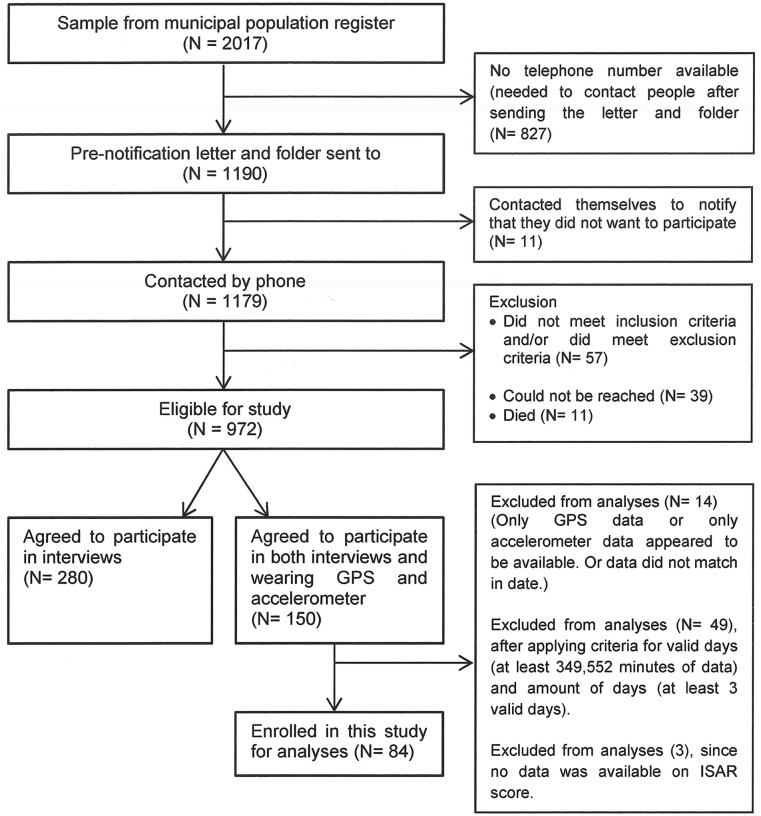
Data were collected among non-frail (N = 74) and frail (N = 10) subjects, aged 65 to 89 years. PA, measured for seven days with accelerometers and GPS-devices, was categorized into three levels of intensity (sedentary, light, and moderate-to-vigorous PA).
Older adults spent most time in sedentary and light PA. Subjects spent 84.7%, 15.1% and 0.2% per day in sedentary, light and moderate-to-vigorous PA respectively. On average, older adults spent 9.8 (SD 23.7) minutes per week in moderate-to-vigorous activity, and 747.0 (SD 389.6) minutes per week in light activity. None of the subjects met the WHO recommendations of 150 weekly minutes of moderate-to-vigorous PA. Age-, sex- and health status-adjusted results revealed no differences in PA between non-frail and frail older adults. Subjects spent significantly more sedentary time at home, than not at home. Non-frail subjects spent significantly more time not at home during moderate-to-vigorous activities, than at home.
Objective assessment of PA in older adults revealed that most PA was of light intensity, and time spent in moderate-to-vigorous PA was very low. None of the older adults met the World Health Organization recommendations for PA. These levels of MVPA are much lower than generally reported based on self-reported PA. Future studies should employ objective methods, and age specific thresholds for healthy PA levels in older adults are needed. These results emphasize the need for effective strategies for healthy PA levels for the growing proportion of older adults.
身体活动对健康老龄化很重要。由于之前的大多数研究采用自我报告的方式来评估身体活动,这往往会高估身体活动水平,因此需要更深入地了解老年人通过客观测量得出的身体活动水平。
本研究旨在深入了解老年人通过客观测量得出的室内和室外身体活动情况,以及不同衰弱程度下身体活动的差异。
收集了74名非衰弱和10名衰弱受试者的数据,年龄在65至89岁之间。使用加速度计和全球定位系统设备测量七天的身体活动,并将其分为三个强度级别(久坐、轻度和中度至剧烈身体活动)。
老年人大部分时间处于久坐和轻度身体活动状态。受试者每天分别有84.7%、15.1%和0.2%的时间处于久坐、轻度和中度至剧烈身体活动状态。平均而言,老年人每周进行中度至剧烈活动的时间为9.8(标准差23.7)分钟,每周进行轻度活动的时间为747.0(标准差389.6)分钟。没有一名受试者达到世界卫生组织每周150分钟中度至剧烈身体活动的建议。年龄、性别和健康状况调整后的结果显示,非衰弱和衰弱老年人在身体活动方面没有差异。受试者在家中久坐的时间明显多于不在家的时间。非衰弱受试者在进行中度至剧烈活动时不在家的时间明显多于在家的时间。
对老年人身体活动的客观评估表明,大部分身体活动为轻度强度,中度至剧烈身体活动的时间非常少。没有一名老年人达到世界卫生组织关于身体活动的建议。这些中度至剧烈身体活动水平远低于基于自我报告的身体活动所普遍报告的水平。未来的研究应采用客观方法,并且需要针对老年人健康身体活动水平制定特定年龄的阈值。这些结果强调了为越来越多的老年人制定有效策略以达到健康身体活动水平的必要性。