Cai Na, Chang Simon, Li Yihan, Li Qibin, Hu Jingchu, Liang Jieqin, Song Li, Kretzschmar Warren, Gan Xiangchao, Nicod Jerome, Rivera Margarita, Deng Hong, Du Bo, Li Keqing, Sang Wenhu, Gao Jingfang, Gao Shugui, Ha Baowei, Ho Hung-Yao, Hu Chunmei, Hu Jian, Hu Zhenfei, Huang Guoping, Jiang Guoqing, Jiang Tao, Jin Wei, Li Gongying, Li Kan, Li Yi, Li Yingrui, Li Youhui, Lin Yu-Ting, Liu Lanfen, Liu Tiebang, Liu Ying, Liu Yuan, Lu Yao, Lv Luxian, Meng Huaqing, Qian Puyi, Sang Hong, Shen Jianhua, Shi Jianguo, Sun Jing, Tao Ming, Wang Gang, Wang Guangbiao, Wang Jian, Wang Linmao, Wang Xueyi, Wang Xumei, Yang Huanming, Yang Lijun, Yin Ye, Zhang Jinbei, Zhang Kerang, Sun Ning, Zhang Wei, Zhang Xiuqing, Zhang Zhen, Zhong Hui, Breen Gerome, Wang Jun, Marchini Jonathan, Chen Yiping, Xu Qi, Xu Xun, Mott Richard, Huang Guo-Jen, Kendler Kenneth, Flint Jonathan
Wellcome Trust Centre for Human Genetics, University of Oxford, Roosevelt Drive, Oxford, Oxfordshire OX3 7BN, UK.
Department and Graduate Institute of Biomedical Sciences, College of Medicine, Chang Gung University, Tao-Yuan 33302, Taiwan, ROC.
Curr Biol. 2015 May 4;25(9):1146-56. doi: 10.1016/j.cub.2015.03.008. Epub 2015 Apr 23.
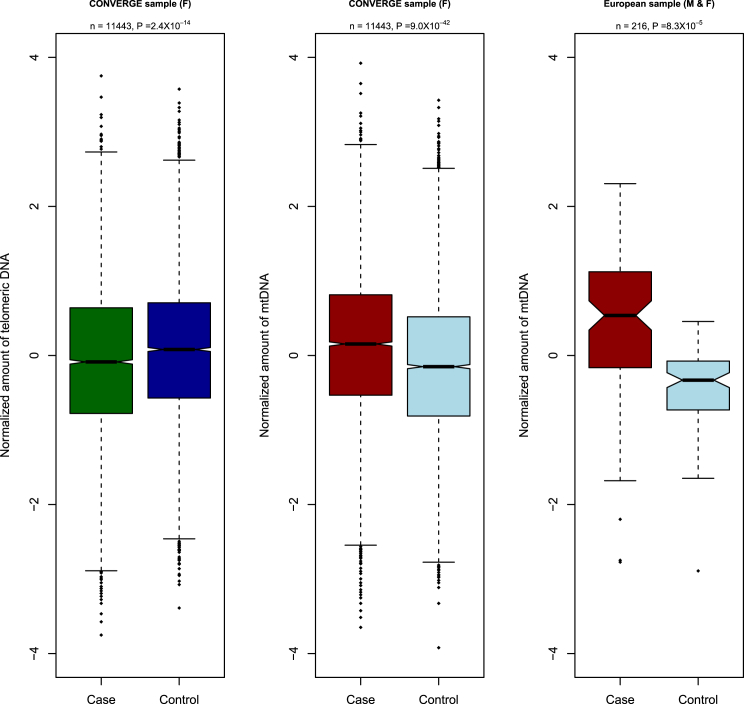
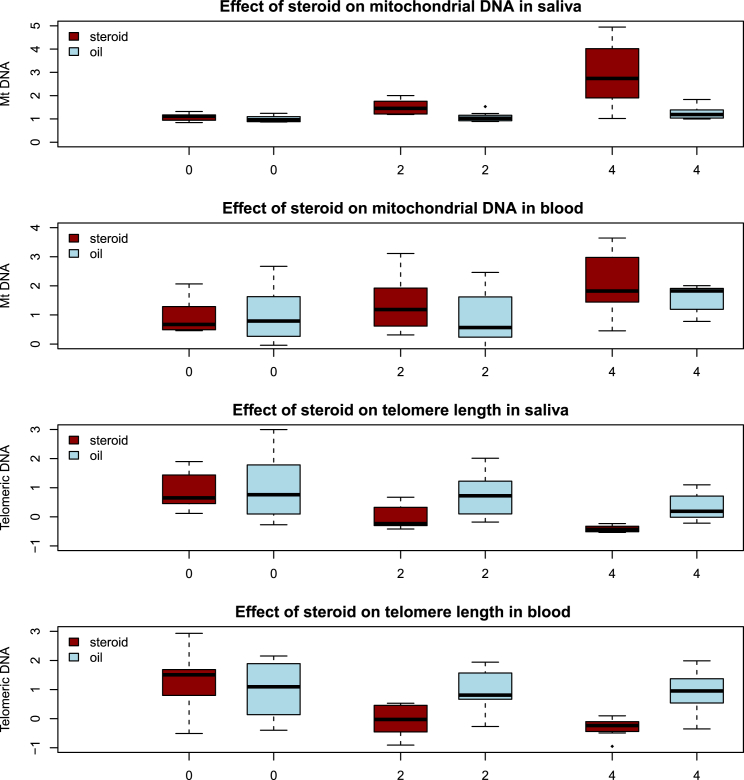
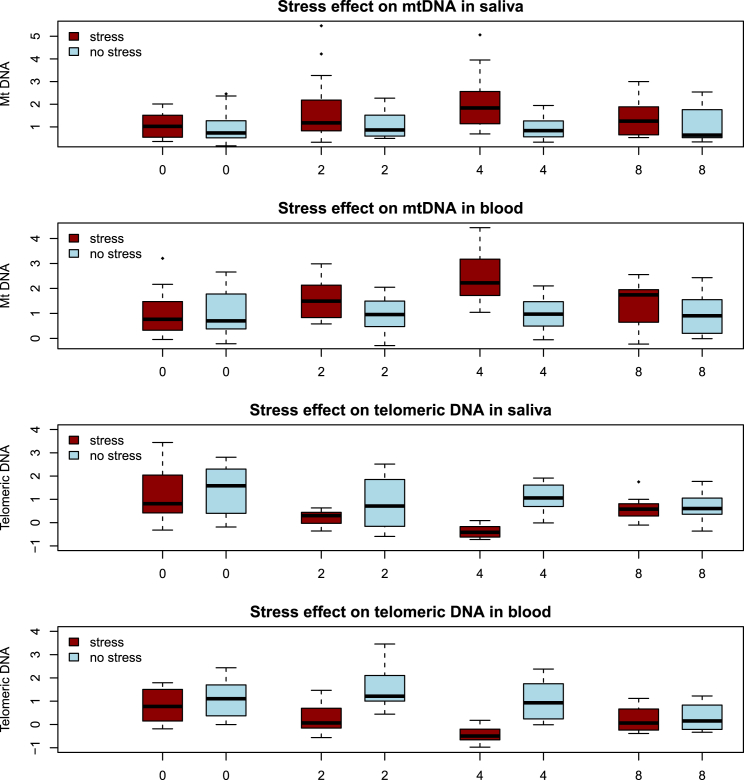
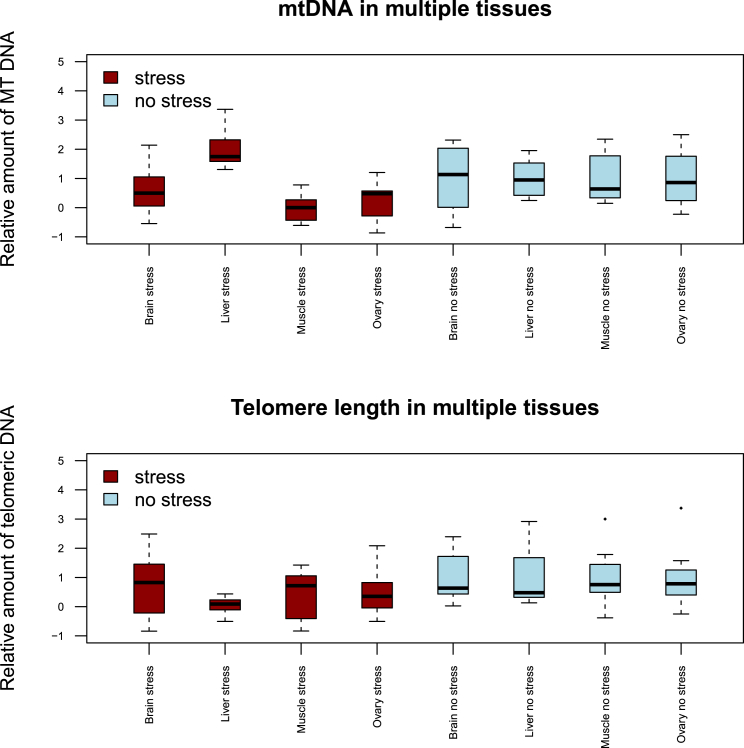
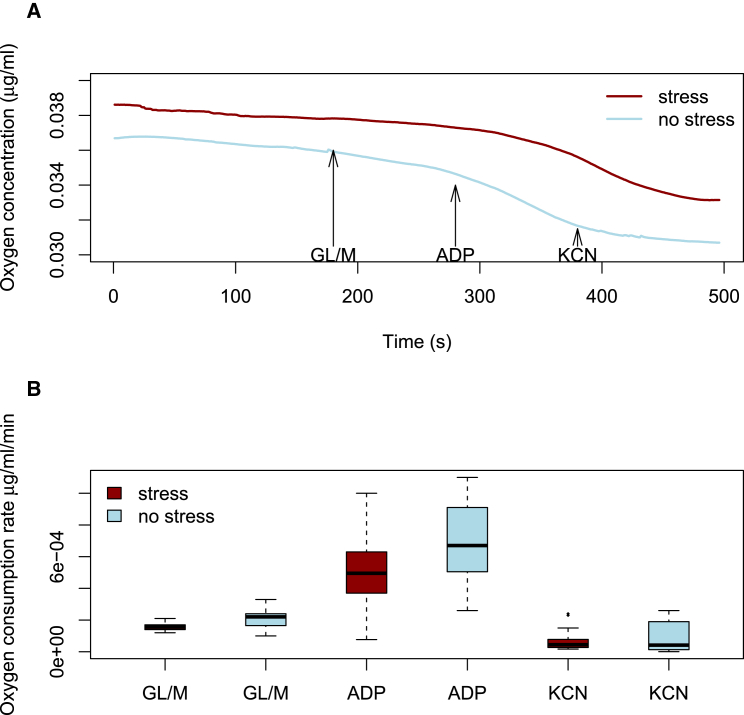
Adversity, particularly in early life, can cause illness. Clues to the responsible mechanisms may lie with the discovery of molecular signatures of stress, some of which include alterations to an individual's somatic genome. Here, using genome sequences from 11,670 women, we observed a highly significant association between a stress-related disease, major depression, and the amount of mtDNA (p = 9.00 × 10(-42), odds ratio 1.33 [95% confidence interval [CI] = 1.29-1.37]) and telomere length (p = 2.84 × 10(-14), odds ratio 0.85 [95% CI = 0.81-0.89]). While both telomere length and mtDNA amount were associated with adverse life events, conditional regression analyses showed the molecular changes were contingent on the depressed state. We tested this hypothesis with experiments in mice, demonstrating that stress causes both molecular changes, which are partly reversible and can be elicited by the administration of corticosterone. Together, these results demonstrate that changes in the amount of mtDNA and telomere length are consequences of stress and entering a depressed state. These findings identify increased amounts of mtDNA as a molecular marker of MD and have important implications for understanding how stress causes the disease.
逆境,尤其是在生命早期,会引发疾病。相关机制的线索可能在于应激分子特征的发现,其中一些特征包括个体体细胞基因组的改变。在此,我们利用11670名女性的基因组序列,观察到一种与应激相关的疾病——重度抑郁症,与线粒体DNA数量(p = 9.00 × 10⁻⁴²,优势比1.33 [95%置信区间[CI]= 1.29 - 1.37])以及端粒长度(p = 2.84 × 10⁻¹⁴,优势比0.85 [95% CI = 0.81 - 0.89])之间存在高度显著的关联。虽然端粒长度和线粒体DNA数量均与不良生活事件相关,但条件回归分析表明,这些分子变化取决于抑郁状态。我们通过小鼠实验验证了这一假设,结果表明应激会导致这两种分子变化,这些变化部分是可逆的,并且可以通过给予皮质酮引发。总之,这些结果表明线粒体DNA数量和端粒长度的变化是应激和进入抑郁状态的结果。这些发现确定线粒体DNA数量增加是重度抑郁症的一个分子标志物,对于理解应激如何导致该疾病具有重要意义。