Bertrand Chantal, Valet Philippe, Castan-Laurell Isabelle
Institut National de la Santé et de la Recherche Médicale, U1048 Toulouse, France ; Institut des Maladies Métaboliques et Cardiovasculaires (I2MC), Université Toulouse III-Paul Sabatier Toulouse, France.
Front Physiol. 2015 Apr 10;6:115. doi: 10.3389/fphys.2015.00115. eCollection 2015.
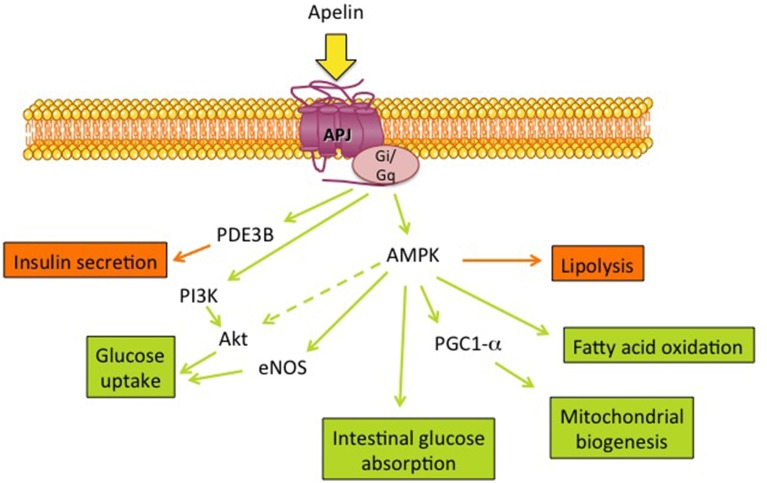
A wide range of adipokines identified over the past years has allowed considering the white adipose tissue as a secretory organ closely integrated into overall physiological and metabolic control. Apelin, a ubiquitously expressed peptide was known to exert different physiological effects mainly on the cardiovascular system and the regulation of fluid homeostasis prior to its characterization as an adipokine. This has broadened its range of action and apelin now appears clearly as a new player in energy metabolism in addition to leptin and adiponectin. Apelin has been shown to act on glucose and lipid metabolism but also to modulate insulin secretion. Moreover, different studies in both animals and humans have shown that plasma apelin concentrations are usually increased during obesity and type 2 diabetes. This mini-review will focus on the various systemic apelin effects on energy metabolism by addressing its mechanisms of action. The advances concerning the role of apelin in metabolic diseases in relation with the recent reports on apelin concentrations in obese and/or diabetic subjects will also be discussed.
在过去几年中发现的多种脂肪因子使人们将白色脂肪组织视为一个紧密整合到整体生理和代谢控制中的分泌器官。Apelin是一种广泛表达的肽,在被鉴定为脂肪因子之前,已知它主要对心血管系统和液体稳态调节发挥不同的生理作用。这拓宽了它的作用范围,现在Apelin除了瘦素和脂联素外,显然已成为能量代谢中的一个新参与者。Apelin已被证明作用于葡萄糖和脂质代谢,还能调节胰岛素分泌。此外,在动物和人类中的不同研究表明,肥胖和2型糖尿病期间血浆Apelin浓度通常会升高。本综述将通过探讨其作用机制,重点关注Apelin对能量代谢的各种全身效应。还将讨论Apelin在代谢疾病中的作用进展以及最近关于肥胖和/或糖尿病患者Apelin浓度的报道。