Martin Justin W, Cushman Fiery
Department of Psychology, Harvard University, Cambridge, Massachusetts, United States of America.
PLoS One. 2015 Apr 27;10(4):e0125193. doi: 10.1371/journal.pone.0125193. eCollection 2015.
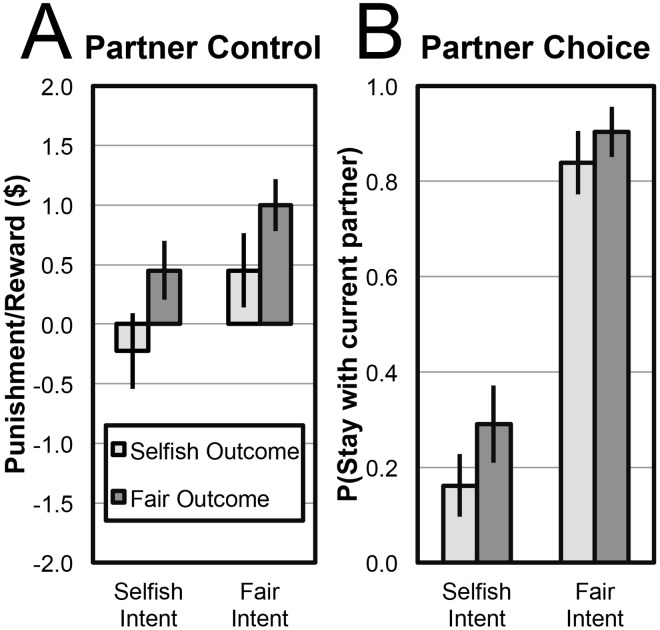
When a cooperative partner defects, at least two types of response are available: Punishment, aimed at modifying behavior, and ostracism, aimed at avoiding further social interaction with the partner. These options, termed partner control and partner choice, have been distinguished at behavioral and evolutionary levels. However, little work has compared their cognitive bases. Do these disparate behaviors depend on common processes of moral evaluation? Specifically, we assess whether they show identical patterns of dependence on two key dimensions of moral evaluation: A person's intentions, and the outcomes that they cause. We address this issue in a "trembling hand" economic game. In this game, an allocator divides a monetary stake between themselves and a responder based on a stochastic mechanism. This allows for dissociations between the allocator's intent and the actual outcome. Responders were either given the opportunity to punish or reward the allocator (partner control) or to switch to a different partner for a subsequent round of play (partner choice). Our results suggest that partner control and partner choice behaviors are supported by distinct underlying cognitive processes: Partner control exhibits greater sensitivity to the outcomes a partner causes, while partner choice is influenced almost exclusively by a partner's intentions. This cognitive dissociation can be understood in light of the unique adaptive functions of partner control and partner choice.
当合作伙伴出现背叛行为时,至少有两种应对方式可供选择:惩罚,旨在改变其行为;排斥,旨在避免与该伙伴进一步进行社会互动。这两种方式,即所谓的伙伴控制和伙伴选择,已在行为和进化层面上得到区分。然而,很少有研究对它们的认知基础进行比较。这些不同的行为是否依赖于共同的道德评价过程?具体而言,我们评估它们在道德评价的两个关键维度上是否表现出相同的依赖模式:一个人的意图以及他们所造成的结果。我们在一个“颤抖手”经济博弈中探讨这个问题。在这个博弈中,分配者基于随机机制在自己和回应者之间分配一笔金钱赌注。这使得分配者的意图和实际结果之间出现分离。回应者要么有机会惩罚或奖励分配者(伙伴控制),要么在后续轮次中选择更换伙伴(伙伴选择)。我们的结果表明,伙伴控制和伙伴选择行为由不同的潜在认知过程支持:伙伴控制对伙伴造成的结果表现出更高的敏感性,而伙伴选择几乎完全受伙伴意图的影响。鉴于伙伴控制和伙伴选择独特的适应性功能,这种认知分离是可以理解的。