Young Liane, Nichols Shaun, Saxe Rebecca
Rev Philos Psychol. 2010 Sep;1(3):333-349. doi: 10.1007/s13164-010-0027-y. Epub 2010 Mar 25.
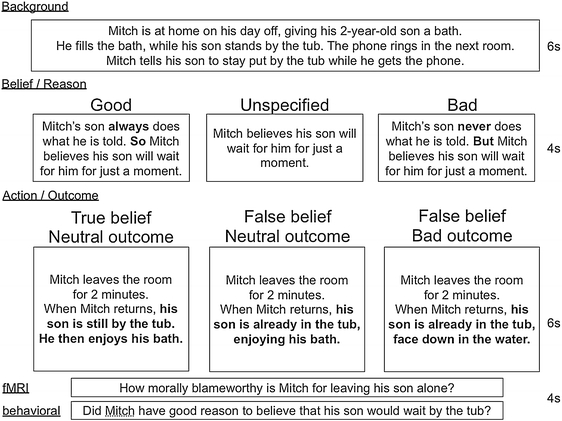
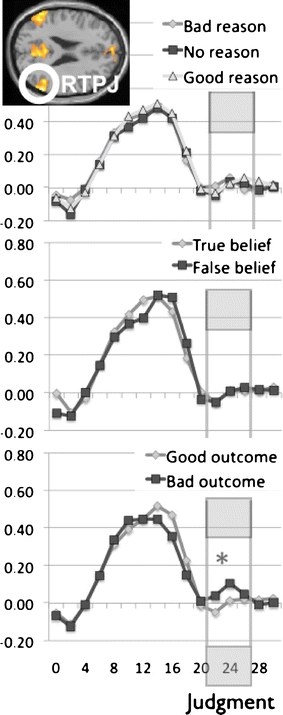
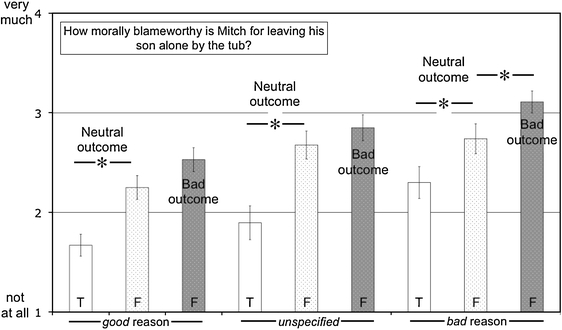
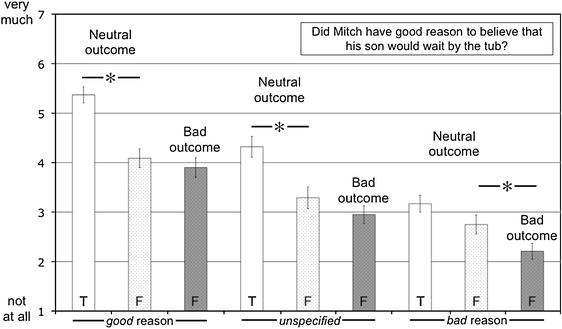
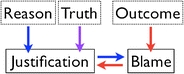
Moral judgments, we expect, ought not to depend on luck. A person should be blamed only for actions and outcomes that were under the person's control. Yet often, moral judgments appear to be influenced by luck. A father who leaves his child by the bath, after telling his child to stay put and believing that he will stay put, is judged to be morally blameworthy if the child drowns (an unlucky outcome), but not if his child stays put and doesn't drown. Previous theories of moral luck suggest that this asymmetry reflects primarily the influence of unlucky outcomes on moral judgments. In the current study, we use behavioral methods and fMRI to test an alternative: these moral judgments largely reflect participants' judgments of the agent's beliefs. In "moral luck" scenarios, the unlucky agent also holds a false belief. Here, we show that moral luck depends more on false beliefs than bad outcomes. We also show that participants with false beliefs are judged as having less justified beliefs and are therefore judged as more morally blameworthy. The current study lends support to a rationalist account of moral luck: moral luck asymmetries are driven not by outcome bias primarily, but by mental state assessments we endorse as morally relevant, i.e. whether agents are justified in thinking that they won't cause harm.
我们期望道德判断不应取决于运气。一个人只应为其能够控制的行为和结果受到责备。然而,道德判断似乎常常受到运气的影响。一位父亲在告诉孩子待在原地并相信孩子会照做后,把孩子留在浴缸边。如果孩子溺水(一个不幸的结果),这位父亲会被判定应受道德谴责,但如果孩子待在原地没有溺水,他就不会被这样判定。先前关于道德运气的理论表明,这种不对称主要反映了不幸结果对道德判断的影响。在当前的研究中,我们使用行为方法和功能磁共振成像来检验另一种观点:这些道德判断很大程度上反映了参与者对行为者信念的判断。在“道德运气”情境中,遭遇不幸的行为者也持有错误信念。在此,我们表明道德运气更多地取决于错误信念而非糟糕的结果。我们还表明,持有错误信念的参与者被判定为信念合理性较低,因此被判定为更应受道德谴责。当前的研究为道德运气的理性主义解释提供了支持:道德运气的不对称主要并非由结果偏差驱动,而是由我们认可为与道德相关的心理状态评估驱动,即行为者认为自己不会造成伤害是否合理。