Osanai Toshiya, Pasupuleti Vinay, Deshpande Abhishek, Thota Priyaleela, Roman Yuani, Hernandez Adrian V, Uchino Ken
Cerebrovascular Center, Cleveland Clinic, Cleveland, Ohio, United States of America.
Department of Medicine, Case Western Reserve University, Cleveland, Ohio, United States of America.
PLoS One. 2015 Apr 27;10(4):e0122806. doi: 10.1371/journal.pone.0122806. eCollection 2015.
Randomized controlled trials (RCTs) of endovascular therapy for acute ischemic stroke have had inconsistent results. We evaluated the efficacy and safety of endovascular therapy in published RCTs.
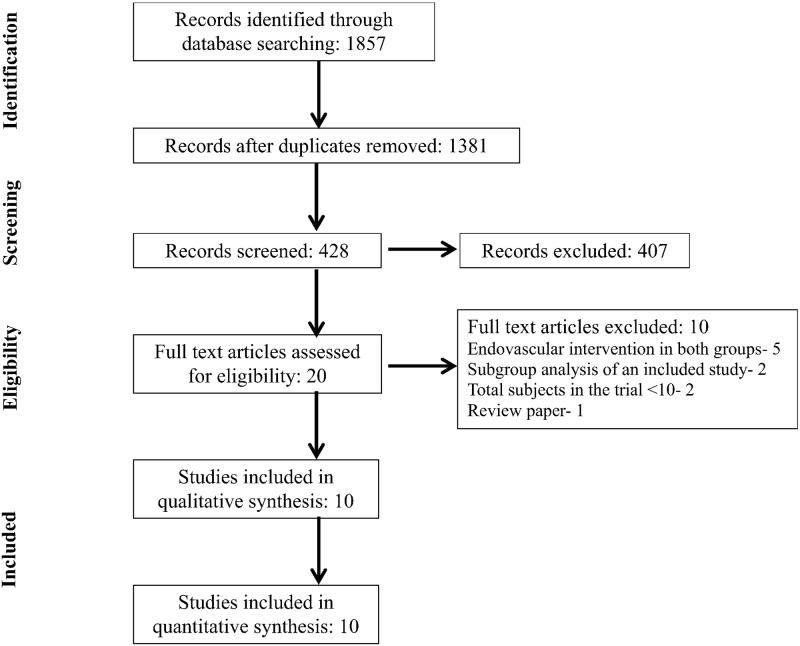
We performed a systematic review of RCTs of endovascular therapy with thrombolytic or mechanical reperfusion compared with interventions without endovascular therapy. Primary outcome was the frequency of good functional outcome (modified Rankin scale (mRS) of 0-2 at 90 days) and secondary outcomes were mortality at 90 days and symptomatic intracranial hemorrhage (sICH). Random-effects meta-analysis was performed and the Cochrane risk of bias assessment was used to evaluate quality of evidence.
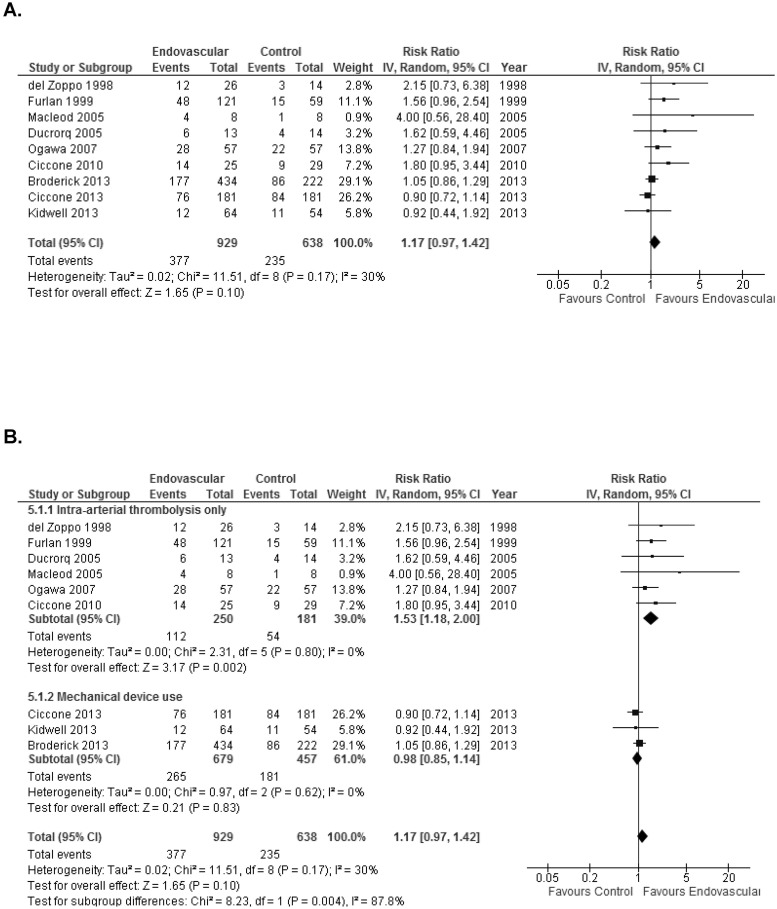
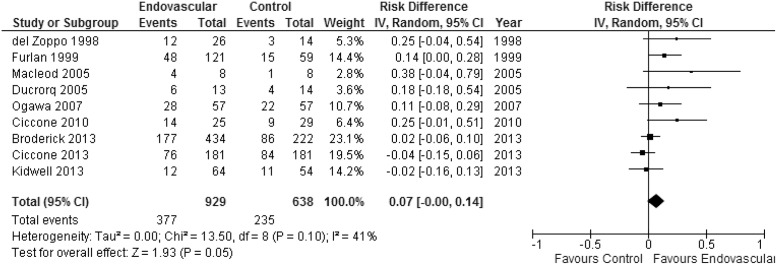
Ten studies involving 1,612 subjects were included. Endovascular therapy was not significantly associated with good functional outcome (Relative Risk [RR] =1.17; 95% CI, 0.97 to 1.42; p=0.10 and Absolute Risk Difference [ARD] =7%; 95%CI -0.1% to 14%; p=0.05); heterogeneity was moderate among studies (I2=30%). Mortality was unchanged with endovascular therapy (RR=0.92; 95 % CI, 0.75 to 1.13; p=0.45) and there was no difference in sICH (RR=1.20; 95 % CI, 0.79 to 1.82; p=0.39). The quality of evidence was low for all outcomes and the recommendation is weak for the use of endovascular therapy as per GRADE methodology.
Intra-arterial therapy did not show significant increase in good outcomes and no changes in either mortality or sICH in patients with acute ischemic stroke. We need further RCTs with better design and quality to evaluate the true efficacy of endovascular therapy.
急性缺血性卒中血管内治疗的随机对照试验(RCT)结果并不一致。我们评估了已发表的随机对照试验中血管内治疗的疗效和安全性。
我们对血管内溶栓或机械再灌注治疗与非血管内治疗干预措施的随机对照试验进行了系统评价。主要结局是良好功能结局的发生率(90天时改良Rankin量表(mRS)评分为0 - 2),次要结局是90天时的死亡率和症状性颅内出血(sICH)。进行随机效应荟萃分析,并使用Cochrane偏倚风险评估来评价证据质量。
纳入了10项研究,共1612名受试者。血管内治疗与良好功能结局无显著相关性(相对危险度[RR]=1.17;95%可信区间,0.97至1.42;p = 0.10,绝对危险度差[ARD]=7%;95%可信区间-0.1%至14%;p = 0.05);各研究间异质性为中度(I² = 30%)。血管内治疗后死亡率无变化(RR = 0.92;95%可信区间,0.75至1.13;p = 0.45),症状性颅内出血也无差异(RR = 1.20;95%可信区间,0.79至1.82;p = 0.39)。所有结局的证据质量均较低,根据GRADE方法,使用血管内治疗的推荐力度较弱。
动脉内治疗在急性缺血性卒中患者中未显示出良好结局显著增加,死亡率和症状性颅内出血也无变化。我们需要进一步设计和质量更好的随机对照试验来评估血管内治疗的真正疗效。