Stokely Shauna L, Peladeau-Pigeon Melanie, Leigh Chelsea, Molfenter Sonja M, Steele Catriona M
Toronto Rehabilitation Institute, University Health Network, 550 University Avenue, 12-101, Toronto, ON, M5G 2A2, Canada.
Dysphagia. 2015 Jun;30(3):349-56. doi: 10.1007/s00455-015-9606-5. Epub 2015 Apr 29.
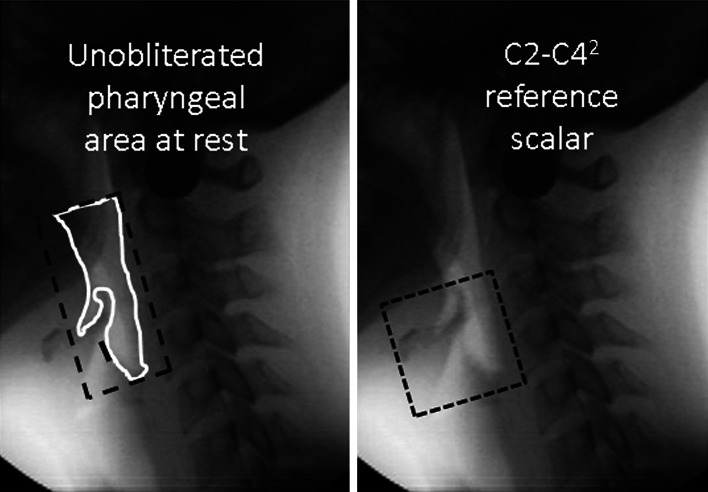
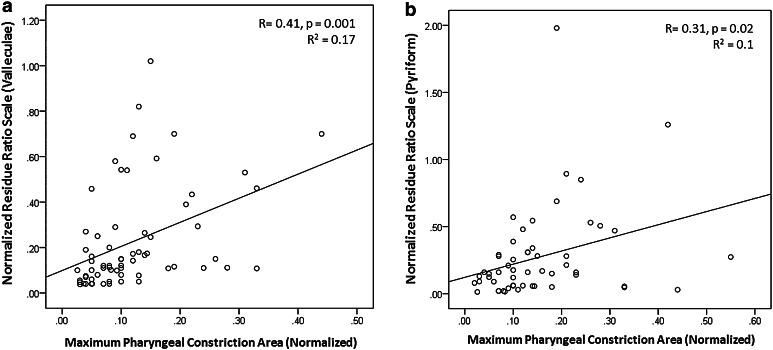
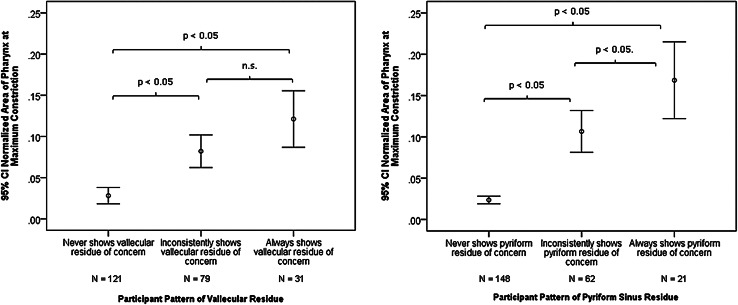
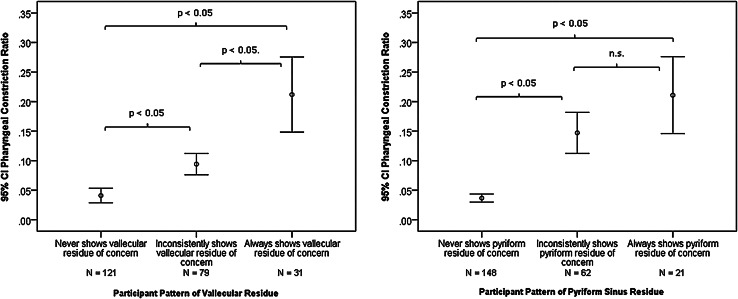
Pharyngeal constriction has been proposed as a parameter that may distinguish functional from impaired swallows. We employed anatomically normalized pixel-based measures of pharyngeal area at maximum constriction, and the ratio of this measure to area at rest, and explored the association between these measures and post-swallow residue using the normalized residue ratio scale (NRRS). Videofluoroscopy data for 5 ml boluses of 22 % (w/v) liquid barium were analyzed from 20 healthy young adults and 40 patients with suspected neurogenic dysphagia. The frames of maximum pharyngeal constriction and post-swallow hyoid rest were extracted. Pixel-based measures of pharyngeal area were made using ImageJ and size-normalized using the squared C2-C4 vertebral distance as a reference scalar. Post-swallow residue and the areas of the vallecular and pyriform sinus spaces were measured on the hyoid rest frame to calculate the NRRSv and NRRSp. The dataset was divided into swallows with residue within or exceeding the upper confidence interval boundary seen in the healthy participants. Mixed model repeated measures ANOVAs were used to compare pharyngeal area (rest, constriction) and the pharyngeal constriction ratio, between individuals with and without residue. Measures of pharyngeal area at maximum constriction were significantly larger (i.e., less constricted, p = 0.000) in individuals with post-swallow residue in either the valleculae or the pyriform sinus. These results support the idea that interventions targeted toward improving pharyngeal constriction have the potential to be effective in reducing post-swallow residue.
咽缩已被提议作为一个可能区分功能性吞咽和受损吞咽的参数。我们采用基于像素的解剖学标准化测量方法,测量最大收缩时的咽面积以及该测量值与静息时面积的比值,并使用标准化残留率量表(NRRS)探讨这些测量值与吞咽后残留物之间的关联。分析了20名健康年轻成年人和40名疑似神经源性吞咽困难患者吞咽22%(w/v)液体钡剂5毫升的视频荧光造影数据。提取了最大咽缩和吞咽后舌骨静止的图像帧。使用ImageJ进行基于像素的咽面积测量,并以C2 - C4椎体距离的平方作为参考标量进行尺寸标准化。在舌骨静止图像帧上测量吞咽后残留物以及梨状窝和会厌谷间隙的面积,以计算NRRSv和NRRSp。数据集被分为吞咽后残留物在健康参与者中观察到的上置信区间边界之内或之外的情况。使用混合模型重复测量方差分析来比较有和没有残留物的个体之间的咽面积(静息、收缩)和咽缩比。在会厌谷或梨状窝有吞咽后残留物的个体中,最大收缩时的咽面积测量值显著更大(即收缩程度更小,p = 0.000)。这些结果支持这样一种观点,即旨在改善咽缩的干预措施有可能有效减少吞咽后残留物。