Van Naarden Braun Kim, Christensen Deborah, Doernberg Nancy, Schieve Laura, Rice Catherine, Wiggins Lisa, Schendel Diana, Yeargin-Allsopp Marshalyn
Developmental Disabilities Branch, National Center on Birth Defects and Developmental Disabilities, Centers for Disease Control and Prevention, Atlanta, Georgia, United States of America.
PLoS One. 2015 Apr 29;10(4):e0124120. doi: 10.1371/journal.pone.0124120. eCollection 2015.
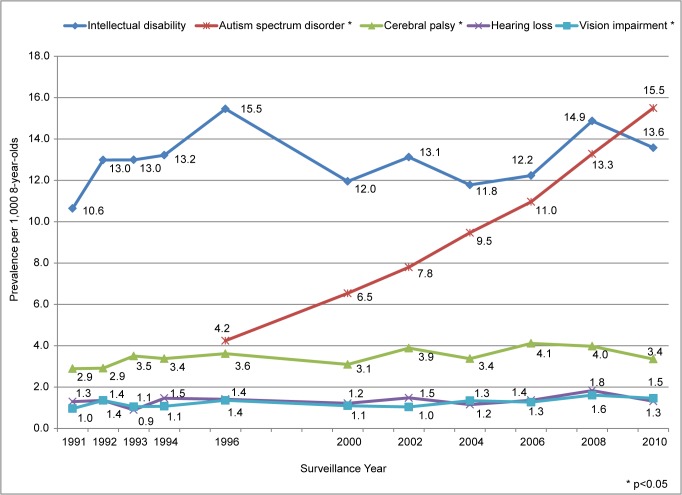
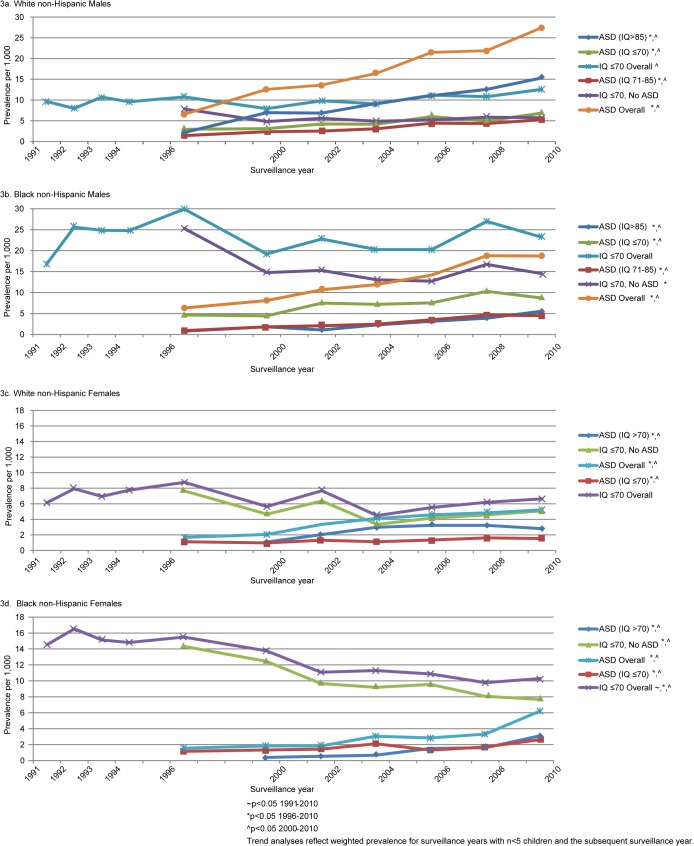
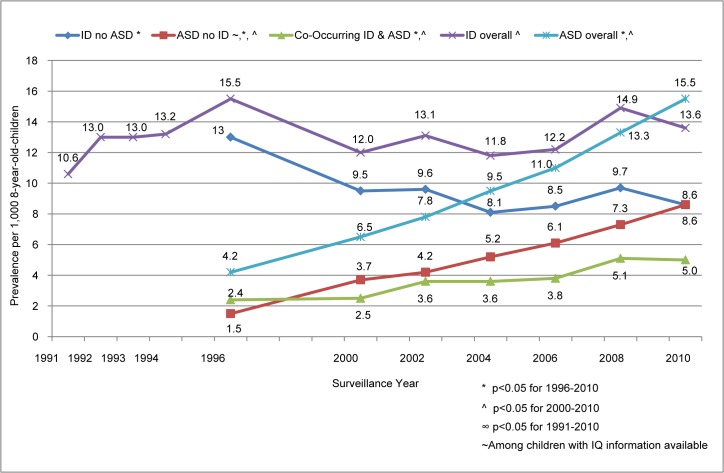
This study examined the prevalence and characteristics of autism spectrum disorder (ASD), cerebral palsy (CP), hearing loss (HL), intellectual disability (ID), and vision impairment (VI) over a 15-20 year time period, with specific focus on concurrent changes in ASD and ID prevalence. We used data from a population-based developmental disabilities surveillance program for 8-year-olds in metropolitan Atlanta. From 1991-2010, prevalence estimates of ID and HL were stable with slight increases in VI prevalence. CP prevalence was constant from 1993-2010. The average annual increase in ASD prevalence was 9.3% per year from 1996-2010, with a 269% increase from 4.2 per 1,000 in 1996 to 15.5 per 1,000 in 2010. From 2000-2010, the prevalence of ID without ASD was stable; during the same time, the prevalence of ASD with and without co-occurring ID increased by an average of 6.6% and 9.6% per year, respectively. ASD prevalence increases were found among both males and females, and among nearly all racial/ethnic subgroups and levels of intellectual ability. Average annual prevalence estimates from 1991-2010 underscore the significant community resources needed to provide early intervention and ongoing supports for children with ID (13.0 per 1,000), CP, (3.5 per 1,000), HL (1.4 per 1,000) and VI (1.3 in 1,000), with a growing urgency for children with ASD.
本研究调查了15至20年期间自闭症谱系障碍(ASD)、脑瘫(CP)、听力损失(HL)、智力残疾(ID)和视力障碍(VI)的患病率及特征,特别关注了ASD和ID患病率的同期变化。我们使用了来自亚特兰大大都市地区一项针对8岁儿童的基于人群的发育障碍监测项目的数据。1991年至2010年期间,ID和HL的患病率估计稳定,VI患病率略有上升。1993年至2010年期间,CP患病率保持不变。1996年至2010年期间,ASD患病率的年均增长率为9.3%,从1996年的每1000人中有4.2例增加到2010年的每1000人中有15.5例,增长了269%。2000年至2010年期间,无ASD的ID患病率稳定;在此期间,伴有和不伴有ID的ASD患病率分别平均每年增加6.6%和9.6%。在男性和女性中,以及几乎所有种族/族裔亚组和智力水平中,均发现ASD患病率有所增加。1991年至2010年的年均患病率估计凸显了为ID儿童(每1000人中有13.0例)、CP儿童(每1000人中有3.5例)、HL儿童(每1000人中有1.4例)和VI儿童(每1000人中有1.3例)提供早期干预和持续支持所需的大量社区资源,而对于ASD儿童来说,这种紧迫性日益增加。