Thurley Kevin, Gerecht Daniel, Friedmann Elfriede, Höfer Thomas
Division of Theoretical Systems Biology, German Cancer Research Center, Heidelberg, Germany; Institute for Theoretical Biology, Charité-Universitätsmedizin, Berlin, Germany; Department of Pharmaceutical Chemistry, University of California, San Francisco, San Francisco, California, United States of America.
Institute for Applied Mathematics, University of Heidelberg, Heidelberg, Germany.
PLoS Comput Biol. 2015 Apr 29;11(4):e1004206. doi: 10.1371/journal.pcbi.1004206. eCollection 2015 Apr.
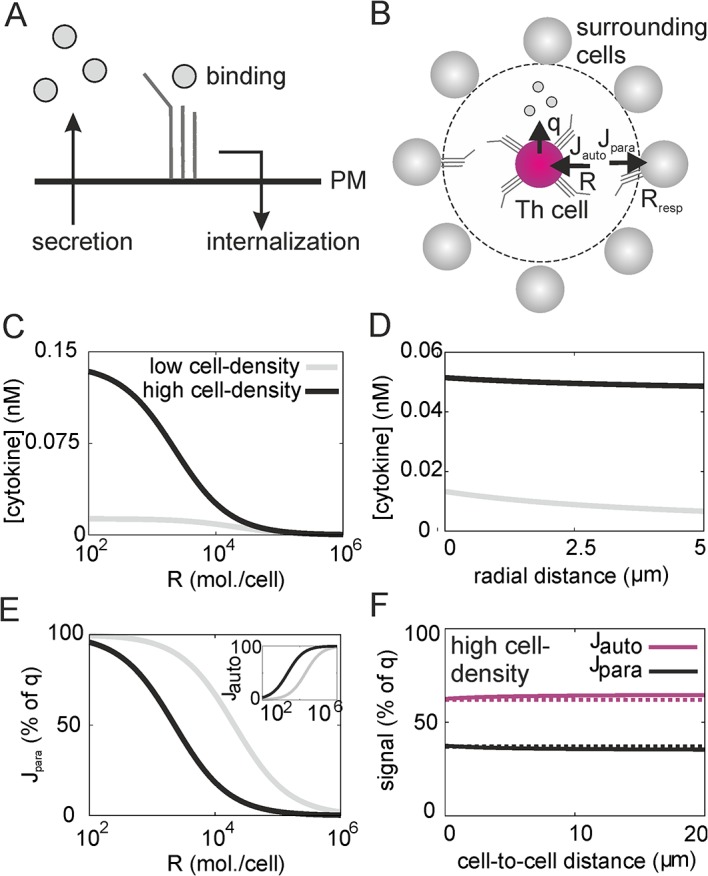
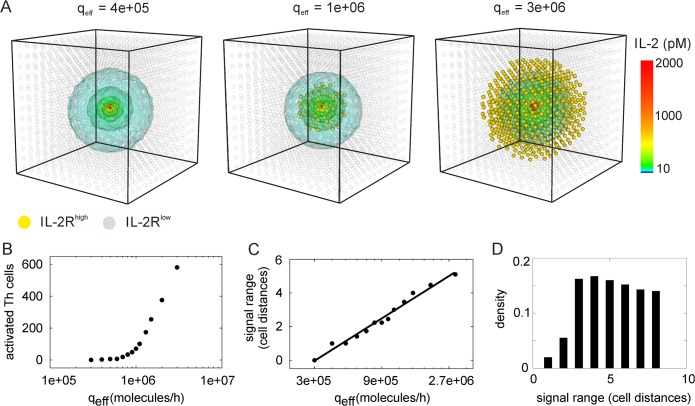
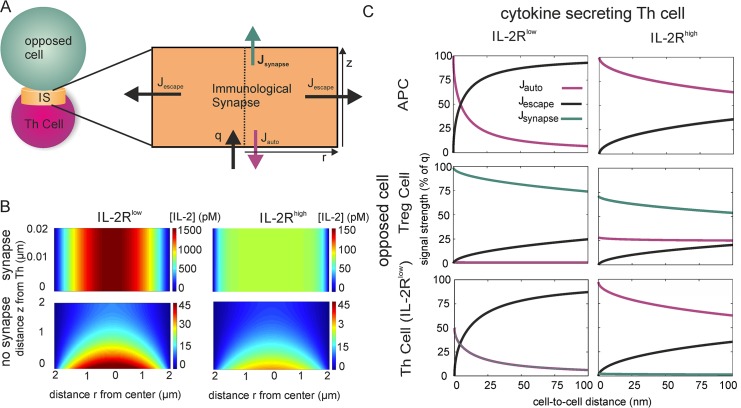
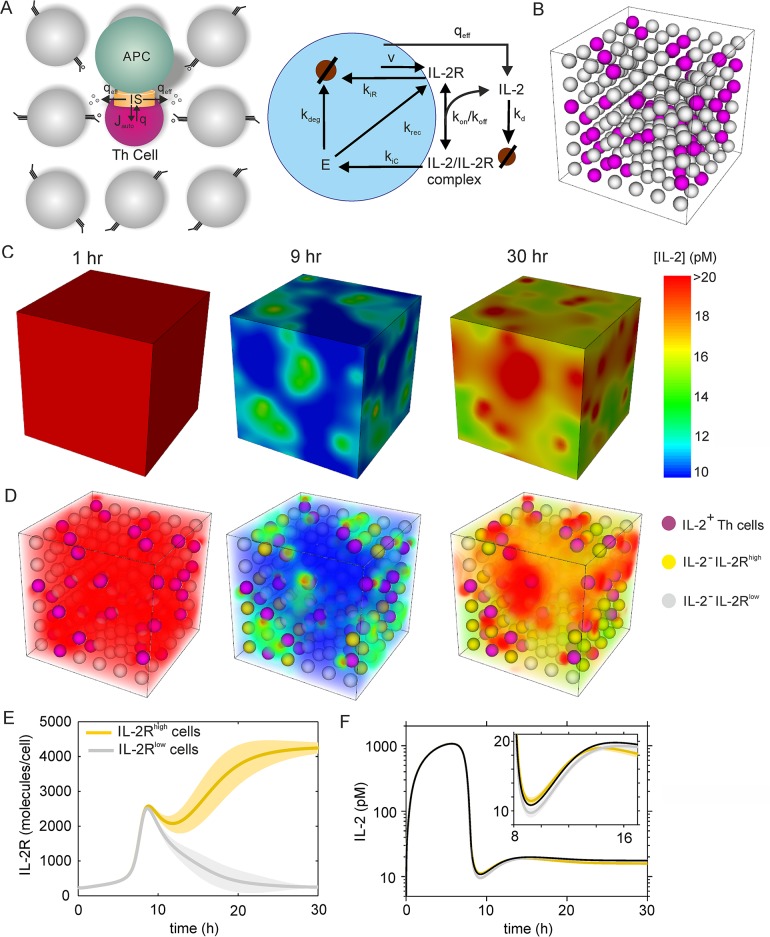
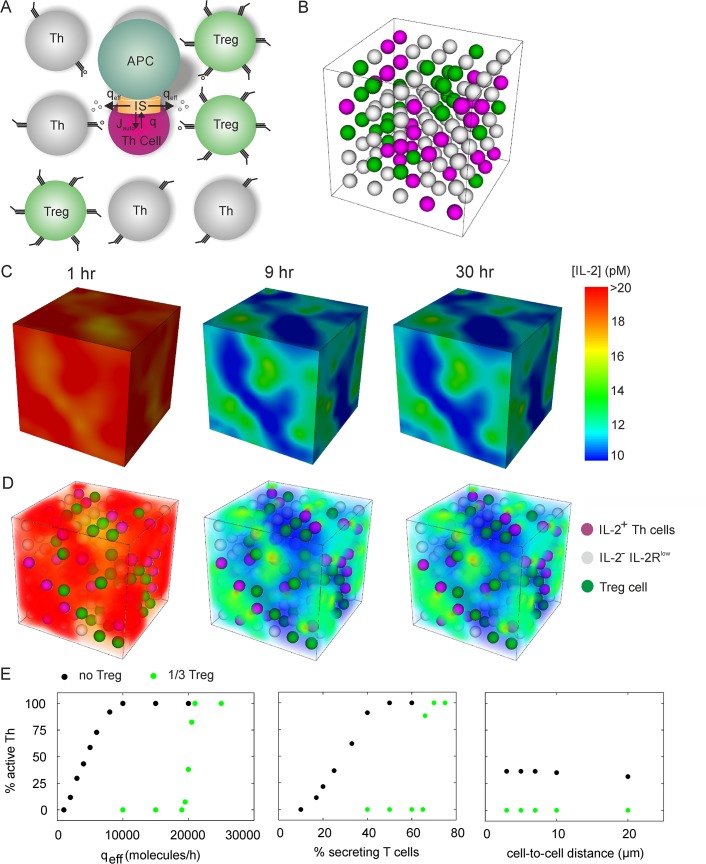
Immune responses are regulated by diffusible mediators, the cytokines, which act at sub-nanomolar concentrations. The spatial range of cytokine communication is a crucial, yet poorly understood, functional property. Both containment of cytokine action in narrow junctions between immune cells (immunological synapses) and global signaling throughout entire lymph nodes have been proposed, but the conditions under which they might occur are not clear. Here we analyze spatially three-dimensional reaction-diffusion models for the dynamics of cytokine signaling at two successive scales: in immunological synapses and in dense multicellular environments. For realistic parameter values, we observe local spatial gradients, with the cytokine concentration around secreting cells decaying sharply across only a few cell diameters. Focusing on the well-characterized T-cell cytokine interleukin-2, we show how cytokine secretion and competitive uptake determine this signaling range. Uptake is shaped locally by the geometry of the immunological synapse. However, even for narrow synapses, which favor intrasynaptic cytokine consumption, escape fluxes into the extrasynaptic space are expected to be substantial (≥20% of secretion). Hence paracrine signaling will generally extend beyond the synapse but can be limited to cellular microenvironments through uptake by target cells or strong competitors, such as regulatory T cells. By contrast, long-range cytokine signaling requires a high density of cytokine producers or weak consumption (e.g., by sparsely distributed target cells). Thus in a physiological setting, cytokine gradients between cells, and not bulk-phase concentrations, are crucial for cell-to-cell communication, emphasizing the need for spatially resolved data on cytokine signaling.
免疫反应由可扩散介质即细胞因子调节,这些细胞因子在亚纳摩尔浓度下起作用。细胞因子通讯的空间范围是一个关键但却鲜为人知的功能特性。有人提出细胞因子作用既可以局限于免疫细胞间狭窄连接(免疫突触)内,也可以在整个淋巴结中进行全局信号传导,但它们发生的条件尚不清楚。在此,我们在两个连续尺度上对细胞因子信号传导动力学的三维反应扩散模型进行空间分析:在免疫突触和密集的多细胞环境中。对于实际参数值,我们观察到局部空间梯度,分泌细胞周围的细胞因子浓度仅在几个细胞直径的范围内急剧衰减。聚焦于特征明确的T细胞细胞因子白细胞介素-2,我们展示了细胞因子分泌和竞争性摄取如何决定这种信号传导范围。摄取在局部上由免疫突触的几何形状决定。然而,即使对于有利于突触内细胞因子消耗的狭窄突触,预计进入突触外空间的逃逸通量也会很大(≥分泌量的20%)。因此,旁分泌信号传导通常会延伸到突触之外,但可以通过靶细胞或强竞争者(如调节性T细胞)的摄取而局限于细胞微环境。相比之下,长距离细胞因子信号传导需要高密度的细胞因子产生者或弱消耗(例如,由稀疏分布的靶细胞)。因此,在生理环境中,细胞间的细胞因子梯度而非体相浓度对于细胞间通讯至关重要,这强调了需要有关细胞因子信号传导的空间分辨数据。