Sáez-Jiménez Verónica, Acebes Sandra, Guallar Victor, Martínez Angel T, Ruiz-Dueñas Francisco J
Centro de Investigaciones Biológicas, Consejo Superior de Investigaciones Científicas, Madrid, Spain.
Joint Barcelona Supercomputing Center-Centre for Genomic Regulation, Institute for Research in Biomedicine Research Program in Computational Biology, Barcelona Supercomputing Center, Barcelona, Spain.
PLoS One. 2015 Apr 29;10(4):e0124750. doi: 10.1371/journal.pone.0124750. eCollection 2015.
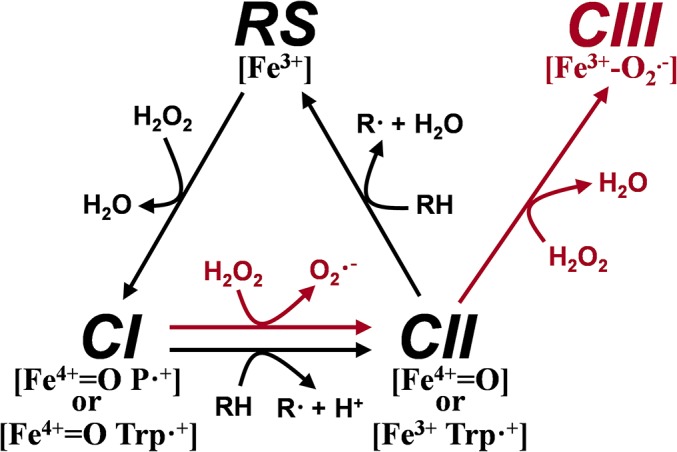
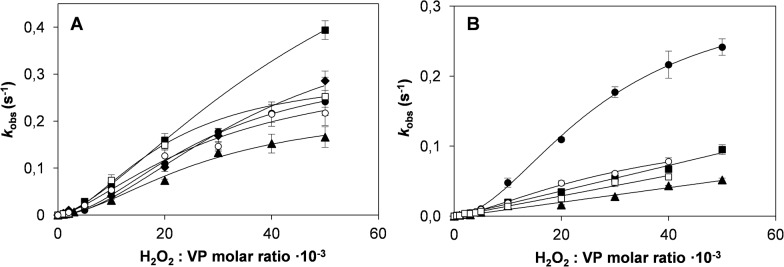
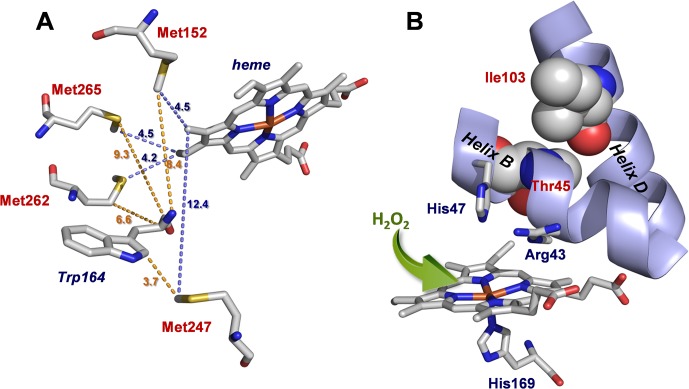
Ligninolytic peroxidases are enzymes of biotechnological interest due to their ability to oxidize high redox potential aromatic compounds, including the recalcitrant lignin polymer. However, different obstacles prevent their use in industrial and environmental applications, including low stability towards their natural oxidizing-substrate H2O2. In this work, versatile peroxidase was taken as a model ligninolytic peroxidase, its oxidative inactivation by H2O2 was studied and different strategies were evaluated with the aim of improving H2O2 stability. Oxidation of the methionine residues was produced during enzyme inactivation by H2O2 excess. Substitution of these residues, located near the heme cofactor and the catalytic tryptophan, rendered a variant with a 7.8-fold decreased oxidative inactivation rate. A second strategy consisted in mutating two residues (Thr45 and Ile103) near the catalytic distal histidine with the aim of modifying the reactivity of the enzyme with H2O2. The T45A/I103T variant showed a 2.9-fold slower reaction rate with H2O2 and 2.8-fold enhanced oxidative stability. Finally, both strategies were combined in the T45A/I103T/M152F/M262F/M265L variant, whose stability in the presence of H2O2 was improved 11.7-fold. This variant showed an increased half-life, over 30 min compared with 3.4 min of the native enzyme, under an excess of 2000 equivalents of H2O2. Interestingly, the stability improvement achieved was related with slower formation, subsequent stabilization and slower bleaching of the enzyme Compound III, a peroxidase intermediate that is not part of the catalytic cycle and leads to the inactivation of the enzyme.
木质素分解过氧化物酶因其能够氧化高氧化还原电位的芳香族化合物(包括顽固的木质素聚合物)而具有生物技术应用价值。然而,多种障碍阻碍了它们在工业和环境应用中的使用,包括对其天然氧化底物过氧化氢(H₂O₂)的低稳定性。在这项工作中,多功能过氧化物酶被用作木质素分解过氧化物酶的模型,研究了其被H₂O₂氧化失活的过程,并评估了不同策略以提高其对H₂O₂的稳定性。在酶被过量H₂O₂失活的过程中,甲硫氨酸残基发生了氧化。位于血红素辅因子和催化色氨酸附近的这些残基的替换,产生了一个氧化失活速率降低7.8倍的变体。第二种策略是在催化远端组氨酸附近突变两个残基(苏氨酸45和异亮氨酸103),目的是改变酶与H₂O₂的反应性。T45A/I103T变体与H₂O₂的反应速率慢2.9倍,氧化稳定性提高2.8倍。最后,两种策略在T45A/I103T/M152F/M262F/M265L变体中结合,其在H₂O₂存在下的稳定性提高了11.7倍。在过量2000当量的H₂O₂存在下,该变体的半衰期增加,与天然酶的3.4分钟相比超过30分钟。有趣的是,所实现的稳定性提高与酶化合物III形成较慢、随后的稳定以及褪色较慢有关,化合物III是一种过氧化物酶中间体,它不是催化循环的一部分,会导致酶失活。