Grandgirard Denis, Furi Leonardo, Ciusa Maria Laura, Baldassarri Lucilla, Knight Daniel R, Morrissey Ian, Largiadèr Carlo R, Leib Stephen L, Oggioni Marco R
Neuroinfection Laboratory, Institute for Infectious Diseases, University of Bern, Bern, Switzerland.
LA.M.M.B., Dip. Biotecnologie Mediche, Università di Siena, Siena, Italy.
BMC Genomics. 2015 Apr 30;16(1):345. doi: 10.1186/s12864-015-1544-y.
The enoyl-acyl carrier protein (ACP) reductase enzyme (FabI) is the target for a series of antimicrobial agents including novel compounds in clinical trial and the biocide triclosan. Mutations in fabI and heterodiploidy for fabI have been shown to confer resistance in S. aureus strains in a previous study. Here we further determined the fabI upstream sequence of a selection of these strains and the gene expression levels in strains with promoter region mutations.
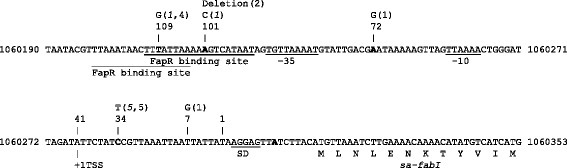
Mutations in the fabI promoter were found in 18% of triclosan resistant clinical isolates, regardless the previously identified molecular mechanism conferring resistance. Although not significant, a higher rate of promoter mutations were found in strains without previously described mechanisms of resistance. Some of the mutations identified in the clinical isolates were also detected in a series of laboratory mutants. Microarray analysis of selected laboratory mutants with fabI promoter region mutations, grown in the absence of triclosan, revealed increased fabI expression in three out of four tested strains. In two of these strains, only few genes other than fabI were upregulated. Consistently with these data, whole genome sequencing of in vitro selected mutants identified only few mutations except the upstream and coding regions of fabI, with the promoter mutation as the most probable cause of fabI overexpression. Importantly the gene expression profiling of clinical isolates containing similar mutations in the fabI promoter also showed, when compared to unrelated non-mutated isolates, a significant up-regulation of fabI.
In conclusion, we have demonstrated the presence of C34T, T109G, and A101C mutations in the fabI promoter region of strains with fabI up-regulation, both in clinical isolates and/or laboratory mutants. These data provide further observations linking mutations upstream fabI with up-regulated expression of the fabI gene.
烯酰-酰基载体蛋白(ACP)还原酶(FabI)是一系列抗菌剂的作用靶点,包括处于临床试验阶段的新型化合物以及杀菌剂三氯生。先前的一项研究表明,fabI基因突变和fabI基因的异二倍体状态可使金黄色葡萄球菌菌株产生耐药性。在此,我们进一步确定了这些菌株中一部分的fabI上游序列以及启动子区域发生突变的菌株中的基因表达水平。
在18%的三氯生耐药临床分离株中发现了fabI启动子突变,无论其先前确定的耐药分子机制如何。虽然差异不显著,但在没有先前描述的耐药机制的菌株中发现启动子突变的比例更高。在一系列实验室突变体中也检测到了临床分离株中鉴定出的一些突变。对在无三氯生条件下生长的具有fabI启动子区域突变的选定实验室突变体进行微阵列分析,结果显示在四个测试菌株中有三个菌株的fabI表达增加。在其中两个菌株中,除fabI外只有少数基因上调。与这些数据一致,体外选择的突变体的全基因组测序表明,除fabI的上游和编码区域外,仅发现少数突变,启动子突变是fabI过表达的最可能原因。重要的是,与不相关的未突变分离株相比,fabI启动子含有类似突变的临床分离株的基因表达谱也显示fabI有显著上调。
总之,我们已经证明,在临床分离株和/或实验室突变体中,fabI上调的菌株的fabI启动子区域存在C34T、T109G和A101C突变。这些数据提供了进一步的观察结果,将fabI上游的突变与fabI基因的上调表达联系起来。