Department of Clinical Microbiology, Hvidovre Hospital, Copenhagen, Denmark.
PLoS One. 2013 Apr 16;8(4):e62197. doi: 10.1371/journal.pone.0062197. Print 2013.
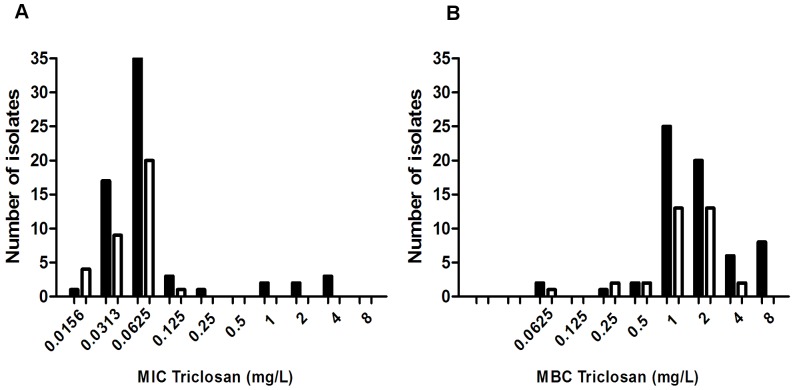
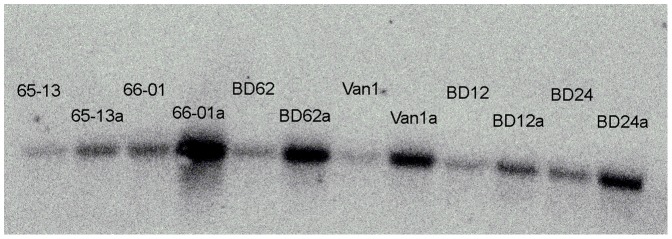
Since its introduction to the market in the 1970s, the synthetic biocide triclosan has had widespread use in household and medical products. Although decreased triclosan susceptibility has been observed for several bacterial species, when exposed under laboratory settings, no in vivo studies have associated triclosan use with decreased triclosan susceptibility or cross-resistance to antibiotics. One major challenge of such studies is the lack of strains that with certainty have not been exposed to triclosan. Here we have overcome this challenge by comparing current isolates of the human opportunistic pathogen Staphylococcus epidermidis with isolates collected in the 1960s prior to introduction of triclosan to the market. Of 64 current S. epidermidis isolates 12.5% were found to have tolerance towards triclosan defined as MIC≥0.25 mg/l compared to none of 34 isolates obtained in the 1960s. When passaged in the laboratory in the presence of triclosan, old and current susceptible isolates could be adapted to the same triclosan MIC level as found in current tolerant isolates. DNA sequence analysis revealed that laboratory-adapted strains carried mutations in fabI encoding the enoyl-acyl carrier protein reductase isoform, FabI, that is the target of triclosan, and the expression of fabI was also increased. However, the majority of the tolerant current isolates carried no mutations in fabI or the putative promoter region. Thus, this study indicates that the widespread use of triclosan has resulted in the occurrence of S. epidermidis with tolerance towards triclosan and that the adaptation involves FabI as well as other factors. We suggest increased caution in the general application of triclosan as triclosan has not shown efficacy in reducing infections and is toxic to aquatic organisms.
自 20 世纪 70 年代上市以来,合成杀菌剂三氯生已广泛应用于家庭和医疗产品。尽管已经观察到几种细菌对三氯生的敏感性降低,但在实验室环境下暴露时,没有体内研究将三氯生的使用与三氯生的敏感性降低或对抗生素的交叉耐药性联系起来。这类研究的一个主要挑战是缺乏可以肯定没有接触过三氯生的菌株。在这里,我们通过比较人类机会性病原体表皮葡萄球菌的当前分离株与在 20 世纪 60 年代三氯生上市前收集的分离株,克服了这一挑战。在 64 株当前的表皮葡萄球菌分离株中,有 12.5%对三氯生有耐受性,定义为 MIC≥0.25mg/l,而在 1960 年获得的 34 株分离株中没有一株对三氯生有耐受性。当在实验室中用三氯生传代时,古老和当前敏感的分离株可以适应与当前耐受分离株相同的三氯生 MIC 水平。DNA 序列分析显示,实验室适应的菌株携带编码烯酰-酰基载体蛋白还原酶同工型 FabI 的 fabI 基因突变,FabI 是三氯生的靶标,fabI 的表达也增加了。然而,大多数当前具有耐受性的分离株在 fabI 或假定的启动子区域没有突变。因此,这项研究表明,三氯生的广泛使用导致了对三氯生具有耐受性的表皮葡萄球菌的出现,这种适应涉及 FabI 以及其他因素。我们建议在一般应用三氯生时要更加谨慎,因为三氯生在减少感染方面没有显示出疗效,而且对水生生物有毒。